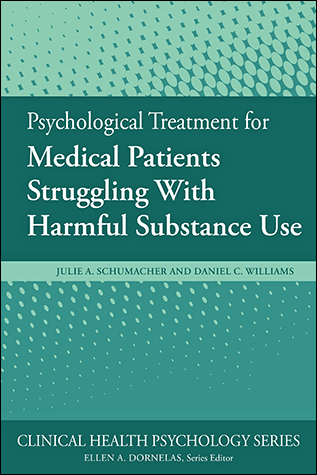
Psychological Treatment of Medical Patients Struggling With Harmful Substance Use
ISBN: 978-1-4338-3078-5Clinical health psychologists often encounter patients needing interventions for substance use, yet rarely do practitioners receive specialized training in this area.
Psychological Treatment of Medical Patients With Harmful Substance Use is designed for mental health providers in medical settings who need the knowledge and skills to assess and treat conditions relevant to substance use. This book is especially useful for mental health providers who treat adult medical outpatients for whom substance use is not their primary presenting problem.
The authors clarify the distinction between nonharmful and harmful substance use, describe the signs and symptoms of substance use disorders, epidemiology, current models denoting biological and socio-cultural causes, and contributing factors (with an emphasis on cardiac, cancer, women's health, and primary care settings). They offer best-practice assessment strategies, and psychological, self-help and pharmacological treatments.
Chapters also describe assessment and intervention for conditions that are often comorbid with substance use, including depression, anxiety, and sleep dysregulation, as well as treatment for family members who are dealing with a loved one's harmful substance use, relapse prevention and continuing care.
Series Foreword
Introduction
I. Overview of Substance Use
- Mental Health Professionals’ Guide to Understanding Harmful Substance Use
- Etiology and Sociocultural Aspects of Harmful Substance Use
- Levels of Care and Standard Treatments for Harmful Substance Use
- Assessment and Brief Intervention for Harmful Substance Use in the Medical Setting
II. Psychological Assessment and Intervention for Common Comorbid Problems
- Assessment and Treatment of Depression
- Assessment and Treatment of Anxiety
- Assessment and Treatment of Sleep Dysregulation
- Psychological Treatment of the Family
- Relapse Prevention and Continuing Care
- Future Direction of Practice
References
Index
About the Authors
Julie A. Schumacher, PhD, is a licensed clinical psychologist who completed her doctoral training at Stony Brook University and postdoctoral fellowship at the Research Institute on Addictions.
For the past 15 years she has been on the faculty in the Department of Psychiatry and Human Behavior at the University of Mississippi Medical Center, where she currently serves as vice chair for education and also briefly held positions as research scientist at the Research Institute on Addictions and director of research at the Prevention Research Institute.
Over the course of her career, she has helped create and supervise a training experience for psychology interns and fellows located at a community-based substance use disorder treatment facility; worked with her coauthor and other colleagues to implement curricula to provide training to psychology interns and fellows in motivational interviewing for substance use disorders and to provide training to medical students, psychiatry residents, nurses, and psychology interns in screening, brief intervention, and referral to treatment for alcohol and drugs; treated or supervised treatment for numerous individuals struggling with their own or a loved one’s harmful substance use; maintained an active program of research primarily focused on the intersection of substance use, violence, and trauma, some of which is presented in this book; and most recently become involved in various task forces, grant applications, and curriculum development efforts aimed at addressing the opioid crisis.
Daniel C. Williams, PhD, is a licensed clinical psychologist who completed his doctoral training at the University of Memphis and his internship at the Veterans Affairs (VA) North Texas Health Care System. Following internship he accepted a position as a psychologist in the Addictive Disorders Treatment Program at the VA Medical Center in Jackson, Mississippi, where he spent nearly a decade growing and developing evidence-based treatment programs for veterans; serving in mental health leadership positions; disseminating evidence-based addiction treatments to psychology trainees, psychologists, and other mental health providers; and providing consultation on mental health services in VA medical centers.
More recently, he has continued this work as an associate professor, vice director of psychology training, and director of the Division of Psychology at the University of Mississippi Medical Center, where he continues, often with his coauthor, training mental health and medical providers in the assessment and treatment of addiction.
Schumacher and Williams have written a remarkably well-organized, comprehensive summary of current evidence. Conclusions are presented with clarity, and recommendations are straight-forward and practical. This book is the perfect starting point for those newly working with relevant populations and settings and will be a valued resource for experienced clinicians as well.
—Jefferson D. Parker, PhD
Professor, Vice Chair of Clinical Affairs and Co-Director of Addictions, Department of Psychiatry and Human Behavior, University of Mississippi Medical Center, Jackson
Have 5 minutes and need a consult about drug and alcohol use among your medical patients? This is the book you need: essential, digested details on the research, factors to consider, assessment instruments to use, and empirically based interventions. Chock full of the essentials providers need in their health care work — the section on sequential, concurrent, or integrated treatment of anxiety and substance use is pure gold!
—David B. Rosengren, PhD
President and CEO, Prevention Research Institute; author of Building Motivational Interviewing Skills: A Practitioner Workbook