Photo credit: Mike Peters, Montclair State University


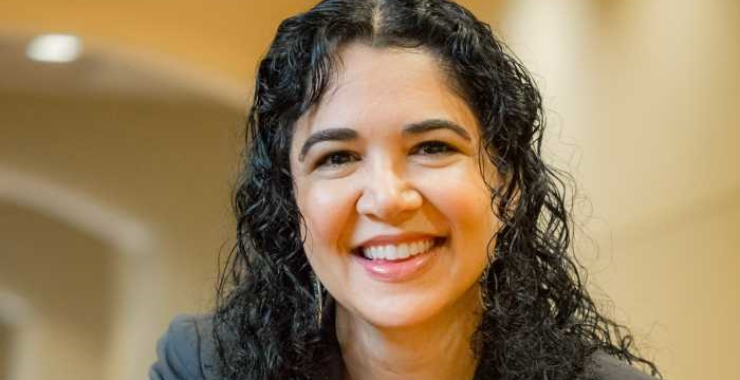
For 21 years now, sometimes twice a year, Muninder Kaur Ahluwalia, PhDopens in new window, professor in the College for Community Health at Montclair State Universityopens in new window in Montclair, New Jersey, has taught Multicultural Counseling and Development, a required graduate-level “exploration and development of the necessary personal awareness, knowledge and skills for culturally competent counseling practice.”
Every counselor needs to be able to span whatever cultural divide exists between them and their clients. “You have to be able to hear people’s stories from their perspective, and you have to be able to hear them from your perspective, so you can support them and serve as a guide through the process of therapy,” Ahluwalia says.
Acquiring that nuanced capability doesn’t happen overnight. Ahluwalia says she thinks of multicultural competence as “a journey to greater self-awareness,” but the course she teaches concentrates on the skills all counselors need to have to work effectively with people who are different from them. “Once on the job, you don’t know who is going to walk in that door,” she says.
Ahluwalia is an APA fellow in Division 17 (Society of Counseling Psychology) and Division 45opens in new window (Society for the Psychological Study of Culture, Ethnicity and Race), and co-coordinator of the master's degree program in counseling at MSU. She believes that advocating for social justice is an imperative for counselors and psychologists working with clients who deal with discrimination in their daily lives. Otherwise, she says, “you're just saying, ‘Let me help you adjust around it.’” She is co-author, with Rebecca L. Toporek, PhDopens in new window, of Taking Action: Creating Social Change through Strength, Solidarity, Strategy, and Sustainability. This practical workbook for prospective social justice advocates uses activities, questionnaires and other tools to help readers identify personal strengths they can leverage to work more effectively for social justice, and then to strategize and collaborate with others to affect change.
Ahluwalia calls the 15-week multicultural competence class “the most exhausting course you can teach.” For the first seven weeks, the focus is on race, because “racism is the template for other ‘isms’ in this country.” A great deal of anger typically comes to the fore in class, she says.
Why do students get angry? “I think we’re talking about fear,” she says—“of losing privilege, of having to change, of facing things you don’t want to face. Students are trying to protect themselves from what feels uncomfortable.” That makes for “a really challenging class.” Confronting other people’s pain, and their own contribution to that pain, is hard, she says.
In the second half, the class looks at other “isms,” referencing author and therapist Pamela Hays, PhD’sopens in new window ADDRESSING acronym for the common bases of prejudice, discrimination and antagonism against individuals—their age, developmental or acquired disabilities, religion, ethnicity, socioeconomic status, sexual orientation, indigenous heritage, national origin, gender, or a combination of those identities.
For the latter half of the course, it’s about respecting the values and choices of clients, she explains. As a personal example, “I’m a Sikh, and as a Sikh, I don’t cut my hair,” Ahluwalia says. But if she disdained her students who had short hair, or tried to insist they must never cut their hair again, “that would be ridiculous,” she says.
In short, a critical aspect of multicultural competence is that counselors can’t apply their own values to their clients’ lives. In the past, talking about a counseling student’s own belief system, “we used to say, ‘Put it aside.’ But I can’t really put my values aside. They’re the way I live my life. However, my job as your psychologist is not about my life, it’s about your life. I will support the values and the beliefs that you have,” Ahluwalia says.
She thinks that, in practice, many therapists get this right, but multicultural competence takes ethics and humility—and it is a process. “Students have to be invested in seeing it as a journey,” she says.
For Ahluwalia, born and raised in New York City to immigrants from South Asia, the aftermath of the terrorist attack on the World Trade Center on September 11, 2001 provided a traumatic personal lesson in the importance of relating to others on a fundamental human level.
She is a member of the Sikh religion, which originated in the Punjab region of the Indian subcontinent in the 15th century. Devout Sikhs wear turbans and other head coverings, and were often conflated in the United States after 9/11 with Muslims, who, as a group, mistakenly came under suspicion as a group because the terrorists responsible for the attack on the World Trade Center and the Pentagon were Muslims.
The experience paralyzed her, but then it made her resolve to help people learn about and appreciate individuals who are different from themselves. She became an emissary for her own people, too, sharing Sikh values through researchopens in new window, writing and public presentations. She credits mentors like New York University associate professor Lisa Suzuki, PhDopens in new window, with whom she has done research, and who is now a close friend, for helping her find her feet.
Ahluwalia says that the proper project for a counselor is not tolerance, which is far too passive and even condescending, but rather embracing differences and learning from others, and “changing how we look at the world.”
Connect with peers
Save 35% off pay now rates
New products available
APA Merch Store opens in new window
Competitive low rates