skip to main content

Joseph Gone advocates for centering Native Americans’ culture in their therapy

APA Style leaf logo Cite This Article in APA Style
O'Hara, D. (2025, January 16). Joseph Gone advocates for centering Native Americans’ culture in their therapy. https://www.apa.org/members/content/native-american-culture

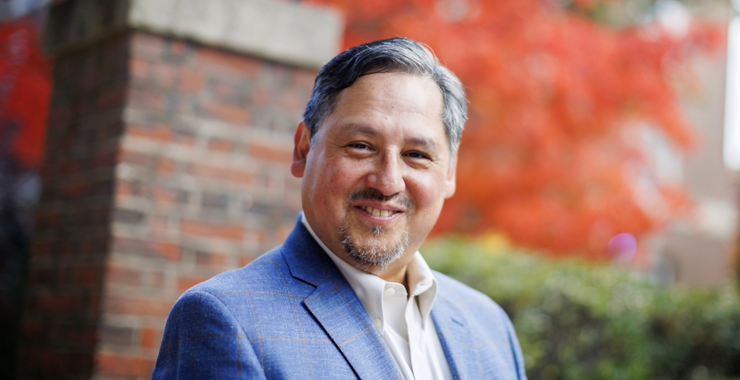
Joseph Gone, PhD
(Photo: Stephanie B. Mitchell/Harvard University)

Joseph P. Gone, PhD, calls himself “an accidental academic,” a clinical community psychologist who turned to research to amplify his work on behalf of the Native American community of which he is a part. A professor of both anthropology and global health and social medicine at Harvard University in Cambridge, Massachusetts, Gone says academia gives him exposure to a smorgasbord of ideas, and a chance to “make sure Indigenous knowledge is represented in psychology.”

In 2023, Gone received the American Psychological Foundation’s Gold Medal Award for Impact in Psychologyopens in new window. He is a Fellow in seven APA divisions, the recipient of numerous fellowships and awards, and an enrolled member of the Aaniiih-Gros Ventre Tribal Nation of north-central Montana. Gone believes psychologists should collaborate with communities, especially traumatized communities like Native Americans, to devise treatments that will dovetail with their members’ culture and experienceopens in new window.

American Indians/Alaska Natives (AI/AN) have a lower life expectancy and quality of life than most Americans, the highest suicide rate of any minority group, and disproportionate rates of substance use disorderopens in new window (SUD) both for drugs and alcohol. Gone says these are “postcolonial disorders that follow from the murder of our way of life, the inability to grieve and to obtain the resources we need to figure out what to do now.”

Many Native Americans seek treatment, but like members of other minority groups, fully half drop out after one sessionopens in new window (compared with a 30% dropout rate for Whites).


Addressing historical trauma

Some Native American scholars identify the cause of their community’s outsize suffering as “historical traumaopens in new window.” Gone thinks that term creates too neat a package for “the legacy of colonial subjugation, from dispossession and violent containment to wave after wave of oppression, that colors the consciousness of people over centuries.”

One U.S. government scheme to stamp out Indian culture during the 19th and 20th centuries forcibly removed Indian children from their homes and sent them to hundreds of boarding schoolsopens in new window across the country. There, they were punished if they spoke their native languages and forbidden to display any signs of their cultural identity. Many children were given new names. Thousands died.opens in new window The stated goal of the programopens in new window was to “kill the Indian…and save the man.”

Placing Native Americans’ trauma in the context of centuries of terror obviates a simple therapeutic fix, Gone says. It requires “a recognition that the status quo is not in our interest.” In a 2023 paper, he called for “overdue advances in reconciliation, redress, and repair…ideally evidenced by societal transformations, structural reforms and social justice.” Until the systemic trauma Native Americans live with even today is remedied, no amount of mental health or medical services is going to solve the problems of Indian country, Gone says.

Nevertheless, effective treatment for SUD is an urgent need. Standard addiction treatment is typically group based. If it’s residential (for 30 to 90 days), participants are locked in at night, and told during the day to “cast your feelings into words; tell your story,” Gone says. However, he says, that approach is not compatible with the way some Indigenous people heal. “The idea that you’re going to sit down with a stranger for 50 minutes and talk about your problems doesn’t compute for traditionally oriented people.”

Spirituality is central to health 

Religion and spirituality are central to Native Americans’ lives and belief system. “Very few are atheists,” he says. Many are Christians, and “some native people take to counseling and therapy like ducks to water,” he says. For more traditional members of the community, though, health and healing are the purview of the spirits. In traditional Native American religious practice, “you’re learning how to be in a right relationship” with those spirits, beseeching them “for health and help through all kinds of ceremonial practices.”

Gone believes that Indigenous spiritual practices can help Native Americans heal from centuries of subjugation and abuse. From 2009 to 2016, he partnered with an urban Native American health center in Detroit to create a structured curriculum for community membersopens in new window to participate in sacred practices associated with the sweat lodge ceremonyopens in new window, with an eye to improving their health and well-being. The sweat lodge is a widespread Indigenous spiritual practice in this country, which enhances its potential for therapeutic use, he says.

In 2012, Gone worked with a residential treatment center for SUD for the Blackfeet Nation in Browning, Montana, to create a cultural immersion camp to treat SUDopens in new window. Budget constraints kept the camp small, and it operated for only 12 days. Four full-time participants, alongside several members of a traditional Blackfeet warrior society, pitched tepees, tanned hides, harvested sacred plants, and took part in traditional rituals, including a pipe ceremonyopens in new window, sweat lodge, and talking circleopens in new window. All four therapeutic participants praised the camp’s approach, and Gone’s team judged that the pilot program had served as a “proof of concept” for treating Native Americans for SUD. However, evaluating outcomes proved to be a challenge—and an obstacle to scaling up the program. The study Gone’s team published noted that Indigenous alternatives to established therapies are “so deeply responsive to local sensibilities that they resist standardized implementation in other communities for…rigorous outcome evaluation.”

Finding and validating solutions that work   

Insisting on “one-size-fits-all” validation ignores differences among people, and may lead to the abandonment of worthy therapies or approaches, Gone says. He is one of a number of scholars who are reimagining researchopens in new window and mental health servicesopens in new window in recognition of the vast diversity of human beingsopens in new window. (Some are even exploring how to measure and describe spiritualityopens in new window.)

“Cultural competence is about trying to open up to new possibilities,” says Gone, who serves as faculty director of the Harvard University Native American Program.

Members of more than 570 distinct tribal nations live in cities and rural areas across the United States, yet fewer than 1% of psychologists identify as AI/AN. The Indian Health Service, which oversees mental health services for Native Americans, is chronically underfunded. “The single biggest innovation we could undertake to secure well-being for Indigenous communities today would be to equip paraprofessionals from our own communities with basic psychological knowledge, techniques, and skills” to address mental health needs on the ground, Gone says.

Gone grew up in Montana, but in a series of cities, not on a reservation. In his youth, he began training to be an Evangelical minister, but soon abandoned that plan and enlisted in the U.S. Army. That led him to the United States Military Academy at West Point, New York, where, as a cadet, he decided to become a psychologist, and transferred to Harvard for the remainder of his undergraduate studies. Gone received a PhD in clinical-community psychology from the University of Illinois in Champaign and began his academic career as an assistant professor in the Committee on Human Development at the University of Chicago in Illinois. That assignment reinforced for him the importance of an interdisciplinary approach to human behavior, which he still employs when he can. He taught at the University of Michigan for 16 years before moving to Harvard in 2018.

Gone says he is grateful to Native Americans like his grandmother, the late Bertha Snow, a keeper of her community’s traditional knowledge, for caring for one another and preserving their culture down through the centuries, against enormous odds.

He says, “It’s remarkable we’ve survived.”

Recommended Reading

APA Member Benefits

Connect with peers

APA Community


Save 35% off pay now rates

Avis and Budget


New products available

APA Merch Store opens in new window


Competitive low rates

Student Loan Refinancing

You may also like