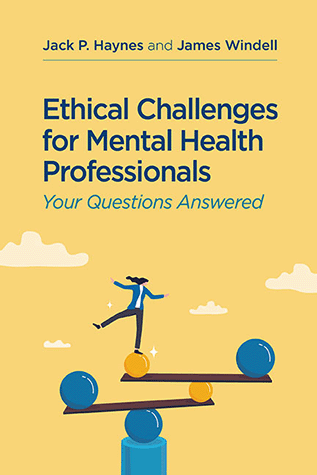
Ethical Challenges for Mental Health Professionals
Available formats
Also available from
- I recommend this book. I have yet to find such an easy-to-read book on ethics that covers so many topic areas. The usefulness of this book is immense and those not reading it will not be as good at their professions because of it. It answers many questions that even my seasoned mentors seemed unsure about. Buy this book!—Doody's Reviews
This book, intended for a broad range of professionals, is a practical, handy guide to ethical decision-making in one’s daily work. Each chapter outlines key ethical issues that arise in mental health practice, cites relevant ethics code principles and standards, and illustrates the dilemmas with vignettes drawn from real life, followed by questions and answers to promote critical thinking.
Common ethical challenges described by the authors include maintaining confidentiality, practicing within one’s area of competence, and providing informed consent. Chapters cover work with special populations--including children, older adults, and individuals exploring their gender identity--as well as work in specialized areas such as assessment and forensic settings. This book provides readers with the framework they need to think through ethical challenges flexibly and make decisions that benefit and protect their clients and themselves.
Acknowledgments
Introduction
- Chapter 1. Overview of Ethics for Mental Health Practitioners
- Chapter 2. Informed Consent
- Chapter 3. Confidentiality
- Chapter 4. Nonsexual, Nonintimate Multiple Relationships
- Chapter 5. Physical Intimacies and Exploitation
- Chapter 6. Telehealth
- Chapter 7. Mandatory Reporting
- Chapter 8. Professional Competencies
- Chapter 9. Assessment and Ethics
- Chapter 10. Ethics and the Mental Health of Adults
- Chapter 11. Ethical Issues Specific to Children
- Chapter 12. Practitioner Ethics and Older Adults
- Chapter 13. Ethical Issues Specific to LGBTQ+ Therapy Clients
- Chapter 14. Ethics and Disabilities
- Chapter 15. Ethics in Correctional Settings
- Chapter 16. Preparing Documents for Court
- Chapter 17. Ethical Expert Witness Testimony
- Chapter 18. Child Custody and Ethics
- Chapter 19. Ethics in Special Situations
- Chapter 20. Ethical Decision-Making Models
- Chapter 21. Putting It All Together
References
Index
About the Authors
Jack P. Haynes, PhD is a licensed psychologist in private practice in Michigan. He has served as chair of the APA Ethics Committee. He also served for eight years on the Michigan Licensing Board for Psychology, including as chair. He is past president of the Michigan Psychological Association and was president of a statewide forensic psychology association. He has been director of research, training, and clinical services for a family court. Dr. Haynes has performed hundreds of court ordered child custody and parenting time evaluations as well as many other evaluations, both civil and criminal, adult and juvenile.
James Windell, MA is a limited license psychologist, college instructor, and author. As a court psychologist, he specialized in work with families and children. Since 1991, he has published more than 40 books in the areas of parenting, divorce, postpartum depression, healing for widows, and criminal justice. He has been a weekly newspaper columnist, the editor of The Michigan Psychologist for the past 20 years, and he has taught criminal justice courses at Wayne State University and Oakland University for 25 years.
Haynes and Windell have gifted readers with a clear and thorough discussion of the ethical dilemmas and legal issues associated with the clinical practices of psychologists, counselors, and social workers. Written in everyday language, the book uses the American Psychological Association Ethics Code to guide the practical ethical scenarios under consideration. This book will become a landmark in helping mental health practitioners understand the complexity of navigating and resolving ethical and legal conflicts.
—John J. Pietrofesa, PhD, Professor (Retired), Wayne State University, Detroit, MI, and Licensed Psychologist, Affiliated Psychologists of Michigan, Bloomfield Hills
Ethics codes can provide a foundation, but they can’t always guide us through the gray areas and real-world dilemmas mental health professionals face in practice. Drs. Haynes and Windell have created a thoughtful, practical, and deeply informed resource of real-world ethical challenges that encourage us to think critically and flexibly when navigating complex ethical dilemmas. This book is a valuable companion for every mental health professional who is committed to ethical integrity and sound judgment.
—Robin M. Deutsch, PhD, ABPP, Professor (Retired), William James College, Boston, MA, and former Chair, APA Ethics Committee
This book, which features a robust collection of ethical issues and illustrative vignettes, is like having two leading ethical experts in our field at your fingertips. It is an indispensable reference for mental health practitioners, offering guidance and clarity in maintaining ethical standards when confronted with challenging practice scenarios.
—Matthew Sullivan, PhD, Former President of the Association of Family and Conciliation Courts
Buy this book if you want the best resource that outlines core ethical principles, discusses ethical challenges through real-world vignettes, and covers diverse populations including children, older adults, and those struggling with gender identity.
—Steven J. Ceresnie, PhD, Private Practice, and Former President of the Michigan Psychological Association, Plymouth, MI
This book is a much-needed resource for clinicians and other professionals, offering practical guidance through complex ethical situations within the mental health profession.
—Kristin A. Meekhof, MSW, coauthor of A Widow’s Guide to Healing and Psychology Today contributor
Watch the author(s) discuss Ethical Challenges for Mental Health Professionals.opens in new window Interested in this book? Purchase a copy to continue (or start) the conversation with your clients.