Confirmation bias is the original sin of cognition. In seeking proof for only what we’ve already decided is true, we open ourselves to unlimited errors of thought. Maybe I’m amazed at my horoscope's accuracy. That seems innocuous enough. But maybe I’m also disgusted, yet not surprised, by the behavior of a particular ethnic or religious group, or convinced that mounting casualty rates prove the imminence of victory in a war my nation is waging. Confirmation bias is a serious subject. That doesn't mean, however, that you can’t have fun teaching about it. In fact, a bit of fun may be just what your students need to loosen its hold.
A (good-natured) dirty trick. Confirmation bias usually gets a big assist from "not me" thinking. Begin this lesson, then, without appearing to. Casually mention how you went to the store the other day and got stuck in the slow line. Grumble about the other line always moving faster, then stand back and watch. Most if not all students will have a story about the same thing happening to them. Nod sympathetically and move on; you’ll come back to this later.
“Paul is dead.” Today's students love The Beatles, whose music now has all the fuzzy warmth of things associated with (gulp) grandparents. Vinyl records will make this lesson even more retro and cool. Play "Strawberry Fields Forever," in which John Lennon remembers the park where he played as a child. At the very end, we hear a distorted and barely audible voice. Play this brief segment several times and ask the class what the voice is saying. Answers will likely range from "I'm very bored" to "cranberry sauce" to a declaration that it’s just gibberish. Wrong. The voice is saying, "I buried Paul."
Some students will hear it; some won't. The key thing is that millions of people did, and for good reason: Paul McCartney, who had given the world such brilliant and beloved songs as "Yesterday" and "Eleanor Rigby," died in a car crash in 1966. The surviving Beatles tried to keep it a secret, and even put an imposter in his place. But by 1969 the truth began to leak out, largely because The Beatles themselves, out of guilt-driven loyalty to their fans, had been planting clues.
If a few class members already know this legend, they can help you reassure the rest not only that Paul is still very much with us but also that The Beatles never dropped any hints about his death. What then gave this rumor such widespread acceptance? Once this question is on the table, so is an examination of confirmation bias.
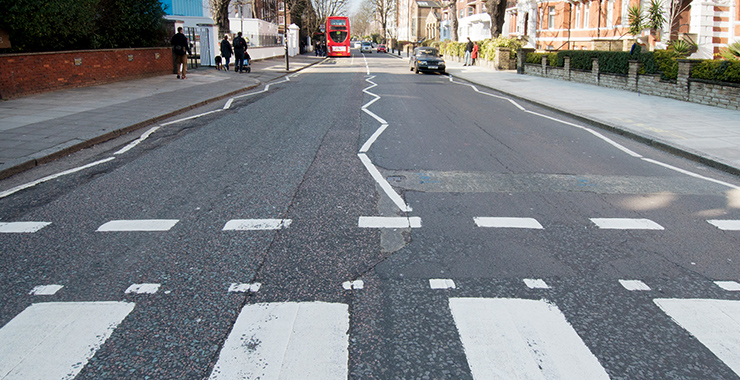
The "proof." There’s a wealth of sources you can draw on (a representative list follows this article). Begin with the cover of the Abbey Road album. In this iconic image, we see the four of The Beatles crossing a London Street. Invite the class to view it as a funeral procession. In the front is John, whose white suit marks him as God. Ringo follows, wearing a preacher’s old-fashioned frock coat. After him comes Paul — or the Paul lookalike, wearing the kind of conservative suit you'd see on a corpse dressed for burial. He's out of step with the others (aha) and shoeless (the dead don't need shoes) and holding a cigarette (often called a “coffin nail”) in his right hand (Paul was left-handed). George is last, appropriately, because his work shirt and jeans indicate he’s the gravedigger.
Nearby, a Volkswagen has a license plate that reads LMW 28IF, which means "Linda McCartney Weeps" (Linda was Paul’s wife) and that Paul would be 28 if he were still alive. The police car on the other side of the road symbolizes the law enforcement officials at the scene of the fatal accident. How do we know Paul died in a car crash? Look at the car parked ahead of the Volkswagen and imagine a line connecting its two right tires; when extended, that line goes through Paul’s head.
By now, you should be hearing comments ranging from "Aren’t you just finding what you want to find?" (which is good) to "Yeah, I sort of see it" (which is better). Offer more proof: On the album’s back cover, some tiles on a concrete wall spell out "Beatles." A cluster of smudges appears to the left. Connect these “dots” and you get the number 3: Only three Beatles are still living. The tile containing the "s" in Beatles has a crack in it, meaning the band is no longer united — and hasn’t been for years. Remember the "I buried Paul" line? Now that we know what to look for, we can find clues aplenty, as many fans did when they pored over album covers, parsed song lyrics and played Beatles songs faster or slower or even (and most notoriously) backwards.
Fact and reason. Hopefully, your students will point out that it's possible to hear just about anything when the words are distorted enough, just as it’s possible to find proof if you've already decided what's true. Try passing out the words to any Beatles song. For example, "Love Me Do" expresses a wish for "somebody new" and "someone like you" — clearly a reference to the band’s need for a lookalike replacement. Except for this problematic fact: The song was composed years before Paul’s “death.”
More facts: the rumor began as a prank article in a college newspaper. The Abbey Road cover came about because The Beatles, having increasing trouble working together, decided on a simple shot of them crossing the street near their recording studio. Paul was barefoot because it was a hot day. The LMW 28IF license would encode no message about Linda McCartney weeping because Paul and Linda hadn't even met in 1966, the year he supposedly died. Plus he was 27 in 1969, and the "I" in "28IF" is a one.
How about some reasonable criteria for an imposter? Looking like Paul would be the easy part. He would also have to sing like Paul, and walk and talk and smile in that adorable way like Paul and compose instantly hummable tunes like Paul. Oh, and play bass. Left-handed. Which returns us to the key question: Why did so many people put so much faith in something so unfounded?