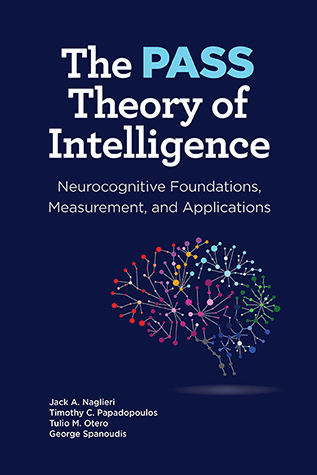
The PASS Theory of Intelligence
A paradigm-shifting alternative to traditional IQ models, PASS theory reshapes how we understand intelligence.
For more than a century, the dominant model of intelligence has reduced the complex and wide-ranging nature of intelligence to a single number-an IQ score. Drawing on A. R. Luria's pioneering neurocognitive research, PASS theory reconceptualizes intelligence as the dynamic interaction of four mental systems: planning, attention, simultaneous processing, and successive processing. First introduced in the 1990s, PASS theory has since been developed, applied, and empirically tested across diverse populations and contexts.
This volume synthesizes decades of research and applications, offering the most comprehensive overview of PASS theory to date. Readers will find a clear explanation of the empirical foundations of PASS theory, advances in measurement, and applications in understanding reading, math, ADHD-related behaviors, and other aspects of neurodiversity. The book also highlights cross-cultural findings, developmental considerations, and educational interventions informed by PASS principles.
Essential reading for those who research and assess learning and cognition—as well as those who design and evaluate interventions—this book provides a scientifically grounded, process-based framework for understanding how people think, learn, and solve problems.
Acknowledgments
Preface: Intelligence as Measured by PASS Theory
- Chapter 1. Overview of PASS theory: The Four Neurocognitive Abilities and How to Measure Them
- Chapter 2. The Evolution of Intelligence: From IQ to Cognitive Processes
- Chapter 3. Neuropsychological Underpinnings of PASS Theory
- Chapter 4. Validation of PASS Theory
- Chapter 5. Developmental Trajectories of PASS Neurocognitive Abilities
- Chapter 6. The Primacy of Planning and Attention
- Chapter 7. Using PASS Theory to Assess Reading and Math Skills
- Chapter 8. Using PASS Theory to Assess Neurodiversity
- Chapter 9. Applying PASS Theory in Interventions
- Chapter 10. Future Directions for PASS Theory
References
Jack A. Naglieri, PhD, is a former professor at Northern Arizona University, The Ohio State University, and George Mason University. He has published 23 books, 51 tests and rating scales, and over 300 research papers. His work emphasizes innovative approaches to assessment of intellectual ability using tests and scales such as the Cognitive Assessment System, Second Edition; the Naglieri Nonverbal Ability Tests: Verbal, Nonverbal, and Quantitative; the Autism Spectrum Rating Scale; and the Comprehensive Executive Function Inventory. He has an extensive test development and research program that focuses on psychometric quality, equitable assessment, and academic interventions.
Timothy C. Papadopoulos, PhD, is professor of psychology at the University of Cyprus and a founding member of the Center for Applied Neuroscience. He received his doctorate in educational psychology from the University of Alberta, Canada, under the supervision of the late J. P. Das, and served as a research associate at the J. P. Das Developmental Disabilities Centre. His research focuses on cognitive risk and protective factors related to neurodevelopmental disorders and intelligence within the PASS framework. He was elected fellow of the International Academy for Research in Learning Disabilities (2024). Visit his webpage.opens in new window
Tulio M. Otero, PhD, is a practicing school psychologist, neuropsychologist, researcher, and test developer. He has published several papers and chapters on neurocognitive assessment and interventions based on PASS theory; the Cognitive Assessment System, Second Edition (CAS2); executive function assessment and interventions; fair and equitable assessment; cultural competency; and the bilingual brain. He is coauthor of the Spanish edition of CAS2, the book Essentials of CAS2 Assessment, and the forthcoming digital version of the CAS2. He is also coauthor of a forthcoming test of dyslexia, the Feifer Assessment of Reading, Spanish edition. Visit Linkedin.opens in new window
George Spanoudis, PhD, is professor of psychology at the University of Cyprus, where he directs the Language and Cognitive Development Lab. His academic background includes an MSc from Aristotle University of Thessaloniki and a PhD from the University of Cyprus. His academic interests involve developmental language disorders, intelligence, cognitive development, and the interplay of executive functioning with language processes. He is the author of two books on cognitive development, intelligence, and education, and has contributed over 80 research papers to the field.