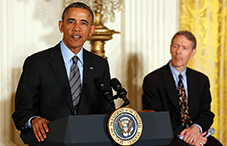

Before Barack Obama was President Obama, he was a high school basketball player who dreamed of going pro. Now, with two athletic daughters and a wife who's made "Let's Move" her platform, sports remain central to Obama's life, the president said at the Healthy Kids and Safe Sports Concussion Summit at the White House in May.
"There's a huge public health interest in making sure that people are participating in sports," Obama said. "But sports is also just fundamental to who we are as Americans and our culture. We're competitive. We're driven. And sports teach us about teamwork and hard work and what it takes to succeed not just on the field but in life."
But for all their benefits, many sports also come with the risk of concussion. According to the latest data from the CDC, young people make nearly 250,000 emergency room trips annually due to brain injuries from sports and recreation. And exactly how they're caused and the extent of the damage is still not well understood, Obama said.
That's why, during the summit, he emphasized the importance of concussion research and education to keep children as safe as possible while staying active. He also announced new research initiatives to further explore the causes and consequences of concussions, including a $30 million research project funded by the NCAA and the U.S. Department of Defense and a $16 million partnership between the NFL and the National Institutes of Health to study the chronic effects of repetitive concussions.
The event featured psychologist Gerard Gioia, PhD, as a panelist, and was attended by several other psychologists, including APA CEO Norman B. Anderson, PhD. Gioia, chief of the division of pediatric neuropsychology at Children's National Health System and director of the Safe Concussion Outcome, Recovery and Education Program, outlined steps parents and coaches can take to prevent or minimize damage from concussions.
For example, he said, learn to recognize a concussion by watching videos on the CDC website or by using tools such as the "Concussion Recognition & Response" smartphone app, which he created with a colleague.
Gioia also advised parents and coaches to err on the side of caution with young athletes who may have been jolted or hit by taking them out of the game and clearing them with an experienced medical provider before returning them to play. "When in doubt, sit them out. If you suspect, you must protect," he said.
In an interview after the summit, Gioia emphasized that psychologists have a major role to play in helping children and adults with brain injuries — including veterans who have sustained a traumatic brain injury — since such injuries can cause mood changes, feelings of loss of identity and other forms of psychological distress. "The good news is that people get better from this injury, and we have an important skill set to help them with their recovery," he said.
— Anna Miller