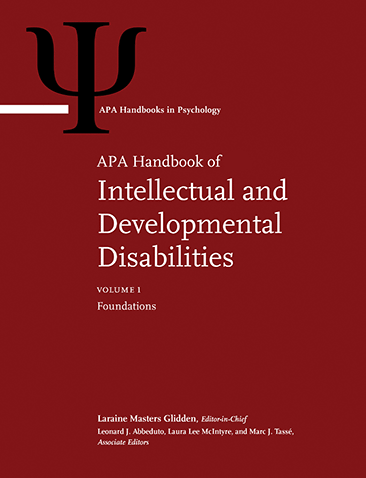
APA Handbook of Intellectual and Developmental Disabilities
Available formats
Part of the landmark APA Handbooks in Psychology® Series from APA
This comprehensive, interdisciplinary handbook presents the latest research in the study, assessment, treatment, and understanding of intellectual and developmental disabilities.
The past five decades have resulted in dramatic breakthroughs in the understanding of intellectual and developmental disabilities (IDD). Editor-in-Chief Laraine Masters Glidden and her editorial team provide an overview of the historical foundations of the field of IDD as well as up-to-date material on clinical diagnosis, assessment, interventions, and treatments for such conditions.
It goes on to address legal, ethical, and educational issues; and other social issues that affect the lives of people with IDD, including family impact and adjustment, relationships and parenting, spirituality, residential and caretaking services, maltreatment and criminal justice issues, stigma and ableism, health, and aging.
Chapters address the etiology and treatment of specific conditions (including Down syndrome, fragile X syndrome, other genetic and chromosomal conditions, autism spectrum disorder, acquired brain injury, cerebral palsy, and fetal alcohol spectrum disorders) as well as functioning in multiple domains and throughout the lifespan. Contributing causes to IDD are explored within various contexts such as culture, race, ethnicity, and socioeconomic status.
Introduction
Volume 1. Foundations
I. Origins and Overviews
- Historical Foundations of the Field of Intellectual and Developmental Disabilities
James W. Trent, Jr. - Intellectual Disability, Developmental Disabilities, and the Field of Intellectual and Developmental Disabilities
Robert L. Schalock and Ruth Luckasson - Legal, Ethical, and Social Issues Affecting the Lives of People With Intellectual and Developmental Disabilities
Katherine E. MacDonald, Micah Fialka-Feldman, Alison Barkoff, and Molly Burgdorf
II. Causality and Variation
- Epidemiology of Intellectual and Developmental
Maureen S. Durkin and Eric Rubenstein - Behavioral Phenotypes and Genomic Testing: Scientific and Societal Implications
Elisabeth M. Dykens - Down Syndrome
Robert M. Hodapp and Deborah J. Fidler - Fragile X Syndrome and Associated Disorders
Leonard J. Abbeduto, Angela John Thurman, Laura del Hoyo Soriano, and Jessica Klusek - Chromosome 15 Syndromes Associated With Intellectual and Developmental Disabilities
Charlotte DiStefano and Shafali S. Jeste - The Autism Spectrum: Diagnosis and Epidemiology
Melanie Pellecchia, Kelsey S. Dickson, Sarah F. Vejnoska, and Aubyn C. Stahmer - Acquired Brain Injury: A Developmental Perspective
Lisa Jacobson and Gwendolyn Gerner - Cerebral Palsy: Epidemiology, Neurobiology, and Lifespan Management
Eric M. Chin, Tara L. Johnson, and Alexander H. Hoon, Jr. - Fetal Alcohol Spectrum Disorders and Other Teratogenic Conditions
Sarah N. Mattson, Lauren R. Doyle, and Leila Glass - Linking Poverty and Developmental Disabilities
Theodore D. Wachs and Kathleen S. Gorman - Culture, Race, and Ethnicity and Intellectual and Developmental Disabilities
Sandy Magaña and Sandra B. Vanegas
III. Assessment, Diagnosis, and Labeling
- Theories and Measurement of Intelligence
Randy G. Floyd, Ryan L. Farmer, W. Joel Schneider, and Kevin S. McGrew - Theories and Measurement of Adaptive Behavior
Marc J. Tassé and Giulia Balboni - Intellectual and Developmental Disabilities and Mental Health
Yona Lunsky, Peter E. Langdon, Brianne Redquest, and Jane Summers - Attitudes, Stigma, and Ableism Toward People With Intellectual Disability
Kristin A. Dell’Armo and Marc J. Tassé
Index
Volume 2. Clinical and Educational Implications: Prevention, Intervention, and Treatment
I. Evidence Based Practice and Treatment
- Early Intervention for Children with Intellectual and Developmental Disabilities
Laura Lee McIntyre, Megan Kunze, Hannah Barton, and Mathew Luehring - Applied Behavioral Analysis and Intellectual and Developmental Disabilities
Wendy Machalicek, Allaina Douglas, Christine Drew, Hannah Barton, Buket Erturk, and Tasia Brafford - Psychoeducational Approaches to Instruction of Students with Intellectual and Developmental Disabilities
Michael L. Wehmeyer - Special Education Law: Programming and Placement
Mitchell L. Yell, James C. Collins, Mickey Losinski, and Michael A. Couvillon - Special Education Curriculum and Pedagogy
Susan R. Copeland and Megan M. Griffin - The Autism Spectrum: Intervention, Treatment, and Services
Amanda C. Gulsrud and Patricia Renno - Diagnosis and Management of Cerebral Palsy and Other Types of Pediatric Brain Injury
Kathleen M. Friel, Claudio L. Ferre, and Andrew M. Gordon - Controversial Treatments, Therapies, and Theories in Science and Professional Practice in the Field of Intellectual and Developmental Disabilities
Richard M. Foxx
II. Lifespan Issues
- Family Impact and Adjustment Across the Lifespan: Parents of Children with Intellectual and Developmental Disabilities
Laraine Masters Glidden, Frank J. Floyd, Richard P. Hastings, and Marsha R. Mailick - Family Impact and Adjustment Across the Lifespan: Siblings of Individuals with Intellectual and Developmental Disabilities
Gael I. Orsmond and Kristin A. Long - The Transition to Adulthood for Individuals with Intellectual and Developmental Disabilities
Leann Smith DaWalt, Julie Lounds Taylor, and Marsha R. Mailick - Intellectual and Developmental Disabilities and the Criminal Justice System
J. Gregory Olley and Ann W. Cox - Achieving Competitive Integrated Employment for Individuals with Intellectual and Developmental Disabilities
Paul Wehman, Carol Schall, Lauren Avellone, Alissa Molinelli Brooke, Valerie Brooke, Jennifer McDonough, and Holly Whittenburg - Residential Services for Adults with Intellectual and Developmental Disabilities
K. Charlie Lakin, Amy S. Hewitt, Heidi J. Eschenbacher, and Jerry W. Smith - Reconsidering Sexuality, Relationships, and Parenthood for Adults with Intellectual Disability
David McConnell, Marjorie Aunos, Laura Pacheco, and Lyndsey Hahn - Spirituality and Supports for Individuals with Intellectual and Developmental Disabilities and Their Families
Erik W. Carter - Maltreatment of Individuals with Intellectual and Developmental Disabilities: A Lifespan View
Linda Hickson and Ishita Khemka - Health of Individuals with Intellectual and Developmental Disabilities: A Lifespan View
Susan M. Havercamp, Rose E. Nevill, and Jill Crane - Aging in Individuals with Intellectual and Developmental Disabilities
Tamar Heller and Lieke van Heumen - Summary and Future Directions: Where We Have Been, Where We Are, Where We Are Going
Laraine Masters Glidden, Leonard J. Abbeduto, Laura Lee McIntyre, and Marc J. Tassé
Index
Laraine Masters Glidden, PhD, editor-in-chief, is a distinguished professor emerita in the department of psychology at St. Mary’s College of Maryland. She earned her BA from Mount Holyoke College in 1964, going on to pursue graduate study in experimental psychology, including research in classical conditioning and learning and memory. She earned her PhD from the University of Illinois in 1970.
Dr. Glidden has maintained an active research, teaching, and administrative career over the past 50 years. Grants from the National Institute of Child Health and Human Development (NICHD), the National Institute of Mental Health, the National Science Foundation, and other organizations helped to fund her research, including the longitudinal Project Parenting Study, funded by the NICHD for 25 years.
Dr. Glidden’s research, writing, editing, and series editing work has resulted in the publication of one authored book and 17 edited books; additionally, she has published 20 book chapters and 79 peer-reviewed articles and book reviews. She has received multiple awards and recognitions for her contributions to the field of intellectual and developmental disabilities, including The Arc Distinguished Research Award in 2008, an appointment as a Global Scholar of Special Olympics International in 2011, and the Edgar A. Doll Award for Lifetime Achievements in Intellectual and Developmental Disabilities from APA Division 33 (Intellectual and Developmental Disabilities/Autism Spectrum Disorder) in 2015.
Leonard Abbeduto, PhD, associate editor, is the director of the MIND Institute, the Tsakopoulos-Vismara Endowed Chair, and professor in the department of psychiatry and behavioral sciences at the University of California, Davis. Dr. Abbeduto’s research is focused on the development of language across the lifespan in individuals with intellectual and developmental disabilities and on the family context for language development.
Dr. Abbeduto has published more than 200 articles, chapters, reviews, and books on fragile X syndrome, autism, Down syndrome, and child development. His program of research has been funded nearly continuously by NIH since 1985. Dr. Abbeduto has received numerous awards, including the Emil H. Steiger Award for Distinguished Teaching from the University of Wisconsin-Madison; the Faculty Stewardship Award from UC Davis; the Enid and William Rosen Research Award from the National Fragile X Foundation; and the Edgar A. Doll Award for Distinguished Research Contribution from APA Division 33.
Laura Lee McIntyre, PhD, associate editor, is professor and head of the department of special education and clinical sciences and director of the Prevention Science Institute at the University of Oregon. Dr. McIntyre’s research involves early identification and treatment of childhood developmental and behavioral problems, with an emphasis on the multiple systems of care that support children (e.g., families, schools, health care).
Her research has received funding from the Eunice Kennedy Shriver National Institute of Child Health and Human Development; the National Institute of Mental Health; the National Institute of Disability, Independent Living, and Rehabilitation Research; and the U.S. Department of Education/Institute of Education Sciences.
Dr. McIntyre is a past president of APA Division Division 33 (Intellectual and Developmental Disabilities/Autism Spectrum Disorder) and currently serves as the president of the American Association on Intellectual and Developmental Disabilities.
Marc J. Tassé, PhD, associate editor, is a professor in the department of psychology and the department of psychiatry and behavioral health at The Ohio State University, and the director of the Ohio State Nisonger Center, a University Center for Excellence in Developmental Disabilities. He has more than 30 years of research and clinical experience in the fields of intellectual disability (ID), autism spectrum disorder (ASD), and other related neurodevelopmental disorders.
Dr. Tassé has been involved in the development of a number of standardized assessment scales for people with ID/ASD, including the Diagnostic Adaptive Behavior Scale, Supports Intensity Scale for Children, Supports Intensity Scale for Adults, Nisonger Child Behavior Rating Form, and the Quebec Adaptive Behavior Scale. His publications include more than 150 articles in peer-reviewed journals, book chapters, and books.
His work has been recognized by the American Association on Intellectual and Developmental Disabilities (AAIDD; Exceptional Service Award: 2007, 2009, and 2011) and the APA (Division 33’s John W. Jacobson Award). He is a past president of AAIDD (2012–2013).