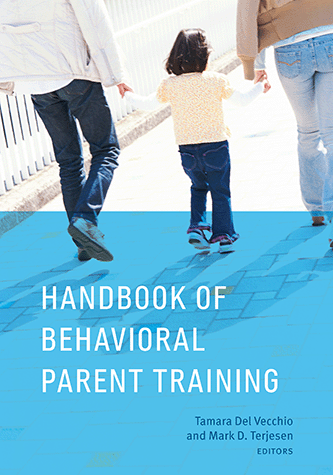
Handbook of Behavioral Parent Training
ISBN: 978-1-4338-4486-7Available formats
Also available from
Master the principles and practices of behavioral parent training (BPT), the gold standard for managing noncompliance and aggression in children.
This comprehensive resource is designed for professionals, researchers, and educators, offering an in-depth exploration of BPT’s principles, techniques, and applications. It covers key topics such as outcome assessment, cultural adaptations, and implementation challenges, as well as detailed discussions of leading BPT programs—including parent–child interaction therapy, The Incredible Years, and interventions tailored for ADHD, ASD, and primary care settings.
The handbook also examines emerging trends, such as the integration of technology into modern parenting interventions, and provides practical insights grounded in the latest empirical research. Unlike other texts that touch on aspects of BPT, this volume delivers a single, authoritative source that combines theoretical foundations with actionable strategies for real-world practice.
Acknowledgements
Introduction to the Handbook: Behavioral Parent Training: A Road Map for the Handbook
Part I: Theoretical and Empirical Foundations
- Chapter 1. Behavioral Parent Training: Foundations and Overview
Samuel T. Jackson, Megan Leary, and Tamara Del Vecchio - Chapter 2. The Efficacy of Behavioral Parent Training for Children with Externalizing and Internalizing Problems
Tycho J. Dekkers, Patty Leijten, Maaike Nauta, Barbara J. van den Hoofdakker, Saskia van der Oord, and Lidewij Wolters - Chapter 3. The Role of Cognitions and Emotions in Behavioral Parent Training
Rachel Ross, Ariella Fromowitz, Sarah Swerdin, Stephanie Rohrig, and Mark D. Terjesen - Chapter 4. The Parent-Child Relationship in Behavioral Parent Training for Parents of Aggressive Children: Positive Parenting and the Case for Acceptance
Emily N. Shah and Timothy A. Cavell - Chapter 5. Cultural Adaptations of Behavioral Parent Training
Ana A. Baumann, Samantha M. Corralejo, and Jean Hunleth - Chapter 6. Overcoming Barriers in Behavioral Parent Training Beyond REACH
Madison Forde, Kailee Kodama Muscente, and Anil Chacko - Chapter 7. Assessment in Behavioral Parent Training: A Clinical Roadmap and Outcomes Evaluation
Phyllis S. Ohr and Janice Lu - Chapter 8. Using Functional Behavior Assessment within Behavioral Parent Training
Andrea Temkin-Yu, Shannon Bennett, Lisa Coyne, Samuel Fasulo, and Anthony Puliafico - Chapter 9. Implementation Feasibility and Readiness for Statewide Scaling of Behavioral Parent Training Programs
Shira Richards-Rachlin and Tamara Del Vecchio - Chapter 10. Training and Evaluating Therapist Competence in Behavioral Parent Training
Hilary B. Vidair, Alexander Dorfman, and Alyssa E. Silvera
Part II: Model Behavioral Parent Training Programs
- Chapter 11. GenerationPMTO: An Overview of the Intervention and Summary of Recent Research and Implementation Efforts
Kendal Holtrop, Margrét Sigmarsdóttir, Laura A. Rains, and Abigail H. Gewirtz - Chapter 12. Helping the Noncompliant Child
Robert J. McMahon, Deborah J. Jones, and Rex Forehand - Chapter 13. Parent-Child Interaction Therapy
Jake C. Steggerda, Reeva C. Morton, Sharon Phillips, and Cheryl B. McNeil - Chapter 14. The Incredible Years® Parent Programs: Four Decades of Evidence-Based Parenting Support, Research, and Delivery
Jennifer Piscitello and Carolyn Webster-Stratton - Chapter 15. The Triple P System of Evidence-based Parenting Support: An Update of Innovations and Future Developments
Matthew R. Sanders, Karen M. T. Turner, and Alina Morawska - Chapter 16. Parenting the Strong-Willed Child: An Evidence-Based Group Curriculum and Self-Administered Self-Help Book for Parents of Young Children
Grace H. Cain, Kat L. Wright, and Deborah J. Jones
Part III: Tailored and Integrated Approaches
- Chapter 17. The Chicago Parent Program
Deborah Gross, Getachew M. Kassa, Susan M. Breitenstein, Emily Hoppe, Lily B. Stavisky, Monique C. Daniels, and Amie F. Bettencourt - Chapter 18. The New Forest Parenting Program
Cathy Laver-Bradbury and David Daley - Chapter 19. Tuning in to Kids: Program Overview
Sophie S. Havighurst and Christiane E. Kehoe - Chapter 20. The Comet Program: How Cultural Adaptation Matters, Even If Some Evidence May Show Otherwise
Martin Forster and Johanna Engelbrektsson - Chapter 21. Development and Implementation of a Culturally Adapted Behavioral Parent Training Program: Cultural Adaptation of GenerationPMTO for Latine in the Americas
Melanie M. Domenech Rodríguez, Nancy Amador Buenabad, J. Rubén Parra-Cardona, and Marion S. Forgatch
Part IV: Special Considerations for Specific Populations
- Chapter 22. Behavioral Parent Training for Attention-Deficit Hyperactivity Disorder
David Reitman, Jonathan Gellman, and Seiny Gonzalez - Chapter 23. Behavioral Parent Training for Autistic Youth
Lauren J. Moskowitz, Ashley Smith, Britney Jeyanayagam, and Lauren B. Quetsch - Chapter 24. Behavioral Parent Training for Internalizing Problems
Rebecca G. Etkin and Eli R. Lebowitz - Chapter 25. Trauma-Informed Behavioral Parent Training
Sarah Tannenbaum, Sarah E. Gurney, Angela Weiyi Wang, Looknoo P. Thammathorn, and Talia Y. Lurie - Chapter 26. Behavioral Parent Training for Promoting Children's Health
Courtney Breiner, Michelle Kirkland, Katarina Kokkosis, Robin Vukoje, Le Thao Vy Vo, Olivia Walsh, and Mark D. Terjesen - Chapter 27. Behavioral Parent Training in Primary Care
Lily B. Stavisky, Amie F. Bettencourt, and Susan M. Breitenstein - Chapter 28. Behavioral Parent Training for Pediatric Irritability: A Transdiagnostic Approach to Case Conceptualization and Treatment
Jessica Hawks - Chapter 29. Behavioral Parent Training in the Context of Conflict and Divorce
Sydney M. Parker, Disha Kotecha, Karey L. O'Hara, and Sharlene Wolchik
Part V: Expanding the Reach of Parent Programs
- Chapter 30. The Role of Population-Based Parenting Support in Enhancing Public Health Outcomes
Matthew R. Sanders, Ronald J. Prinz, and Trevor G. Mazzucchelli - Chapter 31. Fathers in Focus: Advancing Engagement in Behavioral Parent Training
Juan Carlos Gonzalez, Corinna C. Klein, and Miya L. Barnett - Chapter 32. Digitally Delivered Behavioral Parent Training Programs
Marsha Ariol, Sean Morse, Hi Jae Jung, and George J. DuPaul - Chapter 33. Delivering Behavioral Parent Training with Under-Resourced Families: Using Technology-Enhancement as an Example
Yexinyu Yang, Yinuo Liu, Mariana Gonzalez, and Deborah J. Jones - Chapter 34. Light Touch Behavioral Parent Training Approaches
Kailee Kodama Muscente, Madison Forde, Brittany Matthews, and Anil Chacko - Chapter 35. Reflections on Behavioral Parent Training: Progress and Priorities
Tamara Del Vecchio and Mark D. Terjesen
About the Editors
Index
Mark Terjesen, PhD, is professor of psychology at St. John's University and a core member of the school psychology programs, previously serving as director. He was the Child and Family Service Coordinator for the Albert Ellis Institute for Rational Emotive Behavior Therapy in Manhattan and was president of the School Division of the New York State Psychological Association and of APAs Division 52 (International Psychology). Dr. Terjesen has trained many professionals internationally in the use of rational emotive behavior therapy (REBT) and cognitive-behavioral practices with children and families.
Tamara Del Vecchio, PhD, is a clinical psychologist whose work centers on parent-child relationships, early childhood aggression, and evidence-based parenting interventions. She received her doctorate in Clinical Psychology from Stony Brook University and is currently a professor of psychology at St. John's University, where she has also served as department chair and director of clinical training. Her scholarly contributions include coediting the Handbook of Training and Supervision in Cognitive Behavioral Therapy and co-developing the Parent Anger Scale (PAS) and the Child Behavior Record (CBR)—assessment tools used internationally to advance research and clinical practice in parenting and child development.
This comprehensive resource gives providers the information they need to understand, implement, and utilize behavioral parent training across a variety of settings. The breadth of material is impressive, including chapters on both internalizing and externalizing disorders, and the broad focus on the similarities among behavioral parent training (BPT) programs—rather than their differences—makes this text applicable to diverse populations and contexts.
—Regine Galanti, PhD, Director, Long Island Behavioral Psychology, Cedarhurst, NY, and author of Parenting Anxious Kids
—Heather Ciesielski, PhD, Clinical Associate Professor, Department of Psychological Sciences, Purdue University, and Director, Purdue Psychology Treatment and Research Clinics, West Lafayette, IN
This handbook is a fantastic resource for clinicians, researchers, and other parenting professionals interested in promoting the well-being of young children through evidence-based BPT programs. The handbook addresses the history of these programs, their theoretical underpinnings, and their structure, implementation, evaluation, and dissemination. The volume details how BPT programs have been modified for various populations and how they have moved beyond their initial focus on reducing child conduct problems. It explores ways that new digital technologies can be used to increase program reach, engagement, and effectiveness. A strength is the inclusion of numerous chapters on the most popular and well-validated BPT programs written by the program developers. The handbook provides a state-of-the-art review of BPT programs that will be of interest to a wide range of audiences including clinicians, prevention specialists, researchers, educators, and graduate students in psychology and family studies.
—Thomas G. Power, PhD, Emeritus Professor, Department of Human Development, Washington State University, Pullman