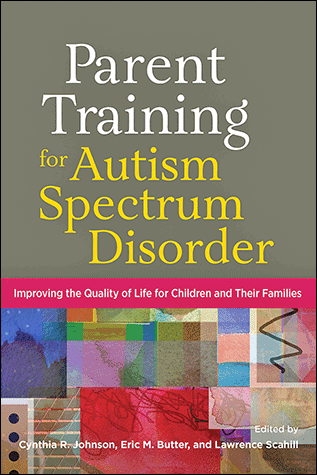
Parent Training for Autism Spectrum Disorder
Available formats
Also available from
Raising a child with autism spectrum disorder (ASD) can be challenging, particularly for parents who do not have easy access to psychological treatment.
This book presents parent training as a unique approach that is accessible and one of the most promising methods for promoting long-term behavioral improvements in children with ASD.
Backed by decades of research, parent training is a psychotherapeutic technique in which clinicians teach parents effective parenting skills and behaviors, so that parents are the main drivers of change for their children.
This clinical guide shows practitioners how to apply this approach with caregivers of children with ASD. Readers will learn strategies for implementing various assessment and intervention techniques and for maintaining parental engagement throughout treatment.
Individual chapters focus on the most common issues confronting parents of children with ASD, including social and communication deficits; disruptive behaviors; sleep disturbances; wandering tendencies; and key life skills, like feeding and toileting.
Vivid case examples illustrate how the techniques can be applied in realistic scenarios.
Contributors
Introduction
Cynthia R. Johnson, Eric M. Butter, and Lawrence Scahill
- History and Theoretical Foundations of Parent Training
Karen Bearss - Clinical Assessment of Children With Autism Spectrum Disorder Before and After Parent Training
Valentina Postorino and Lawrence Scahill - Promoting Parent Engagement in Parent Training for Children With Autism Spectrum Disorder
Rachel M. Fenning and Eric M. Butter - Parent Training for Social Communication in Young Children With Autism Spectrum Disorder
Stephanie Y. Shire and Tristram Smith - Parent Training for Disruptive Behavior in Autism Spectrum Disorder
Karen Bearss, Luc Lecavalier, and Lawrence Scahill - Parent Training for Sleep Disturbances in Autism Spectrum Disorder
Cynthia R. Johnson and Beth A. Malow - Parent Training for Food Selectivity in Autism Spectrum Disorder
T. Lindsey Burrell, William Sharp, Cristina Whitehouse, and Cynthia R. Johnson - Parent Training for Toileting in Autism Spectrum Disorder
Daniel W. Mruzek, Benjamin L. Handen, Courtney A. Aponte, Tristram Smith, and Richard M. Foxx - Parent Training for Elopement in Autism Spectrum Disorder
Nathan A. Call, Mindy Scheithauer, Joanna Lomas Mevers, and Colin Muething - Conclusions and Future Directions
Lawrence Scahill and Eric M. Butter
Index
About the Editors
Cynthia R. Johnson, PhD, is the director of the Cleveland Clinic Center for Autism, Cleveland, Ohio, and is on the faculty of the Lerner College of Medicine at Case Western University. She has been awarded National Institutes of Health-funded and numerous other grants.
A member of The RUBI (Research Units in Behavior Interventions) Autism Network, Dr. Johnson's recent research has been on the treatment of frequently co-occurring/associated problems in autism spectrum disorder, including disruptive behaviors, sleep disturbances, and feeding problems.
Dr. Johnson is a licensed psychologist and a board-certified behavior analyst.
Eric M. Butter, PhD, is a clinical psychologist with specialization in autism spectrum disorder (ASD), attention-deficit/hyperactivity disorder (ADHD), and other neurodevelopmental disabilities and is an associate professor jointly appointed in pediatrics and psychology at The Ohio State University.
Dr. Butter's research has focused on the biomedical correlates and potential etiologies of ASD and ADHD, as well as the disorders' psychological and medical treatment. He has been continuously involved in several autism research networks since 1999.
Dr. Butter is the chief of psychology at Nationwide Children's Hospital in Columbus, Ohio, and continues to work on implementing and expanding parent training interventions for children with ASD.
Lawrence Scahill, MSN, PhD, is the director of clinical trials at the Marcus Autism Center in Atlanta, Georgia, and a professor of pediatrics at Emory University. He is a recognized leader in the design and conduct of clinical trials in children with neurodevelopmental disorders, such as autism spectrum disorder and Tourette's disorder.
Dr. Scahill is an editor of Pediatric Psychopharmacology: Principles and Practice and coauthor of Parent Training for Disruptive Behavior in Children With Autism Spectrum Disorder.
He has played a central role in the Research Units on Pediatric Psychopharmacology Autism Network and the Research Units on Behavioral Intervention.
The field has desperately needed a book like this for a long time! Johnson, Butter, and Scahill have assembled the most accomplished clinical scientists in the field of parent training intervention for autism to produce a volume that possesses both breadth, in terms of the wide-ranging application of parent training, and incredible depth, in their coverage of the rich history of this approach and the science behind it.
—Susan W. White, PhD
Center for the Prevention of Youth Behavior Problems, University of Alabama, Tuscaloosa
This book is authoritative, comprehensive, and based on sound evidence and rich clinical experience. It covers all the key topics in parent training for children on the autism spectrum from improving social communication skills and reducing disruptive behavior to tackling everyday practical matters such as sleeping, eating, and toileting.
—Professor Tony Charman
Chair in Clinical Child Psychology, King's College London, London, England
The contributors provide current research evidence and practical advice on helping families with children on the autism spectrum manage everyday problems. The specific strategies within are situated in a clear framework of current approaches to intervention.
—Helen McConachie, PhD
Newcastle University, Newcastle upon Tyne, England