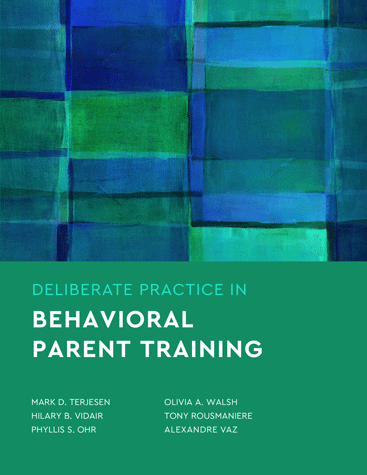
Deliberate Practice in Behavioral Parent Training
ISBN: 978-1-4338-4041-8Deliberate practice exercises provide trainees and students an opportunity to build competence in essential behavioral parent training skills while developing their own personal therapeutic style.
These exercises present role-playing scenarios in which two trainees act as a client and a clinician, switching back and forth under the guidance of a supervisor. The clinician improvises appropriate and authentic responses to client statements organized into three difficulty levels—beginner, intermediate, and advanced—that reflect common client questions and concerns.
Trainees will learn how to collaborate with parents to help them build positive relationships with their children as a foundation for creating behavioral change. They will learn how to teach parenting skills like praise to encourage positive behaviors, planned ignoring, establishing consequences that are respectful and developmentally appropriate, and strategies for parents to manage their own strong emotions.
Step-by-step instructions guide participants through the exercises, identify criteria for mastering each skill, and explain how to monitor and adjust difficulty. Guidelines to help trainers and trainees get the most out of training are also provided.
To demonstrate how deliberate practiceopens in new window can be fully integrated into a professional curriculum, this series features exercises developed and refined within the clinical training curriculum at the Sentio online marriage and family therapy (MFT) therapist training programopens in new window in California, which is where we started developing this series. These exercises, which have been tested at clinical training sites around the world, are used to enhance clinical outcomes within the firsthy brid MFT program approved by the California Board of Behavioral Sciencesopens in new window to fully integrate deliberate practice into its entire curriculum. By integrating these models into its hybrid MFT program in California, Sentio University demonstrates that therapist training graduate programs can use deliberate practice to bridge the gap between theory and clinical mastery through repetitive, feedback-informed practice to support the development of modern, outcome-focused clinicians.
Series Preface
Tony Rousmaniere and Alexandre Vaz
Acknowledgments
Part I. Overview and Instructions
- Chapter 1. Introduction and Overview of Deliberate Practice and Behavioral Parent Training
- Chapter 2. Instructions for the Behavioral Parent Training Deliberate Practice Exercises
Part II. Deliberate Practice Exercises for Behavioral Parent Training Skills
Exercises for Beginner Behavioral Parent Training Skills
- Exercise 1. Psychoeducation About Behavioral Parent Training
- Exercise 2: Psychoeducation About the Functions of Child Behaviors
- Exercise 3. Identifying and Validating Parent Affect
- Exercise 4. Teaching Parents How to Provide Praise
Exercises for Intermediate Behavioral Parent Training Skills
- Exercise 5. Teaching Parents to Provide Positive Attention
- Exercise 6. Teaching Planned Ignoring With Positive Attention
- Exercise 7. Teaching Parents About Effective Communication
- Exercise 8. Teaching Parents How to Implement Positive Incentives to Bring About Behavioral Change
Exercises for Advanced Behavioral Parent Training Skills
- Exercise 9. Teaching Parents About Consequence Interventions
- Exercise 10. Providing Strategies for Parent Affect Management
- Exercise 11. Teaching Parents About Managing Behavior in Public Settings
- Exercise 12. Development of Homework Assignments
Comprehensive Exercises
- Exercise 13. Annotated Behavioral Parent Training Practice Session Transcript
- Exercise 14. Mock Behavioral Parent Training Sessions
Part III. Strategies for Enhancing the Deliberate Practice Exercises
- Chapter 3. How to Get the Most Out of Deliberate Practice: Additional Guidance for Trainers and Trainees
Appendix A. Difficulty Assessments and Adjustments
Appendix B. Deliberate Practice Diary Form
Appendix C. Sample Behavioral Parent Training Syllabus With Embedded Deliberate Practice Exercises
References
Index
About the Authors
Mark D. Terjesen, PhD, is professor of psychology at St. John’s University in Queens, NY, where he also serves as director of clinical training and program director of the school psychology PsyD program. He has studied, published, presented, and trained internationally in assessment and clinical work with children, adolescents, and families. Dr. Terjesen is the coeditor of the Handbook of Behavioral Parent Training. He was president for multiple organizations, including the School Division and the Cognitive Behavioral Therapy Division of the New York State Psychological Association and Division 52 (the Society for Global Psychology) of the American Psychological Association.
Hilary B. Vidair, PhD, is associate professor of psychology and former director in the Clinical Psychology Doctoral Program at Long Island University Post. For over 15 years, she has trained and supervised doctoral students in cognitive behavioral therapy and behavioral parent training. Dr. Vidair has published and presented on evidence-based treatments for children and adolescents, behavioral parent training, and methods for training students in clinical work and research. She authored the book Navigating Research Projects in an Applied Graduate Program. She also serves as the director of program development at Cognitive Behavioral Associates in Great Neck, New York.
Phyllis S. Ohr, PhD, is associate professor of psychology at Hofstra University in Long Island, NY, where she serves as assistant director of clinical training for the clinical psychology PhD program. She is also clinical director of the Child and Parent Psychological Services Clinic, a training and research program. She is a certified trainer of parent–child interaction therapy and, with her mentees, has published and presented yearly at conferences on parent–child relationships, selective mutism and social anxiety, and treating disordered eating in young children. In 2010, she received the American Psychological Association’s student-nominated mentorship award.
Olivia A. Walsh, PsyD, is postdoctoral fellow at North Coast Psychological Services. She provides therapy and assessments for children, adolescents, and young adults in private practice and schools. Dr. Walsh’s research focuses on deliberate practice in behavioral parent training (BPT). She has presented at national conferences on cognitive behavioral therapy, BPT, and deliberate practice. Dr. Walsh has also served as an adjunct instructor at St. John’s University, teaching undergraduate psychology courses. In recognition of her contributions to the field, she received the Ted Bernstein Award from the New York Association of School Psychologists in 2022.
Tony Rousmaniere, PsyD, is president of Sentio University marriage and family therapy (MFT) program in Californiaopens in new window. He led the development of online/hybrid MFT programopens in new window, which is the first MFT therapist training program approved by the California Board of Behavioral Science for MFT licensure that fully integrates deliberate practiceopens in new window. Dr. Rousmaniere is the author/coeditor of many books on psychotherapy training. He is also the executive director of the Sentio Counseling Centeropens in new window, which is Sentio MFT program’s guaranteed practicumopens in new window site where students provide sliding-scale online therapy in Californiaopens in new window, and past president of the APA’s Division 29.
Alexandre Vaz, PhD, is chief academic officer of Sentio University marriage and family therapy (MFT) program in Californiaopens in new window. This innovative online/hybrid MFT programopens in new window was the first approved by the California Board of Behavioral Science for MFT licensure to fully integrate deliberate practiceopens in new window into its curriculum to ensure superior clinical outcomes. He is also director of clinical training for the Sentio Counseling Centeropens in new window which is Sentio MFT program’s guaranteed practicumopens in new window site where students provide low-cost online couples therapy in Californiaopens in new window. Dr. Vaz is the author/coeditor of many books on deliberate practice and psychotherapy training.
Terjesen and colleagues have produced the essential guide for comprehensively training and supervising mental health professionals in the provision of behavioral parent training (BPT). This book is unique in providing a graduated set of deliberate practice exercises that support trainees and supervisees in translating parent training knowledge into implementation of skills that serve as the foundation for effective delivery of established BPT programs. The “learning by doing” exercises cogently described in this book have been rigorously evaluated by multiple BPT trainers across more than a dozen countries. I strongly recommend the use of this text for training mental health professionals working with families who could benefit from BPT.
—George J. DuPaul, PhD, Lehigh University, Bethlehem, PA
The only book I’ve seen that teaches you how to become an expert in delivering parent training. Incredibly useful whether you are a beginner or a seasoned pro. You will get better after reading this expertly written book.
—Camilo Ortiz, PhD, ABPP, Long Island University-Post Campus, Brookville, NY
This book is part of the Essentials of Deliberate Practice series by Tony Rousmaniere and Alexandre Vaz. The materials on this page include a Deliberate Practice Reaction Form and a Deliberate Practice Diary Form that can be used with every book in this series, as well as volume-specific content.
These documents are offered for your personal use in clinical training or teaching courses. If you reprint or adapt them for publication, permission is required from the publisher.
Deliberate Practice Reaction Form
The Deliberate Practice Reaction Form can be used with any of the deliberate practice exercises throughout the series to measure how challenging it was for the trainees and to adjust the difficulty as needed. Appendix A includes a black-and-white version of the form with instructions for assessing and modifying an exercise’s difficulty. A color version of the Deliberate Practice Reaction Form is also available for individual download.
- Appendix A: Difficulty Assessments and Adjustments (PDF)opens in new window
- Deliberate Practice Reaction Form (PDF)opens in new window
Deliberate Practice Diary Form
The Deliberate Practice Diary Form is an optional form that trainees can complete during a training session’s final evaluation or between sessions to process their experiences with the activity, including what was and was not helpful and what they learned. Appendix B, which is the same across all books in the series, presents this form.
Volume-specific materials
The following content is unique to Deliberate Practice in Interpersonal Psychotherapy and includes (a) a guide to implementing and troubleshooting the implementing the interpersonal inventory in Exercise 2 and (b) a sample syllabus that integrates the deliberate practice exercises into a standard clinical course.
- Appendix C: Sample Behavioral Parent Training Syllabus With Embedded Deliberate Practice Exercises (PDFopens in new window| Wordopens in new window)
Video demonstration
A YouTube series (Practice Time! with Amy DeSmidt and Jamie Manseropens in new window) highlights authentic deliberate practice sessions featuring exercises from various volumes in the Essentials of Deliberate Practice series.
Supplemental resources for therapist training
Designed for faculty at graduate institutions, these supplemental resources provide a framework and clear examples for implementing deliberate practice within existing therapist training curricula. Sentio University is where we started to develop what would become the APA Essentials of Deliberate Practice series. We provide a comprehensive suite of free psychotherapy training resources based on the deliberate practice methodologyopens in new window. These materials are designed to supplement modern hybrid and online therapist training curricula and are used extensively within our own clinical programs.
- California MFT program integration: These materials are a core component of the Sentio hybrid MFT program in Californiaopens in new window, the first in the state to fully integrate DP into its entire curriculum and receive California Board of Behavioral Sciences approval for licensure.
- Free deliberate practice exercises: Access our library of therapist skill-building worksheetsopens in new window used to enhance the online California MFT degree through repetitive, feedback-informed practice.
- Deliberate practice video demonstrations: Visit our YouTube channel for free therapist training videosopens in new window to view clinical demonstrations from the APA Essentials of Deliberate Practice book series. These videos illustrate key skills used to enhance the online California MFT degree through repetitive, feedback-informed practice.
- AI and emerging therapy resources: Learn how deliberate practice can be used to safely and ethically integrate AI for therapist trainingopens in new window. Review our AI research programopens in new window and our clinical guidelines on using AIopens in new window to prepare for the modern landscape of digital mental health.