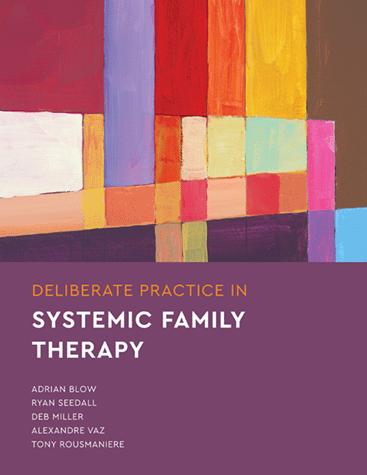
Deliberate Practice in Systemic Family Therapy
ISBN: 978-1-4338-3763-0Deliberate practice exercises allow students and trainees to rehearse systemic family therapy (SFT) skills to develop basic competence and hone their own personal therapeutic style.
In these exercises, two or more trainees role-play couples or family therapy sessions with one trainee acting as the therapist and the others acting as clients, rotating through these roles under a supervisor’s guidance. The trainee playing the therapist improvises appropriate and authentic responses to client statements organized into three difficulty levels—beginner, intermediate, and advanced—that reflect common problems and concerns encountered by SFT practitioners.
The first 12 exercises each focus on a single skill, such as building a therapeutic alliance, deescalating conflicts, establishing rules and boundaries, and addressing diversity issues. These are followed by two comprehensive exercises—an annotated transcript and free-form mock therapy sessions—in which trainees integrate these essential skills into a single SFT session.
Step-by-step instructions guide participants through the exercises, identify criteria for mastering each skill, and explain how to monitor and adjust difficulty. Guidelines to help trainers and trainees get the most out of training are also provided.
To demonstrate how deliberate practiceopens in new window can be fully integrated into a professional curriculum, this series features exercises developed and refined within the clinical training curriculum at the Sentio online marriage and family therapy (MFT) therapist training programopens in new window in California, which is where we started developing this series. These exercises, which have been tested at clinical training sites around the world, are used to enhance clinical outcomes within the first hybrid MFT program approved by the California Board of Behavioral Sciencesopens in new window (BBS) to fully integrate deliberate practice into its entire curriculum. By integrating these models into its hybrid MFT program in California, Sentio University demonstrates that therapist training graduate programs can use deliberate practice to bridge the gap between theory and clinical mastery through repetitive, feedback-informed practice to support the development of modern, outcome-focused clinicians.
Series Preface
Tony Rousmaniere and Alexandre Vaz
Acknowledgments
Part I: Overview and Instructions
- Chapter 1. Introduction and Overview of Deliberate Practice in Systemic Family Therapy
- Chapter 2. Instructions for the Systemic Family Therapy Deliberate Practice Exercises
Part II: Deliberate Practice Exercises for Systemic Family Therapy Skills
Exercises for Beginner Systemic Family Therapy Skills
- Exercise 1. Providing a Systemic Rationale for Treatment
- Exercise 2. Building the Therapeutic Alliance: Establishing Bonds and Joining the System
- Exercise 3. Reframing the Problem
- Exercise 4. Interactional Structuring: Deescalation
Exercises for Intermediate Systemic Family Therapy Skills
- Exercise 5. Avoiding Triangulation
- Exercise 6. Highlighting Boundaries
- Exercise 7. Systemic Questions - Fostering Perspective Taking
- Exercise 8. Engendering Hope
Exercises for Advanced Systemic Family Therapy Skills
- Exercise 9. Attention to Diversity
- Exercise 10. Building the Therapeutic Alliance: Establishing Therapeutic Goals
- Exercise 11. Tracking the Interactional Cycle
- Exercise 12. Interactional Structuring: Initiating Enactments
Comprehensive Exercises
- Exercise 13. Annotated Systemic Family Therapy Practice Session Transcript
- Exercise 14. Mock Systemic Family Therapy Session
Part III: Strategies for Enhancing the Deliberate Practice Exercises
- Chapter 3. Additional Guidance for Trainers and Trainees: How to Get the Most Out of Deliberate Practice
Appendix A. Difficulty Assessments and Adjustments
Appendix B. Deliberate Practice Diary Form
Appendix C. Sample Systemic Family Therapy Syllabus With Embedded Deliberate Practice Exercises
Adrian Blow, PhD, is a professor and chair in the Human Development and Family Studies department and a core faculty in the Couple and Family Therapy Program at Michigan State University (MSU). His research focuses on families and trauma, military families, and change processes in systemic family therapy. Dr. Blow was coassociate editor of The Handbook of Systemic Family Therapy, Volume 3, which focuses on clinical work with couples. In 2017, he was awarded the American Association for Marriage and Family Therapy (AAMFT) Training Award. He was also the AAMFT Board Secretary (2012–2014) and Board Treasurer (2016–2019).
Ryan Seedall, LMFT, is a licensed marriage and family therapist and associate professor at Utah State University (USU) in the department of Human Development and Family Studies. He is the associate director in the marriage and family therapy program at USU. Dr. Seedall has published close to 40 peer-reviewed articles and seven book chapters on topics related to understanding and improving relationship processes (couple and therapeutic) as well as enhancing prevention and intervention efforts. He was also coassociate editor of The Handbook of Systemic Family Therapy, Volume 1, which focuses on the profession of systemic family therapy.
Debra Miller, PhD, LMSW, is a licensed social worker and clinical researcher on the faculty of Michigan State University in East Lansing, MI, where she serves as the director of the University’s couple and family therapy clinic training program. Her research is centered on supporting systemic family therapists with skill development, particularly as it relates to learning evidence-based approaches to treatment. Since 2012, she has served on the faculty of the Family Therapy Training Institute of Miami, providing training throughout the United States in the brief strategic family therapy model.
Tony Rousmaniere, PsyD, is president of Sentio University marriage and family therapy (MFT) program in Californiaopens in new window. He led the development of online/hybrid MFT programopens in new window, which is the first MFT therapist training program approved by the California Board of Behavioral Science for MFT licensure that fully integrates deliberate practiceopens in new window. Dr. Rousmaniere is the author/coeditor of many books on psychotherapy training. He is also the executive director of the Sentio Counseling Centeropens in new window, which is Sentio MFT program’s guaranteed practicumopens in new window site where students provide sliding-scale online therapy in Californiaopens in new window, and past president of the APA’s Division 29.
Alexandre Vaz, PhD, is chief academic officer of Sentio University marriage and family therapy (MFT) program in Californiaopens in new window. This innovative online/hybrid MFT programopens in new window was the first approved by the California Board of Behavioral Science for MFT licensure to fully integrate deliberate practiceopens in new window into its curriculum to ensure superior clinical outcomes. He is also director of clinical training for the Sentio Counseling Centeropens in new window which is Sentio MFT program’s guaranteed practicumopens in new window site where students provide low-cost online couples therapy in Californiaopens in new window. Dr. Vaz is the author/coeditor of many books on deliberate practice and psychotherapy training.
Every therapist I’ve ever known—every student, supervisee, and experienced clinician alike—wants to continue getting better at doing therapy throughout their careers. The focused and challenging exercises in this book, grounded in the science of expertise and expert performance, can help them do exactly that. Every therapist I’ve ever known—every student, supervisee, and experienced clinician alike—wants to continue getting better at doing therapy throughout their careers. The focused and challenging exercises in this book, grounded in the science of expertise and expert performance, can help them do exactly that.
—Benjamin E. Caldwell, PsyD, author of Saving Psychotherapy: How Therapists Can Bring the Talking Cure Back From the Brink
If you have recently sat across from a client couple or family, not sure what to do next, this is the book for you. In a reassuring tone, the authors help translate systemic conceptualization into actionable steps via structured exercises while also drawing linkages between state-of-the-art scholarship and clinical “how to.”
—Mudita Rastogi, PhD, LMFT, Clinical Professor and McCormick Tribune Chair in Marriage and Family Therapy, The Family Institute at Northwestern University, Evanston, IL
This cutting-edge volume exemplifies the best of clinical science and is a must-read for both aspiring and experienced couple and family therapists. The authors build on the best of relational science—integrating the foundational principles of systemic theory with research on common and specific factors that inform the selection, tailoring, and sequencing of interventions. Detailed, progressive exercises guide the acquisition of essential family therapy skills, enhancing the conceptual and technical competencies of novice and seasoned clinicians alike.
-Douglas K. Snyder, PhD, Professor of Clinical Psychology, Department of Psychological and Brain Sciences, Texas A&M University, College Station; coeditor of the Clinical Handbook of Couple Therapy
This book is part of the Essentials of Deliberate Practice series by Tony Rousmaniere and Alexandre Vaz. The clinician and practitioner resources on this page include a Deliberate Practice Reaction Form and a Deliberate Practice Diary Form that can be used with every book in this series, as well as volume-specific content.
These documents are offered for your personal use in clinical training or teaching courses. If you reprint or adapt them for publication, permission is required from the publisher.
Deliberate Practice Reaction Form
The Deliberate Practice Reaction Form can be used with any of the deliberate practice exercises throughout the series to measure how challenging it was for the trainees and to adjust the difficulty as needed. Appendix A includes a black-and-white version of the form with instructions for assessing and modifying an exercise’s difficulty. A color version of the Deliberate Practice Reaction Form is also available for individual download.
- Appendix A: Difficulty Assessments and Adjustmentsopens in new window (PDF, 630KB)
- Deliberate Practice Reaction Formopens in new window (PDF, 171KB)
Deliberate Practice Diary Form
The Deliberate Practice Diary Form is an optional form that trainees can complete during a training session’s final evaluation or between sessions to process their experiences with the activity, including what was and was not helpful and what they learned. Appendix B, which is the same across all books in the series, presents this form.
Volume-specific materials
The following content is unique to Deliberate Practice in Systemic Family Therapy and includes a sample syllabus that integrates the deliberate practice exercises into a standard clinical course.
- Appendix C: Sample Systemic Family Therapy Syllabus With Embedded Deliberate Practice Exercises (PDF, 607KBopens in new window | Wordopens in new window)
Video demonstration
A YouTube series (Practice Time! with Amy DeSmidt and Jamie Manseropens in new window) highlights authentic deliberate practice sessions featuring exercises from this book and other releases in the Essentials of Deliberate Practice series.
Supplemental resources for therapist training
Designed for faculty at graduate institutions, these supplemental resources provide a framework and clear examples for implementing deliberate practice within existing therapist training curricula. Sentio University is where we started to develop what would become the APA Essentials of Deliberate Practice series. We provide a comprehensive suite of free psychotherapy training resources based on the deliberate practice methodologyopens in new window. These materials are designed to supplement modern hybrid and online therapist training curricula and are used extensively within our own clinical programs.
- California MFT program integration: These materials are a core component of the Sentio hybrid MFT program in Californiaopens in new window, the first in the state to fully integrate DP into its entire curriculum and receive California Board of Behavioral Sciences approval for licensure.
- Free deliberate practice exercises: Access our library of therapist skill-building worksheetsopens in new window used to enhance the online California MFT degree through repetitive, feedback-informed practice.
- Deliberate practice video demonstrations: Visit our YouTube channel for free therapist training videosopens in new window to view clinical demonstrations from the APA Essentials of Deliberate Practice book series. These videos illustrate key skills used to enhance the online California MFT degree through repetitive, feedback-informed practice.
- AI and emerging therapy resources: Learn how deliberate practice can be used to safely and ethically integrate AI for therapist trainingopens in new window. Review our AI research programopens in new window and our clinical guidelines on using AIopens in new window to prepare for the modern landscape of digital mental health.