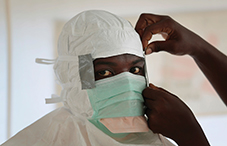

What do you pack when you're going off to Liberia to fight Ebola? For Anthony Tranchita, PhD, the list includes photos of his wife and two young children, a photo of a favorite hunting spot and a sense of trepidation.
While he's doing his duty as a commander in the U. S. Public Health Service (PHS) Commissioned Corps, Tranchita told The Washington Post, "there's also some of that fear, some of that, ‘Wow, what is this going to be like?'"
Tranchita, a psychologist at North Dakota's Grand Forks Air Force Base in his everyday life, will lead a four-person behavioral health team at a 25-bed field hospital built by the U.S. military in Monrovia, Liberia. The mobile medical unit, which will provide triage and temporary clinical care, is part of the effort to reassure medical volunteers they'll receive first-rate care if they themselves contract Ebola.
The behavioral health team will be taking care of hospital workers with Ebola symptoms, says Lt. Cmdr. Kate Migliaccio, a senior public information officer for the PHS.
Helping health-care staff maintain their own resilience is key, British psychologist Theresa Jones, ClinPsyD, told Vice magazine.
"It's so easy for incredibly skilled doctors and nurses, who are used to being able to perform miracles, to start seeing their work as futile," said Jones, who spent a month managing a three-person psychosocial team at Médecins Sans Frontières Ebola treatment center in Monrovia. "I see my job as helping my colleagues — from HR staff to the burial team — to find what it is they need to keep on going."
Other psychologists are doing their part to maintain calm among those back home. A Harvard School of Public Health poll in October found that many Americans are needlessly alarmed. More than half of adults are convinced there will be a large outbreak in the United States in the next year. And 85 percent believe that they can catch Ebola if someone with the disease coughs or sneezes on them, a transmission route the World Health Organization describes as unlikely.
To counter such concerns, Valerie Reyna, PhD, a professor of human development and psychology at Cornell, appeared on the "PBS NewsHour" in October. Explaining how to calm fears without underestimating risks, Reyna emphasized the need for the federal government to be open and transparent about Ebola's transmission.
"If there's uncertainty… we have to be open about that," Reyna said on the episode, which is available at PBSopens in new window. "People can be reassured when they're given information."
Reyna also explained the mechanics of the "social contagion" of fear in an October Huffington Post article, available at Huffington Post opens in new window. As people are exposed to sensationalistic media coverage and social media posts about this unfamiliar threat, she said, fear grows. "It's just like the spread of physical epidemics," she said.
Meanwhile, APA is also taking action. In a new Help Center fact sheet called "Managing your fear about Ebola," available at APA's Topics Page, psychologists Ester Cole, PhD, and Gerard A. Jacobs, PhD, recommend that Americans limit media exposure, gather information from a trusted source, such as the Centers for Disease Control and Prevention, and seek professional help if fear becomes overwhelming. APA has also issued a press release offering guidance on health-risks communication, available online.
Researchers can help fight Ebola, too. The National Science Foundation, for example, is seeking proposals for non-medical, non-clinical care research designed to increase understanding of Ebola's spread, educate people about how to avoid it and address related topics. For more information about using NSF's rapid response research grants mechanism for Ebola-related work, visit NSFopens in new window.
The White House is also eager to put the expertise of psychologists and other scientists to use, says Geoffrey K. Mumford, PhD, associate executive director for government relations in APA's Science Directorate. The directorate's government relations staff participated in two by-invitation-only White House conference calls to discuss the administration's response to Ebola.
While the White House has set up an "Ebola Grand Challenge" websiteopens in new window at as a clearinghouse for technological solutions, says Mumford, the administration is also open to receiving proposals about behavioral science-based interventions.
"There was a clear acknowledgment of the need to apply behavioral and social science, both in West Africa and also as Ebola infections are emerging domestically," says Mumford. "The White House is eager to crowd-source as many ideas as possible."
Rebecca A. Clay is a journalist is Washington, D.C.