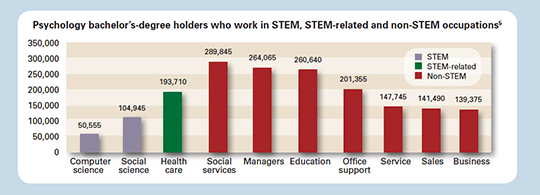
Psychology bachelor’s-degree recipients work in a variety of occupations, suggesting the versatility of an undergraduate psychology degree.1,2 About 10 percent work in U.S. Census-defined science, technology, engineering and math (STEM) occupations and 10 percent work in STEM-related occupations.3
- Of the 10 percent who work in STEM occupations, 56 percent (104,945) of those work in the field of social science, 27 percent (50,555) work in computer science, and 5 percent each work in life sciences (10,130), physical sciences (8,610) or engineering (8,530).
- Of the 10 percent who work in STEM-related occupations, 99.5 percent (193,710) work in health care.4
- The 80 percent of psychology bachelor’s-degree holders who work in non-STEM fields are employed in a variety of occupations, including education, social services, business and more.
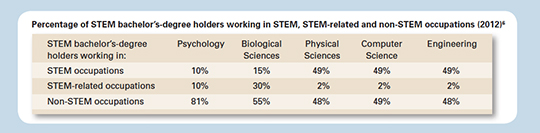
Bachelor’s-degree holders in psychology are less likely to work in STEM occupations than other STEM majors are. Approximately 49 percent of engineering, computer science and physical sciences majors with at least a bachelor’s degree work in STEM positions, followed by biological science majors (15 percent).
— Peggy Christidis, PhD, Karen Stamm, PhD, and Luona Lin, MPP
For more information, contact APA’s Center for Workforce Studies.
1 U.S. Census Bureau, American Community Survey (2012). Retrieved from https://www.census.gov/dataviz/visualizations/stem/stem-htmlopens in new window.
2 Degree refers to the bachelor's degree in psychology, or first-listed major among double-majors, for respondents age 25 to 64 who have completed a bachelor's or higher degree in psychology.
3 STEM includes computer and mathematical occupations, engineers, engineering technicians, life scientists, physical scientists, social scientists, science technicians and STEM managers. STEM-related occupations include architects, health-care practitioners, health-care managers and health-care technicians.
4 Approximately 0.5 percent of STEM-related workers with a psychology bachelor's degree are employed as architects.
5 Occupations with less than 5 percent of psychology bachelor's degree holders were not included in the figure. These occupations include: engineers, mathematicians and statisticians, life scientists, physical scientists, architects, legal, arts and entertainment, construction, production and agriculture.
6 Totals may not sum to 100 percent due to rounding.