

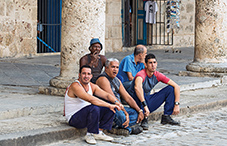

Sixty-eight percent of Cubans are satisfied with their country's health-care system, according to a public opinion poll conducted in March by Bendixen and Amandi International for Univision Noticias and Fusion in collaboration with the Washington Postopens in new window .
Seventy-two percent are satisfied with its educational system. And 97 percent believe that the normalization of relations between Cuba and the United States will be good for Cuba, according to the poll, which was conducted without authorization by the Cuban government.
Exploring what makes the Cuban health-care system so successful was the goal of three groups of psychologists who traveled to the island as part of APA's International Learning Partner Program. American psychologists have much more to learn from Cuban psychologists, such as the nation's integration of physical and mental health care, its emphasis on prevention and early intervention and its resourcefulness in the face of limited resources.
Thanks to the opening up of diplomatic relations between the two countries, the personal connections made on the trips and a memorandum of understanding between APA and Cuba's two leading psychological associations, partnerships among psychologists in the two nations are set to flourish.
"Our hope is that we'll start to build bridges and develop collaborations," says Suzanne Bennett Johnson, PhD, an APA past president and distinguished research professor at Florida State University College of Medicine, who led the 2013 and 2014 trips. "We keep talking about integrated care in this country. They already do it."
Learning from Cubans
Of course, the Cuban health-care system faces big challenges. "The biggest challenge is lack of access to pharmaceuticals and technology, largely because of the U.S. embargo," says Diane Appelbaum, RN, who directs the Community Partnerships for Health Equity program at MEDICC (Medical Education Cooperation with Cuba), a nonprofit group that works to enhance cooperation among U.S., Cuban and global health professionals as a way to improve health and equity.
Low salaries for health-care professionals are another problem. Before the increase in tourism, says Appelbaum, salaries for Cubans, including doctors, were not high, but there was a level playing field. Now, Cubans working in the tourist industry make so much more that there is a skewed, two-tiered economy. While the government has increased doctors' salaries in recent years, says Appelbaum, they still don't make as much as hotel maids make in tips. "I've seen taxi drivers who are doctors," says Appelbaum, a family nurse practitioner who has made more than 40 trips to Cuba with MEDICC and other groups.
Plus, the country faces some serious mental and behavioral health challenges. Suicide is among the country's leading causes of death, according to a 2013 article in the MEDICC Reviewopens in new window . A quarter of patients who come to health-care facilities have depression diagnoses. And in a country known for tobacco and rum production, smoking and drinking rates — while on the decline — are still high. Nearly a quarter of Cuban adults still smoke, and a quarter of patients in emergency rooms have been drinking.
But despite these and other challenges, Cuba's overall health outcomes are impressive.
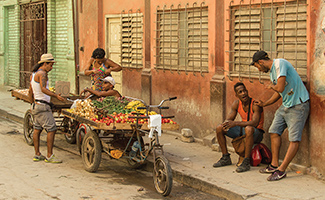
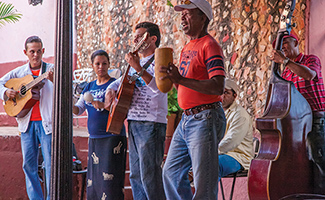
According to the World Bankopens in new window, Cuba's health expenditure per capita in 2012 was $558, compared with $8,895 in the United States. Yet both countries had a life expectancy at birth of 79 years. And Cuba's infant mortality rate is lower than that in the United States, with five infants dying before their first birthdays per 1,000 live births compared with six in the United States.
One possible factor behind those impressive statistics is the integration of physical and mental health care. "The purpose is to put the focus on the person, not the disease," says Roberto Corral Ruso, PhD, a psychology professor at the University of Havana and vice president of the Cuban Psychological Society.
With the Affordable Care Act emphasizing that kind of integration, says Bennett Johnson, U.S. psychologists can learn a lot from their Cuban counterparts. "Psychologists were very involved after the revolution in thinking through how health care would be delivered," says Bennett Johnson. "Psychologists in Cuba don't have to convince anyone of their worth. They know what they're worth."
As a result, psychologists are completely integrated into all aspects of Cuba's health-care system, says Sandra Soca Lozano, who is both a pediatric psycho-oncologist and a psychology professor at the University of Havana. Because the system is public — no private organizations offer health services in Cuba — every citizen can access care.
The health-care system has several levels, says Soca. The first is the primary care available in the consultorio, which Soca describes as a kind of "medical house." Staffed by specialists in internal or family medicine, obstetrics and gynecology, pediatrics and psychology, each consultorio serves a neighborhood or small community of 1,200 to 2,500 people. Larger facilities, called policlinics, offer more specialized equipment and care, including psychological care.
The next level of care consists of hospitals, which includes psychiatric facilities. In addition, there are research institutes for specific medical specialties, which also offer medical assistance to the general population.
"Psychologists are a priority in all these institutions," says Soca. In the onco-hematology ward of the pediatric hospital where she works, for example, Soca routinely checks on all patients, monitoring for depression, anxiety and other problems, and prepares patients and families for diagnoses and medical interventions.
Consultations between psychologists and physicians go both ways, Soca adds. For patients with physical health problems, psychologists help educate physicians about psychological and other factors that can affect such conditions as diabetes and hypertension.
"When we're working in the research institutes, one of the problems psychologists have to deal with is that sometimes the doctor is so focused on the medical problem," says Soca. "We have to say, ‘He's a person, not only a liver or a heart or a kidney.'" When seeing patients with psychological concerns, psychologists can refer them to physicians to check potential problems like hormone levels.
Integration begins even during training, says Bennett Johnson. Psychology trainees — whether engaged in hands-on learning at the policlinics or academic training at the medical school — learn alongside medical, nursing and other health-care students.
And that training is intense, Bennett Johnson says. While most Cuban clinicians don't have doctoral-level degrees, she explains, their training can be just as rigorous. While U.S. psychology students earn an undergraduate degree and study many subjects outside their major before going on to graduate school, Cuban students spend five years in a psychology-only program to earn the equivalent of a bachelor's degree, then work for two years at a mental health facility before entering a general psychology master's program or a health psychology specialist program, which takes another two or three years. "They're getting pretty close to the equivalent of our PsyD programs," says Bennett Johnson.
Going on for the more research-oriented PhD requires another four to seven years. While the Cuban government pays for all education, including the doctorate, Cuban psychologists usually only go on for doctoral training if they hope to take on leadership roles, such as chairs of academic departments.
Making do with less
Cuba's emphasis on prevention may be another factor behind its successful health outcomes, says Amanda Kracen, PhD, a psychologist at the Siteman Cancer Center in St. Louis who went on the 2014 trip.
While the United States focuses on treatment, she says, Cuba's lack of resources has resulted in more emphasis on health promotion and prevention.
For example, all Cubans have annual physical and mental health screenings as part of primary care, with nurses visiting patients' homes to conduct screenings if they don't show up at the doctor's office.
Because primary-care physicians and psychologists live in the neighborhood, they also know who's pregnant and can ensure proper prenatal care. Psychologists treating pregnant women visit their homes to ensure that they and other family members are adjusting to the pregnancy and then follow up to monitor babies' development.
"It felt like they were years or even decades ahead of us in the States," Kracen says. "We even drove past a park near the local medical clinic where dozens of neighbors were doing tai chi together."
The lack of resources — which includes limited access to computers, the Internet and cash — also prompts resourcefulness.
Take CNEURO, a neuroscience center in Havana. The center's work began in 1969 with the help of U.S. psychologist Erwin Roy John, PhD. He wanted to send a computer to Cuba to spur the use of computers to study the brain, but was prevented by the U.S. embargo. "We ended up by surprising him and developing our own minicomputer — the same year as Japan," says Pedro Valdes-Sosa, MD, PhD, ScD, CNEURO's co-founder and general vice-director for research.
Working with New York University, Valdes-Sosa and his team developed a technique called neurometrics for studying brain responses, a methodology described in a 1977 Scienceopens in new window paper. The technology enabled them to launch one of the world's first national hearing screening programs, which assesses the brain's electrical activity in response to stimuli. "This program has had demonstrable effects on children with hearing impairment in terms of IQ and language development," Valdes-Sosa says.
The center's next priority is exploring the neuroscience of aging. "This is important since, due to our health advances, Cuba has one of the most aged populations in the hemisphere," says Valdes-Sosa. According to the World Bankopens in new window, 13 percent of Cubans were 65 or older in 2013, compared to just 5 percent in neighboring Haiti and 6 percent in the Dominican Republic and Mexico.
Collaborating with Cuban psychologists
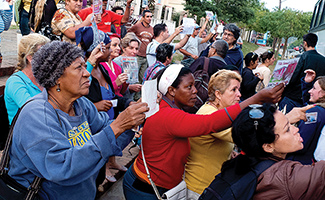
With the easing of restrictions, U.S. psychologists who want to collaborate with their Cuban counterparts may have an easier time of it these days.
Facilitating those relationships is the purpose of the memorandum of agreement between APA and the Cuban Psychological Society and Cuban Health Psychology Society. Signed in 2013, the agreement provides a formal framework for discussing matters of common concern and finding ways to work together for the betterment of psychology and the public interest, says Merry Bullock, PhD, APA's senior director for international affairs, who traveled to Cuba with APA's 2013 group.
While APA's first two trips to Cuba focused primarily on "show and tell," says Bullock, the 2014 trip emphasized the kind of collaboration APA hopes to see more of, with psychologists from the two nations sharing knowledge and building relationships. Almost all of the dozen psychologists who went to Cuba last year presented papers at the Seventh International Conference on Health Psychology, for example. "We're trying to set the stage for people to go to Cuba and find others with similar interests to foster collaborations," says Bullock.
Now APA is returning the hospitality by hosting three Cuban psychologists at this year's APA Annual Convention, Aug. 6–9, in Toronto.
In addition, the convention will feature two symposiums on the Cuban health-care system. "Cuba: Integrated Health Care, Psychology and Psychologists" will feature three Cuban psychologists — Soca; Corral; and Alberto Cobián Mena, PhD, president of the Cuban Health Psychology Society — plus three U.S. psychologists who participated in APA's trips to Cuba — Bennett Johnson; Carol D. Goodheart, PhD, a past president of APA who led the first group; and APA President-elect Susan H. McDaniel, PhD, who joined the 2013 group.
"Psychological Care in Cancer in Cuba and the United States: Accessibility, Acceptability and Approaches" will feature Soca, Kracen and 2014 group members Lara Traeger, PhD, a psychologist at Massachusetts General Hospital, and Felicity Harper, PhD, an associate professor of oncology at Wayne State University School of Medicine.
APA is also planning a fourth trip to coincide with an international psychology conference called Hominis 2016 in Havana next May.
Says Corral, "We wish to start a permanent and mutually enriching contact in terms of research, publications and best psychological practices, from a climate of respect and understanding of our contextual differences."
Rebecca A. Clay is a journalist in Washington, D.C.