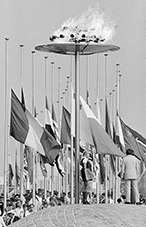
 As a longtime member of the Olympic Sports Science Division, psychologist Steven Ungerleider, PhD, has worked with athletes and coaches at 13 Olympic Games, but it's one of the games he was not able to attend that always stands out: the 1972 Summer Olympics in Munich, West Germany.
Ungerleider missed the games because his father had recently died, and consequently he watched constant television coverage of what became known as the Munich Massacre. During the incident, 11 Israeli Olympic team members were taken hostage and eventually killed by a Palestinian group, and a German police officer also died. The event — which is considered by historians to be the first act of modern terrorism — is the subject of a new documentaryopens in new window produced by Ungerleider that will be released in the fall.
In preparation for the film, called "Munich 1972 & Beyond," Ungerleider has been interviewing the widows and children of the victims, athletes who participated in the 1972 Olympic Games, and political leaders including German chancellor Angela Merkel, Israeli Prime Minister Benjamin Netanyahu, and former American diplomat Henry Kissinger.
"Many of the victims' families never had a sense of closure because the Olympic Committee was very quiet and did not give honor or any type of formal acknowledgement of the 11 murdered Israelis due to the complex politics in the Middle East," says Ungerleider, who has served on numerous Olympic committees, including ones related to ethics and anti-doping education. "They talk about the fact that there was practically no security at the games and they felt vulnerable. I hope the film will go a long way to heal and give back to the people who suffered."
Ungerleider and co-producer David Ulich — who is a board member for the U.S. Olympic Foundation — conceived the idea of producing a documentary while in Munich last year. The duo had been invited to Germany to help select an architect for a memorial to honor those who had died. The memorial is slated to open in 2016 and will be constructed 300 yards from where the victims were murdered, Ungerleider says.
While in Munich, Ungerleider and Ulich were captivated by the stories they heard about the massacre. When they returned to the United States, they sought funding to create a documentary, and the Foundation for Global Sports Development agreed to finance the project. The foundation is a group of more than 10 former Olympians and professionals who work to advocate for healthy sport activities through programs such as anti-doping education and concussion awareness.
The producers selected two award-winning documentary film experts to direct the film, which will focus on the interviews with political figures and the victims' family members. The film will also describe how the attack happened and the impact it had on subsequent games. Although the directors will ask the majority of questions during the filmed interviews, Ungerleider had an integral role in finding people to interview and initiating contact with them.
"Due to his psychological background, [Ungerleider] has a unique ability to generate trust among people he speaks to," says Ulich. "A lot of these people don't want to talk to anyone connected to the Olympic Committee because they have been hurt by the lack of acknowledgement over the years, but he knows how to explain the good intentions of the documentary."
Ungerleider and Ulich plan to release the documentary at film festivals and on television networks. In addition, extra footage will be included in a version distributed to schools for educational purposes.
"The point we want to make in the film is that there is no place in this world for terrorism, especially on Olympic soil where 205 countries come together," says Ungerleider, who has been an active member of the APA for more than 40 years. "Every Olympian puts down his or her sword to compete in peace and harmony, and we need to focus on that."
— Heather Stringer