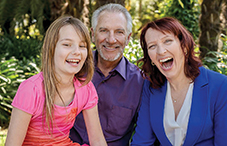

Defying the odds comes naturally to Alette Coble-Temple, PsyD, who at birth was given a 10 percent chance of surviving. As a result of oxygen deprivation during the delivery, she developed cerebral palsy. She has spent most of her life in a wheelchair and has a severe speech impediment.
Despite those obstacles, she became a psychologist — even after a college professor told her that people wouldn't want to open up to someone with a disability. Today she is a professor of clinical psychology at John F. Kennedy University, where she earned her doctorate in 1999, and conducts independent psychological evaluations for the California Department of Corrections and Rehabilitation Board of Parole Hearings on inmates who are scheduled for parole. She is also a mother — her daughter is 11 — though many around her told her that raising a child would be too overwhelming for her.
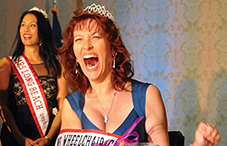
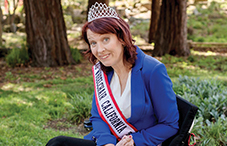
Now, she's in a prime position to empower others to achieve beyond expectations. Earlier this year, Coble-Temple was crowned Ms. Wheelchair California, in a social justice and leadership competition sponsored by the Ms. Wheelchair California Foundation, which selects a statewide spokeswoman for disability concerns based on her advocacy work, personal and professional achievements, and communication skills. Coble-Temple, who will compete for the national title of Ms. Wheelchair America next month, is devoting much of her reign to promoting the parental rights of people with disabilities, who are often discouraged from having or adopting children and denied reproductive health care, and who sometimes even lose custody of their children once they are disabled.
"Her work with children with disabilities and especially young women has already made a significant impact," says Doug Haldeman, PhD, who chairs the clinical psychology department at John F. Kennedy University. "She teaches people that a disability doesn't have to limit you, that you are as big as your dreams."
The Monitor spoke to Coble-Temple about her advocacy work and the ways all psychologists can advance the rights of people with disabilities.
What inspired you to enter the Ms. Wheelchair California competition?
About a year and a half ago, I was attending a conference and APA CEO Dr. Norman Anderson spoke about APA's Leadership Institute for Women in Psychology. He made me realize I was too comfortable in what I was doing professionally, so I decided to apply to the leadership institute [to expand my reach]. I got accepted and decided it was time to go back to one of my passions — disability advocacy. Disability culture, policy and advocacy are often overlooked, so I set a goal to become a spokesperson and mentor for people with disabilities.
I didn't share that goal with my husband immediately. But a few weeks after I got home, he came up to my office and said, ‘I got you an application for Ms. Wheelchair California, and I think you should do this.' I told him, "Absolutely not!" — all I could envision were ‘Toddlers and Tiaras.' But he urged me to take a closer look at the application. That's when I realized it wasn't a beauty pageant, it was a social justice pageant. I asked the university if I could free up the time to do this and I was surprised how everybody encouraged and supported me.
Why are you focusing on parenting?
My platform is called PRIDE — Parental Rights Include Disability Equality. There's been some positive movement on the surface for parents with disabilities. In some states, like California, they have changed the laws so that you can't take a child away solely based on a parent having a disability. Yet some state laws still have that language. And even when the laws change, practices often don't change. Part of my platform is actually directly related to psychology. In most custody cases involving parents with disabilities, the courts rely primarily on psychologists' evaluations. What's scary is that many of those psychologists are not trained on disability, nor are they trained on how to assess parenting and caregiving tasks using adaptive baby-care equipment or other caregiving equipment. So I want to increase that education through this role and through my role on APA's Committee for Women in Psychology, which I just started on this year. One of the projects I want to take on is drafting a resolution related to parents with disabilities in response to a federal report called Rocking the Cradle: Ensuring the Rights of Parents with Disabilities and their Children. One of the report's recommendations is the need to address how psychology providers work with this constituency.
There's also a big social media component to your advocacy work.
Yes, I blog weekly on advocacy issues facing the disability community, such as affordable independent housing. I also try to engage people through Facebook, Twitteropens in new window, Instagramopens in new window, LinkedInopens in new window and a YouTubeopens in new window channel.
It's important for our community to be exposed to positive messages from people who have a significant impediment. I love the quote, "You can't be what you can't see."
And I think that's particularly true for people with disabilities who may want to be parents. If you think about it, you don't see many parents with disabilities. A lot of people with disabilities don't consider parenting as a possibility. Overall, we don't even know how many parents with disabilities there are in the United States who need support. We need to provide education and support for people with disabilities who are parents, grandparents or want to be parents. This is especially important for the Department of Veterans Affairs.
What sort of support do they need the most?
Honestly, a lot of parents with disabilities don't know what they need or even realize adaptive equipment is out there. Much more discussion and action is needed on all this. For example, how many rehabilitation hospitals or independent living agencies even offer workshops that talk about parenting or offer adaptive baby care? There are only a few places, including an agency in Berkeley, California, called Through the Looking Glassopens in new window, that do a nice job of this. They offer a variety of supports, adaptive equipment and a lending library of resources. There are also some agencies on the East Coast, including the Invisible Children's Project in Orange County, New York, and the Positive Parenting Resources Center in Greenfield, Massachusetts.
What else do you get to do as Ms. Wheelchair California?
In my two months as Ms. Wheelchair California, I have already made 10 public appearances, ranging from visiting a Girl Scouts troop, to visiting Capitol Hill in Washington, D.C., and to medical institutions like the Long Beach Veterans Association and Healthcare System. I am trying to make as many appearances as I can and reach a variety of different populations, including those in reproductive health, lawyers and legislators. Everything is interconnected. I approach everything I do from a multidisciplinary perspective.
Of all the paths you could have taken, what made you decide to be a psychologist?
There were two main reasons. First, at age 5, I underwent psychological testing related to a civil suit surrounding the circumstances of my birth. The psychologist who assessed me determined I was "profoundly mentally retarded." My parents said, "This can't be, we know our daughter and she isn't mentally retarded." But if you do inappropriate testing at that age with someone who can't use their hands, you can get false results. That's a story that stuck with me and inspired me.
Second, I was strongly connected to the San Francisco 49ers as a kid. My father was a season ticket holder and at one point I met the owner and we became pen pals. I also became friends with a lot of the players. I would watch how the players were treated when they were injured and it made me mad. They were suddenly disabled and ostracized. So in high school I decided I would become a psychologist and work with athletes. I worked with high school, club, collegiate and professional athletes for five or six years once I earned my masters in sport psychology. After receiving my doctorate I took a turn and got into developmental psychology and forensic psychology, where I provide assessments for the California Parole Board.
What can psychology do to prevent people with disabilities from being ostracized?
Be an asset rather than an obstacle. In general, disability needs to be a priority in research, public interest, practice and science. We also need to gain the [disability] community's trust. There's an overall lack of trust with the disability community because our field hasn't been a true ally to the sociocultural model of disability — it has leaned more to the medical model. Psychology needs to be mindful of that history. There needs to be more research that is culturally sensitive so that people with a disability have a voice. We need to collect data on different disabilities. We need to make sure our doctoral programs are required to teach about disability culture.Programs need to embrace students with disabilities rather than alienate them.
I still hear from psychology students who are told they can't be psychologists if they can't administer the assessment measurement. But all you need to be a psychologist is to understand the elements of a testing measurement — physically administrating the assessment should not be a requirement for graduation. Students are told in the APPIC internship application process that if they mention a disability they are less likely to get matched. Why are we making that recommendation? Why aren't we instead changing how our internship programs view disability?
Did you ever experience any type of discrimination like that?
I had a professor tell me that no one would want to tell me their problems because they will think their problems are less than yours. I have had people ask me how people understand me with my speech impediment. That's part of why I like to work in correctional settings and with kids. These are two populations that understand me the most. The reality is, some clients will terminate therapy because of the client-therapist fit. And that's OK.
What are you most proud of?
My daughter. Being a mom. After I was married, even my in-laws thought having a child would be way too much for us. But I am happy to say that within a few weeks of our adopting Kathryn, they wrote us an apology and said it was the best thing that could have happened to our family. Now Kathryn is an articulate, confident, spunky 11-year-old who stands up for what she believes in and does that in part, I think, from seeing me model that.
Find resources for parents with disabilities in Chapter 14 of the National Council on Disability report Rocking the Cradle: Ensuring the Rights of Parents with Disabilities and their Childrenopens in new window.