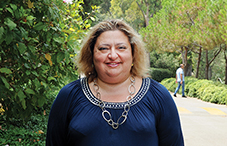

When Lebanese-born psychologist Brigitte Khoury, PhD, attended psychology graduate school in the San Francisco Bay area in the 1990s, many of her friends, colleagues and professors were lesbian, gay, bisexual or transgender (LGBT). While not gay herself, Khoury appreciated how open and proactive they were about their rights — a stark contrast to the climate in her native Lebanon, where homosexuality remains illegal and LGBT citizens are more likely to be closeted and fearful.
Khoury received her doctorate in clinical psychology from Palo Alto University in 1996 and went on to complete her postdoctoral training at Stanford University. When she returned to Lebanon in 1997 to take a position at the American University of Beirut (AUB), she knew she wanted to help LGBT people there flourish as much as their U.S. peers. Among her other responsibilities, she spent the next 18 years working to improve the health and mental health care of LGBT citizens, work she continues today.
"I realized coming back to Lebanon that [the laws] were so unfair to such a large percentage of the population," says Khoury. "LGBT people are a very vital and important part of society. We can't just ignore them" — or worse, shun or imprison them.
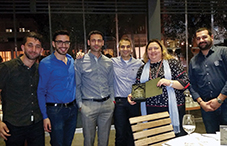
For these long-standing efforts on behalf of Lebanese LGBT people, Khoury won a special, first-time award from the Lebanese Medical Association for Sexual Health, or LebMASH, a nongovernmental agency of health-care providers devoted to improving the sexual health of all Lebanese people and the general health of LGBT people. Called the Leader in LGBT Healthcare Equality Award, it honors the winner's consistent, broad-based efforts to improve care for LGBT people in a way that captures the group's belief in the importance of improving sexual health services for everyone, says LebMASH President Omar Fattal, MD.
"Brigitte saw early on that you cannot be pro human rights and somehow neglect gay rights," Fattal says. "She had this [positive] approach [to LGBT issues] because she had that approach in general. She's not someone who is just pro gay rights — she is pro everybody's rights."
Since Khoury's return to Lebanon, the cultural climate for LGBT people has improved, but there is still a long way to go, she says. LGBT people have their own community and their own places to hang out, but "it's very difficult for them to be open with the general community," she says. In fact, while it doesn't happen often, people can still be arrested just for showing up at a gay night club. "There is a lot of rejection and a lot of religious beliefs that come into play." Khoury strives to improve this situation through research, advocacy, training, teaching and counseling. In 1994, she founded the Lebanese Psychological Association or LPA — no easy feat, since she needed to bring together psychologists of diverse backgrounds, clinical orientations and university affiliations to do so. (APA backed the formation of LPA.)
 Thanks in large part to Khoury's urging, and with encouragement from LebMASH and other advocacy organizations, LPA went on to achieve a major victory for LGBT rights: In response to a television program arguing in favor of reparative therapy, LPA and the Lebanese Psychiatric Society issued a joint statement on homosexuality similar to APA's 1975 policy. The LPA statement, issued in May 2014, explains that homosexuality is not a disease and does not require treatment.
"Brigitte was key to making that happen," says Fattal, who notes the statement has drawn significant international media attention.
On the research front, Khoury directs AUB's Arab Regional Center for Research, Training and Policy Making in Mental Health. The center is working with the World Health Organization as a regional field study center to collect clinical data for the International Classification of Diseases, the ICD-10. One of the projects, on transgender people from the Arab region, will be used to inform the upcoming revision of the document, the ICD-11. Those data also will be used as part of a comparison study on transgender populations in Mexico, Lebanon, India and South Africa.
Khoury is also on the faculty of medicine in AUB's department of psychiatry, where she directs and manages the clinical psychology training program and supervises psychology interns, including on LGBT clinical issues. And she teaches classes in AUB's medical school on psychopathology, sexuality and sexual health, and other mental health topics.
"When I started teaching, I had students ask me, ‘Isn't homosexuality a disease, a psychiatric illness?'" she says. "So really, we started educating them from scratch."
Some students made snide comments about the class content, but others experienced relief, coming to Khoury with their sexual concerns and seeking her out for therapy. As a result, Khoury sees a large number of LGBT clients in her practice, helping them to better accept and understand themselves, gain greater self-esteem, and help to educate their family members about what it means to be gay.
"No one chooses to be gay or lesbian," Khoury explains to parents. "It's your same son or daughter — nothing has changed. The things you like about them are still there."
For Khoury, receiving the LebMASH award is both an honor and an incentive to keep moving forward on this important human and health rights issue.
"The fact that this award was given in Beirut, in Lebanon, has a lot of meaning," she says. "It says, ‘This is a group of people who need health services, who deserve the best health practices we can offer because they're just people like us.'"