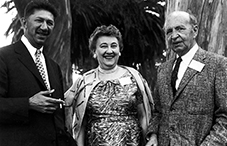

To many American psychologists, Charlotte Bühler is a familiar name. She was one of the leading lights of the humanistic psychology movement in the United States in the 1960s and 1970s. Among her other achievements, she was the president of the American Association for Humanistic Psychology in 1965 and 1966 and president of the First International Conference on Humanistic Psychology in Amsterdam in 1970. She also co-authored a widely used textbook, "Introduction to Humanistic Psychology" (1972).
The name of her husband, Karl Bühler, is less likely to be recognized. However, in Central Europe, he is just as well known as his wife, if not more so. Most of his books from the first half of the 20th century are still in print in Germany and there is a great deal of secondary literature on his work. This situation illustrates the local character that psychology has had for much of its history and still has today. It is not unusual for a psychologist to be influential in one part of the world and virtually unknown elsewhere.
An illustrious career
Karl Bühler came to prominence in the first decade of the 20th century as part of a group of psychologists at the University of Würzburg who pioneered the use of experimental methods to study thought. Bühler's work on this subject led to a controversy with Wilhelm Wundt over the methods of the Würzburg psychologists — and Bühler played a major role in the controversy.
Although he was not a part of the Gestalt school of psychology, Bühler was one of the first psychologists to experiment on Gestalt phenomena. His book, "The Gestalt Perceptions" (1913), predates much of the work of the better-known figures who are associated with this approach.
Bühler went on to publish a treatise on developmental psychology, "The Mental Development of the Child" (1918). The book was widely used in teacher-training institutes and had already reached its sixth edition by 1930. An abridged version, "Outline of the Mental Development of the Child" (1919) had reached its fifth edition by 1929.
His prominence in developmental psychology led to his being appointed director of the Institute of Psychology at the University of Vienna in 1922. Here, he and his wife surrounded themselves with a group of talented colleagues and students, many of whom are well-known in English-speaking countries because of their subsequent emigration to Great Britain and the United States. They included Egon Brunswik, Else Frenkel, Paul Lazarsfeld, Marie Jahoda and Karl Popper.
Bühler's main work of the 1920s was "The Crisis of Psychology" (1927–29). Like many of his contemporaries, he was concerned about the bewildering variety of approaches to psychology that existed at the time and he offered some cogent proposals on how they might be reconciled.
He gave guest lectures at several American universities in 1927 and 1929. He must have impressed his hosts because he was subsequently offered the William James Chair in Psychology at Harvard University, which had been vacant since William McDougall's move to Duke University in 1927. Charlotte Bühler notes with regret in her autobiography that her husband was interested in taking the position but that she persuaded him not to take it. She was happy in Vienna and had no desire to leave.
She regretted this decision because the Bühlers had a very different reception when they arrived in the United States as refugees only a few years later. Neither was able to obtain a permanent position at a major American university. Part of the problem was that refugees had begun to arrive in large numbers following the Nazi rise to power in Germany in 1933. The refugees who began to arrive after the German annexation of Austria in 1938 were relative latecomers and there were few academic positions left. It also did not help that Karl Bühler had become famous for his work on language in the 1930s, a topic that was neglected in American psychology during the years of behaviorist domination. Many people regard the "Theory of Language" (1934) from this period as his greatest work.
Relative obscurity
Bühler spent the years from 1940 to 1945 at a small Catholic college in St. Paul, Minnesota. It was by all accounts an excellent college, but it was not the kind of position that his reputation and standing in Europe deserved. Charlotte Bühler did not fare much better. She spent the latter part of that period as a clinical psychologist at the Minneapolis General Hospital. Frustrated by their lack of success in the academic world, they moved to Los Angeles in 1945 where they became clinical psychologists at different hospitals.
Charlotte Bühler later had a resurgence in her career after she befriended Abraham Maslow and became an enthusiastic advocate of humanistic psychology. But her husband, who was already 60 years old when he arrived in the United States, was less able to adapt. He published little and lived in relative obscurity.
He had not been forgotten in his native Germany, however. When the International Congress of Psychology was held in Bonn in 1960, he was made "honorary president" for the occasion. The German Psychological Society took the opportunity to award him its highest honor, the Wilhelm Wundt Medal, for distinguished contributions to psychology. He returned to Los Angeles, where he died in 1963.
Differential success
New editions of all of Karl Bühler's major works were published in Germany in the 1960s and 1970s. A biography of him to accompany a collection of unpublished manuscripts was also published during that time. In 1984, on the 50th anniversary of his book "Theory of Language," two volumes of essays on his work were published under the title "Bühler Studies." Two international conferences were also held to commemorate the occasion and the papers from these conferences were published as an edited book. Most of his major works are still in print in Germany. For example, a new edition of "The Crisis of Psychology" was published in 2000. This will eventually form part of a new edition of "Collected Works."
The situation is very different in the English-speaking world. The only major work by Bühler that was translated into English during his lifetime is the abridged version of his book on developmental psychology, "Outline of the Mental Development of the Child." Although his "Theory of Language" had a major influence on German-speaking émigrés, including Roman Jakobson, Karl Popper and Heinz Werner, an English translation of the book was not published until 1990 and it never received the kind of attention that it has had in Central Europe. Perhaps most surprising of all, "The Crisis of Psychology" has never been translated into English. Gordon Allport expressed astonishment at this situation when he reviewed the third German edition of the work from 1965. It is particularly surprising as the unity of psychology is still an important topic within theoretical psychology. The Review of General Psychology devoted a special issue to this topic as recently as 2013.
It is widely accepted that immigrants have to adapt to a new culture in their personal lives. What is often overlooked is that émigré psychologists had to adapt to a new culture in their professional lives as well. The differing success of Karl and Charlotte Bühler in the United States shows that some were more able to adapt to this new professional culture than others.
These local differences continue to exist. It might seem surprising that someone can be regarded as a major figure in the history of psychology on one side of the Atlantic and virtually unknown on the other, but this situation is not at all unusual. The only thing that makes Karl Bühler stand out from the others is that he spent the last 23 years of his life in one of the countries where he is virtually unknown.
Adrian C. Brock is an independent scholar based in Manchester, England.