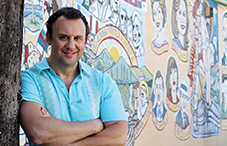

Gregg A. Pizzi, PsyD, has developed a thriving practice in Miami serving Spanish-speaking gay, lesbian and bisexual clients and their families and providing bilingual evaluations for the courts. So when international Spanish-language television network Telemundo asked him to be an expert on a popular "Judge Judy"-style show, his answer was a definitive, "¡Sí!"
The show — called "Caso Cerrado" ("Case Closed") — is one of the network's most popular, boasting some 1.5 million Spanish-speaking viewers in the United States, Latin America and the Caribbean. It features arbitrations based on real-life disputes, with medical, legal and mental health experts providing testimony as they would in a real court case.
"Being the only non-Hispanic in the studio was both humbling and empowering," says Pizzi, who was born in the United States and is bilingual.
Issues raised on the show centered mainly on how to address traditional Latino values in the context of family relationships and changing cultural mores. Pizzi's on-air assessments have included the need for family members to create better psychological and emotional boundaries and to learn to accept and respect all family members for who they are, including those who are LGBT.
"For Hispanics, family unity is given a lot more priority than it is in American culture," Pizzi explains. "So when an issue of racial or sexual diversity arises, the first thing that should be considered is how the family will be affected. Balancing that with the individual's need for self-expression is a little like walking a tightrope."
Pizzi is originally from Northvale, New Jersey, a New York City commuter town without a large Hispanic community. But as a kid, he developed a close friendship with a Cuban family who lived nearby, and he became fascinated by Hispanic pop culture.
His interest in all things Hispanic remained strong during high school, college and into graduate school at Yeshiva University, which he attended from 1993 to 1998. So when it came time to do his internship, his first match choice was a small psychiatric hospital outside Miami. He was accepted, loved it and stayed to complete his postdoctoral residency and create a private practice there. In 2002, he moved to Michigan to live with his partner and to receive training as a forensic psychologist at the state's Center for Forensic Psychiatry.
When he moved back to Miami in 2010 to re-establish his practice there, he felt he had come home again.
"This is my hub," says Pizzi. "I realized how much I missed speaking Spanish every day, drinking Cuban coffee in the afternoons, and walking around in shorts most of the time."
Pizzi, who came out as gay while he was at Yeshiva, has made it a point to obtain extra training in bicultural, LGBT and relationship issues, his central areas of practice. He's done externships at New York University and Columbia University, and is a board-certified sex therapist in Florida.
Being on "Caso Cerrado" gave him the opportunity to share his expertise on a wide scale, says Pizzi, who taped about a dozen episodes. He appreciated the chance to provide broad-based psychoeducation to people who probably wouldn't have gotten it otherwise, including on LGBT relationship and family issues.
"The message I tried to get across was that regardless of each family member's differences, all people need to feel loved and cared for," says Pizzi. "Whether the family has a single parent, two moms or two dads, the most important ingredient for a child's happiness is love."
His presence on "Caso Cerrado" also gained him a bit of a following. Once the shows began airing, "I immediately started getting emails and Facebook messages from people throughout the United States and Latin America," he says. Much of the contact was from young people in the LGBT community, thanking him for his psychological counsel and telling him they admired his role as a successful gay professional who devotes his practice to helping improve the mental health of LGBT people and their families.
Pizzi's clinical and media work share a common purpose: helping a warm, family-oriented culture come to grips with cultural changes and begin to reconcile the old, the new and the formerly forbidden, he adds.
"If we Americans think we have pressure dealing with these kinds of issues, [this population] really has pressure," he says. "It's like I'm giving them a preview of what is to come in their culture, but maybe 25 years ahead of time."
— Tori DeAngelis