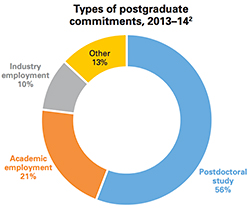
 Among recent graduates with research doctorates in psychology,1 53 percent had definite commitments for employment or postdoctoral study at the time they applied for graduation and 47 percent did not have definite plans.
For those with definite commitments, 56 percent intended to take a postdoctoral study position. The remaining 44 percent indicated academic or industry employment, or other commitments.2
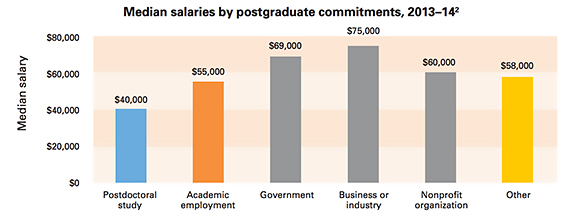
Median salaries were lowest for those entering postdoctoral study positions, and highest for those entering industry employment (business or industry, government and nonprofit organization).
— Luona Lin, MPP, Karen Stamm, PhD, and Peggy Christidis, PhD
For more information, contact APA's Center for Workforce Studies.
1 National Science Foundation, National Center for Science and Engineering Statistics. (2015). Doctorate recipients from U.S. universities: 2014. Special Report NSF 16-300. Arlington, VA. Survey of Earned Doctorates. Retrieved from www.nsf.gov/statistics/2016/nsf16300/data-tables.cfm. This report is based on 3,765 individuals who received research doctorates in psychology from U.S. institutions in the 2013-14 academic year, and does not include those with definite postgraduate commitments located outside the U.S. (approximately 3 percent of all psychology research doctorate recipients). A research doctorate requires the completion of a dissertation or equivalent project and is not primarily intended for the practice of a profession.
2 Academic employment refers to employment in 4-year colleges or universities, medical schools, university-affiliated research institutes, or other educational institutions. Industry employment refers to employment in non-educational institutions in government, business or industry (for profit), or nonprofit organizations.