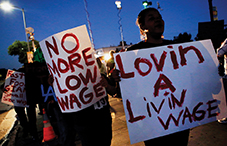

Imagine working 40 hours per week, every single week of the year, and not making enough money to provide your family with essentials such as food, shelter and transportation. According to a report by the Pew Research Center, more than 1.5 million hourly workers in the United States earn the federal minimum wage of $7.25 per hour. More than three-quarters of them are over age 20 (Pew Research Centeropens in new window, 2014). A full-time worker making the federal minimum wage earns $15,080 per year — an annual income that sits below the federal poverty level of $16,020 for a family of two.
That's a hardship for the families living on such meager incomes. But it should also be of concern to the field of psychology, says Laura Smith, PhD, of Teachers College, Columbia University. She recently published a call to arms for her field, making the case that minimum wage reform deserves more attention from the psychological community ( American Psychologist opens in new window, 2015).
"Psychologists broadly are concerned with human well-being. From that point of view, it has always been natural for psychologists to address not just psychopathological conditions, but also psychosocial circumstances that compromise mental health," she says. "Furthermore, most people can agree that somebody who works full time shouldn't be on the way to the homeless shelter."
Poverty harms
A large and robust body of evidence links poverty to poor psychological outcomes. According to data from the National Institute of Mental Health, low-income individuals are two to five times more likely to suffer from a diagnosable mental disorder than those of the highest socioeconomic group. Poverty's effects on children are also particularly significant — and long lasting. Poor children are at a greater risk for problems including lower IQ, poor academic achievement, poor socioemotional functioning, developmental delays and behavioral problems.
"It's been clear for decades that poverty is harmful to people's well-being," Smith says.
Nevertheless, poverty remains prevalent in the United States. According to figures from the U.S. Census Bureau, 46.7 million Americans — 14.8 percent — were living in poverty in 2014. For children under 18, the rate was 21.1 percent.
That situation is not the norm in most other industrialized nations. As Smith cites in her article, an analysis by economist Timothy Smeeding, PhD, and colleagues found that while the United States had the second-highest overall income level of the world's 19 wealthiest nations, it also had the third-highest percentage of citizens living in poverty ( Center for Policy Research opens in new window, 2001).
When it comes to the complex factors that create and perpetuate poverty, minimum wage is only one piece of the puzzle. Still, Smith says, "minimum wage reform seems like such an obvious place to start."
Research has demonstrated that increasing incomes can improve mental health outcomes for people in poverty. Some evidence comes from a natural experiment that occurred in the 1990s, when a tribe of Cherokee Indians in North Carolina opened a casino and began distributing a share of the profits to all of its members.
Jane Costello, PhD, at Duke University, had already been following a sample of those families when the royalty checks started coming in. Poor children in her study population had more psychiatric problems than those who had never been poor. But among families who moved out of poverty after receiving the casino stipends, the rate of children's psychiatric problems fell to the same level as those who had never been poor ( JAMA opens in new window, 2003).
Lisa Strohschein, PhD, at the University of Alberta, saw a similar pattern when she analyzed data from the U.S. Department of Labor's National Longitudinal Study of Youth. Initially, children in families with household poverty experienced higher levels of depression and antisocial behavior. But the incidence of those issues declined in families whose incomes rose during the study period ( Journal of Health and Social Behavior opens in new window, 2005).
More recently, graduate student Katharine Burmaster, at the University of California, Berkeley, and colleagues showed that interventions to raise wages could have a direct effect on mental health. They took advantage of a natural experiment in the Dominican Republic, where workers in one factory began receiving a "living wage" that raised their income above the poverty line, while workers in another continued to earn the standard wage. A little more than a year after the wage increase, researchers found 23 percent of workers in the living-wage factory had depressive symptoms, compared with 40 percent in the standard factory — a reduction in risk of 47 percent ( BMJ Open opens in new window, 2015).
Psychology's role
The link between poverty and diminished emotional and physical well-being seems clear. But does that mean psychologists should be more active in efforts to reform policies aimed at fighting poverty and increasing the minimum wage?
"Given the power of socioeconomic status and income to affect mental health and overall health — absolutely," says Nancy Adler, PhD, who directs the Center for Health and Community at the University of California San Francisco School of Medicine.
It wouldn't be the first time that the field of psychology has thrown its weight behind important social issues. As Smith noted in her article, psychology played an important role in advancing policies that promoted racial justice and prohibited discrimination based on sexual orientation.
"At the time, those issues didn't seem to everyone like such obvious banners for psychology to wave," she says. "I'm hoping to point out to psychologists that we have something to contribute to the national dialogue on minimum wage reform as well."
While APA does not have an official policy statement on minimum wage policy reform, it does take seriously the issue of poverty, says Gabriel Twose, PhD, senior legislative and federal affairs officer. In 2000, the association adopted a resolution on poverty and socioeconomic status that advocates for more research on a range of issues related to the causes and impacts of poverty. The resolution also commits APA to support public policies that improve the lives of people in poverty, including encouraging access to education and training that would allow individuals to qualify for jobs that pay a sufficient wage to support their households.
In 2012, the association submitted a letter to the U.S. Senate in support of the Raise the Wage Act (S. 1150), which would gradually raise the federal minimum wage to $12 per hour.
Some four years later, that legislation has gone nowhere. But change is beginning to happen, city by city, across the nation. More than half of states, as well as Washington, D.C., have enacted minimum wages higher than the federal hourly wage of $7.25. In 2015 alone, 14 jurisdictions approved $15 minimum wage laws. Those laws are predicted to benefit more than a million workers, including home health-care workers in Massachusetts, fast-food workers in New York state and city workers in Pittsburgh.
Smith is optimistic about the outcomes in places that have already boosted wages. One argument against raising wages is that paying workers more would upset local economies. Yet a recent meta-analysis by economist John Schmitt, PhD, at the Center for Economic Policy and Research, found that modest increases in the minimum wage have little to no effect on employment. Any job losses, he reports, tend to be offset by factors including improved productivity, reduced training costs and reduced employee turnover (Center for Economic Policy and Researchopens in new window, 2013).
"The early results are suggesting that not only has minimum wage reform not hurt the economy in those cities, it may actually be helping," says Smith.
Next steps
What's needed now, Adler suggests, is more research to fully explore whether and how those natural experiments in wage reform are improving outcomes for workers and families in those cities. "We need better research to look at the mental health impacts," she says.
Yet while more data are always welcome, Smith adds that it's also time psychologists moved their expertise beyond the research lab and into public discourse. "I think that sometimes we need to become spokespeople with regard to what our research currently shows. In addition to doing another study, we need to be in the business of helping to promote that knowledge."
Deborah Belle, EdD, a professor of psychology who studies poverty and mental health at Boston University, agrees with Smith. She suggests speaking out to the public, writing to legislators, getting involved in civic organizations and advocating for policies at the local level. Psychologists can also get involved with APA's Psychology Action Networkopens in new window, which delivers federal updates and action alerts to help individuals become effective advocates for psychology. "We do have some movements in this country that are heading in the right direction," says Belle. "I think we should climb onboard and discuss ways our research supports these efforts."
Psychology is about helping people, Belle says, and she believes influencing policy is the most effective way to do so. "To provide clinical services for even a fraction of people in poverty is a monumental undertaking. The far more efficient and cost-effective way to improve mental health is through mechanisms like laws to raise wages," she says. "We need to see it as part of our central mission."