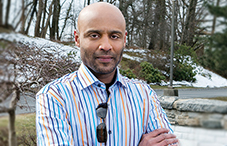

What do you do at Mercy College?
My primary title is professor of psychology and behavioral sciences, but by training I am an epidemiologist, statistician and mental health counselor. Epidemiology is largely a quantitative public health discipline that uses principles of statistics and research methods, and I incorporate epidemiology into the courses I teach. For example, I may use data about HIV infection and show the percent distribution across different ethnic groups. Then I explain how these data might influence which interventions would be appropriate.
My background in epidemiology and evidence-based practice also came in handy when I served as a collaborating investigator with the American Psychiatric Association for the DSM-5 Field Trials in Routine Clinical Practice. The goal was to evaluate the usefulness, reliability and validity of criteria proposed for various mental disorders.
One of the most exciting developments in my career has been my involvement with the media in addressing the Ebola virus disease epidemic. When the epidemic began, the media was rushing to find people to help explain it to the public. I accepted the challenge to educate people about the level of risk to Americans and the behavioral and other factors propelling the spread of the disease in West Africa.
How do you use your psychology training in your job?
My training was interdisciplinary, and one of the recurring themes was the biopsychosocial model of disease. Understanding this has been critical in my job. If we are going to make effective assessments, we need to recognize that there are biological, psychological and social factors influencing disease. For example, we had to educate people about the strong psychosocial factor driving the spread of the Ebola virus — a deeply engrained religious burial ritual that involved touching the deceased.
I also applied my training in health education. I had to understand the psychosocial predisposition of my audience. Many people were terrified by the images and stories in the media, so I broke down information into small bits that could be easily understood and alleviate panic. For example, I was frequently quoted as saying "Ebola is deadly but hard to catch," which concisely communicated the fact that the risk of contracting the virus was low in the United States.
Where did you get the training and experience needed to get this job?
My primary training started with a master of public health degree from The University of the West Indies in Jamaica. I had an emphasis in epidemiology and health education. During a practicum, I visited a university health center to educate patients about reducing their risk of HIV infection, and I loved teaching these patients so much that I knew I wanted to pursue a career in education. I earned a PhD in international health, with a concentration in research and education, from Touro University International in the United States. My doctoral dissertation research encompassed psychometrics and the teaching of statistics in the health and behavioral sciences in support of evidence-based practice.
How did you find out about the job?
I saw a posting to teach statistics in the psychology and behavioral sciences department at Mercy College. I knew I would love the opportunity to do that, but I was skeptical I would be given a chance if I applied because my background was in epidemiology, a field that is not readily understood. To my surprise, I was called in for an interview and the chair of the department knew a lot about epidemiology. She told me they even offered a course in it, which was interesting to me because there were very few places that offered an epidemiology course for psychology and behavioral sciences. I immediately felt at home.
What is challenging or difficult about your job?
I would say that working with the media on the Ebola issue has been challenging. The news cycle moves fast and you have to be ready on short notice to provide meaningful commentary on complex issues. I remember receiving a phone call from an outlet that wanted me to address a study that had just been published 30 minutes earlier about possible mutation of the virus. In a short period of time I had to find the study, read it, get a comprehensive understanding of the issues, and then be able to address the public. It can be a nerve-wracking experience to be on television and be viewed as the expert. All things considered, it was a wonderful experience to be involved in responding to the epidemic, and I continue to get interview requests.
What do you enjoy most about it?
I love the teaching aspect of my work. I particularly enjoy seeing students come to understand difficult concepts and experience that "aha" moment. My epidemiology background has allowed me to make my courses — especially statistics — more applied, so I really use a concept-based approach over mathematical procedures. Math is about numbers, and statistics is about numbers in context. It is about application and interpretation, and that is what I really like. I'm passionate about encouraging other educators to use this concept-based approach. It's thrilling to not only see students learning during a course, but also hear years later how they have applied their learning to their work. I see a lot of students moving into behavioral epidemiology.
Is there anything else readers should know?
I would like to send a message that there is much in common between epidemiology and psychology, and these two disciplines need each other. There is work being done in these two areas, but it tends to be done in silos. Epidemiological methods are necessary for determining risk factors for disease and understanding psychopathology. We need more of a bridge between the disciplines to collaborate.
—Heather Stringer