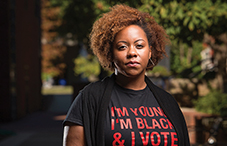

Hundreds of students and psychologists gathered at APA's 2016 Annual Convention in Denver for a march in solidarity with the Black Lives Matter movement. Their goal was to bring attention to racial discrimination and the police shootings of African-Americans and to encourage psychologists and APA to support the Black Lives Matter movement.
"We sincerely feel that while APA has done some great things to support research, programs and outreach that draw attention to discrimination, stress and police brutality, more can and still needs to be done," said a mission statement from the organizers, who are psychology graduate students at Arizona State University and the University of Kentucky.
Also at APA's convention, student activists held workshops and panels to discuss the movement and to plan future events. Students from the group Eradicate #BostonCollegeRacism, for example, presented a toolkit they developed to help those on other campuses start their own anti-racism groups (see the November 2015 gradPSYCH for more on Eradicate #BostonCollegeRacism).
The march and convention programming were among the most recent examples of how graduate students are leading support for the Black Lives Matter movement in psychology and on campuses. Earlier this year, on the anniversary of Martin Luther King Jr.'s assassination, psychology graduate students at 20 schools across the country staged die-in protests coordinated around the Twitter hashtag #psychologists4blacklives. At each event, they lay down in public places—university quads, libraries and dining halls and on city hall steps—for 16 minutes, one minute for each bullet that hit Chicago teen Laquan MacDonald, killed by a police officer in 2014.
In Chicago, more than 50 students protested in front of City Hall.
"It was a very emotional experience," says Kia Watkins, a graduate student at the Adler School of Professional Psychology who participated in the event. "It was a cold day. It started raining. Not all of the reaction we got [from passersby] was positive. But we reminded ourselves of the bigger picture and what it meant."
At the convention, the #psychologists4blacklives leaders discussed expanding a die-in protest to more schools next year.
"I believe social justice and advocating for our clients outside of the therapy room is a very logical and natural progression from the APA ethical requirement of advocating for our clients within therapy," says organizer Luciano Lima, a doctoral student at the Illinois School of Professional Psychology in Chicago. "We don't want to just heal the wounds of the patients we're seeing, but also help prevent the wounds from happening in the first place."
Read about Della Mosley's efforts at www.apa.org/gradpsych/2015/11/social-change.