In 2013, there were 2.5 million people in the labor force with psychology as their highest degree:
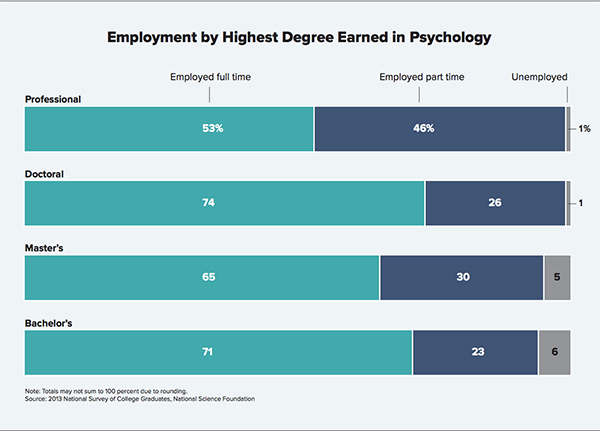
1.4 million had a bachelor's, 456,000 had a master's, 140,000 had a doctoral and 45,000 had a professional degree in psychology.1 Most of these people were employed full time.2 Those with the highest degrees had the highest rate of employment—about 99 percent of psychology doctorates or professional degree holders in the labor force were employed on a full- or part-time basis.3
By Peggy Christidis, PhD, Luona Lin, MPP, and Karen Stamm, PhD
For more information, contact cws@apa.org.
1National Science Foundation, National Center for Science and Engineering Statistics. (2013). National Survey of College Graduates Public Use Microdata File and Codebook. Retrieved from https://sestat.nsf.gov/datadownloadopens in new window. Although PhDs and PsyDs are both doctoral-level degrees, the National Science Foundation codes psychology PhDs as "doctorates" and PsyDs as "professional degrees."
2"Full-time employment" includes individuals who worked at least 35 hours per week in their principal jobs (jobs they worked the most hours) in a typical week.
3"Part-time employment" includes individuals who worked less than 35 hours per week in their principle jobs in a typical week. "Unemployed" includes those who were not employed but were seeking employment.