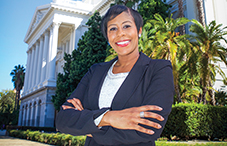

"Sometimes it feels like I do group therapy with lobbyists and stakeholders," says Le Ondra Clark Harvey, PhD, of her job as chief consultant for the California State Assembly's Committee on Business and Professions. "I bring together opposing sides on what are often controversial issues, and I try to get them to come to a middle ground."
Harvey, who has been in the job since 2015, spoke with the Monitor about her typical duties and the psychological expertise that helped her secure the position.
What do you do at the state Assembly?
I lead a team of consultants who analyze any bills the Legislature may be considering that could affect businesses and professionals. We research the merits and fiscal ramifications of the bill and the history of the profession that will be affected. We also talk to proponents and opponents of the legislation and try to create amendments that can bring opposing sides together.
We see about 130 bills per year, which can cover everything from creating a medical marijuana bureau to starting a loan-repayment program for dentists. Recently, legislators drafted a bill that would allow psychology students on practicum to provide services to minors without direct supervision in certain situations. I worked with different groups to create a bill that would lift certain restrictions while at the same time ensure the protection of the client.
Once we finish analyzing a bill, we share the analysis with the committee chair, provide him with a recommendation and hear his vote recommendation for the bill. Then the chair and the other committee members hear testimony and vote. If the bill gets a majority, then it typically goes to the entire Assembly floor for another vote.
How do you use your psychology training in your job?
The work involves a lot of mediation. It's similar to the work I did in community health centers where I did group and family therapy. I help people think in a different way about issues and walk out of the room respecting each other even if they do not agree.
My graduate training also taught me critical and analytical thinking skills, which help me analyze research data related to bills. I know how to assess whether it's reliable data.
What led you to a job focused on policy and politics?
Throughout graduate school, I worked at a community mental health center where I served disenfranchised populations. Sometimes people couldn't get to their appointments because they had no money for transportation. Others couldn't afford to keep their kids in school. It was difficult to focus on the trauma therapy I was providing because their basic needs were not being met. I wanted to work on the laws and policies that were keeping me from being the best practitioner possible.
I saw how that could happen when I participated in the Minority Fellowship Programopens in new window in Washington, D.C. I met with a legislator who opened my eyes to the fact that if I voiced the challenges my clients were facing, I could influence the decisions legislators were making.
Later, I accepted an internship as a social justice fellow at the Center for Policy Analysis on Trade and Health in San Francisco, and I started to better understand the legislative process. In 2011, I decided to take a fellowship at the California State Capitol, which I thought would be a temporary position. Four months into my placement, I was offered a full-time job as a consultant for the Senate Committee on Business, Professions and Economic Development. I got my current job in 2015.
What makes you stand out in your job?
Many people who work in the Capitol are political science majors who came here as interns directly after undergraduate school. There are not many paths to get a job here, so we get a lot of people who tend to think similarly. I had outside experiences in graduate school doing research, working in a community health center and being involved as a leader in APA and the Association of Black Psychologists. These experiences helped shape the lens that I examine policy through.
There are approximately 30 standing committees in the Legislature, and though things are slowly changing, most of the chief consultants do not proportionately reflect the diversity of California.
I'm the youngest, first woman and first African-American to work as the chief consultant for the Assembly Committee on Business and Professions.
What is challenging about your job?
Delivering bad news is often a tough part of my job. Sometimes, I have to go back to the author or sponsor of a bill and share that the chair wants to amend it significantly or will be voting against the bill. Sometimes, people are very angry and may try other tactics to get the bill approved. There have been times when I made a recommendation to the chair, and he or she agreed with me, but due to the politics of the situation, the chair changed his or her mind. I never take this personally; it is part of the legislative process.
Can you describe a work experience that was particularly meaningful for you?
One time there was a bill that would have mandated that psychologists take continuing education on suicide prevention. The bill was a reaction to media attention focused on college students who had committed homicides and then suicide. I pointed out that perhaps the problem was not lack of training among mental health providers. Instead, other people who were interacting with these men needed the training, such as physicians or residential assistants in college dormitories. The bill passed through the legislative process, but in the end the governor wrote a veto message that referenced arguments raised in my analysis of the bill.
Anything else readers should know?
I encourage students and psychologists to think broadly about their training. The skills we learn prepare us to do work in all kinds of fields. I believe that we limit ourselves by believing that our training is primarily useful for jobs as scientists or practitioners, but we can use our training to affect change in the world in many ways.
Learn more "How Did You Get That Job?" is a regular feature of the Monitor on Psychology.