

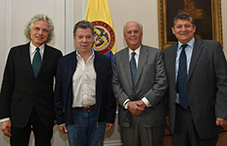

Thanks to the power of international collegiality, two U.S. psychologists had a unique opportunity in 2015 to share psychological insights pertaining to the Colombian peace process with President Juan Manuel Santos and his staff. (Santos received the 2016 Nobel Peace prize for his efforts at forging the peace.)
During a visit to the country that year, David H. Barlow, PhD, of Boston University, and Steven A. Pinker, PhD, of Harvard University—both of whom have ties with colleagues at the University of Los Andes in Bogota, Colombia—were invited to share information and ideas from their respective areas of clinical and political psychology in a one-hour meeting with the Colombian leader. Barlow talked about ways that evidence-based psychological protocols could be adapted and disseminated to help people recover from war trauma—work that Colombian psychologists are beginning to implement at a new Center for Emotional Health at the University of Los Andes (see main article). Pinker—well-known for his work demonstrating that the world-wide incidence of war and violence has declined since 1945—shared strategies shown to be effective in achieving peace in high-conflict areas. In particular, he discussed findings that peacemaking often requires people to compromise on their desire for vengeance—a notion that Santos later advocated for and that eventually helped cement parliament's approval for the peace plan.
"I did not give him the idea, or change his mind," says Pinker, "but I did emphasize that there was a literature from psychology and political science behind his strategy."—Tori DeAngelis