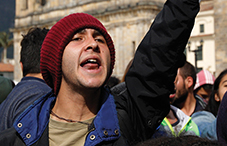

When the government of Colombia and the rebel group known as the Revolutionary Armed Forces of Colombia (FARC) finally reached a peace accord in November, it signaled the official end to a 52-year conflict—the world's longest-running civil war. The five-decade war was marked by widespread violence toward citizens, political tumult and the displacement of 6 million people—roughly an eighth of the country's population. But the end of the war is just the beginning of what promises to be a long road ahead: the healing and reintegration that Colombia needs to survive and thrive as a nation.
The war was the result of numerous groups—left-wing guerrilla groups, most notably the FARC, as well as paramilitary groups and crime syndicates—fighting for territory and political influence. A particularly sought-after prize was land used to grow coca, the principle ingredient in cocaine and a major income source for various factions. A peace deal that was in the works for nearly five years almost collapsed in October, but eventually passed in November. The conflict has claimed at least 220,000 lives since 1958, according to a Colombian government commission.
Not surprisingly, Colombians' mental health has been an enormous casualty of the war, with depression, anxiety and trauma reactions at levels that aren't yet completely determined but are likely extremely high, says Leonidas Castro-Camacho, PhD, professor of clinical psychology at the University of Los Andes, one of the country's premier research institutes. Yet, he says, few psychologists or other mental health professionals are adequately trained to treat the nation's high rates of anxiety, depression, fear and trauma—all of which are exacerbated by social tensions, like those created by resettling victims and former combatants in the same underserved areas of major cities.
"The situation resembles that of the United States following World War II, when thousands of veterans were returning from the war, many with post-traumatic stress disorder, and there weren't nearly enough qualified professionals to treat them," Castro-Camacho says.
This major gap is now attracting talented psychologists and other researchers to fill it. One new effort is the creation of the Center for Emotional Health (Centro de Salud Emocional), a research, training and implementation-dissemination center at the University of Los Andes that started as a collaboration between Castro-Camacho, Fabio Idrobo, PhD, also of the University of Los Andes, and renowned U.S. psychologist David H. Barlow, PhD, founder of the Center for Anxiety and Related Disorders at Boston University. The center will act as a sister organization to the Boston center, and will focus on evidence-based practices to treat the range of anxiety, depression, trauma and other mental health conditions triggered by conflict.
"Many victims of the war don't have just one mental health problem, they have a diversity of emotional problems," Castro-Camacho says. He is currently conducting a randomized clinical trial with 100 participants who are victims of armed conflict, testing a cultural adaptation of Barlow's unified protocol for transdiagnostic treatment of emotional disorders. The protocol uses cognitive-behavioral techniques to treat co-morbid conditions with common psychological and emotional roots—depression, anxiety and PTSD, for instance—by targeting underlying aspects of temperament such as neuroticism. Partway into the study, participants are showing reduced anxiety and depression, as well as more positive affect, Castro-Camacho is finding.
As the center ramps up, it will also adapt, test and disseminate other protocols that have shown evidence of success in other war-torn countries, says Idrobo, who is the center's science director.
In a related vein, a task force of the Colombian College of Psychologists—the country's equivalent of APA—is assisting Colombia's Ministry of Health in setting the standards of core competencies for psychologists who work in war-affected settings. The competencies pinpoint the specific training psychologists need in such areas as identifying the psychological and social problems of war victims, evaluating and diagnosing clients, and designing and implementing evidence-based programs to help them. "This is an opportunity to develop the skills that psychologists need to really contribute to the needs of the country," Castro-Camacho says.
Studying what works
Other researchers are also testing protocols to help war-affected citizens. One such intervention is the common elements treatment approach, or CETA, developed by researchers at Johns Hopkins University's Bloomberg School of Public Health to help people who have experienced violent trauma. It's similar to Barlow's transdiagnostic protocol, but is geared specifically for use by lay providers in low- and middle-income countries. Another is narrative community group therapy, a community-based approach designed by researchers at the CISALVA Institute at the University of Valle under the direction of Maria I. Gutierrez-Martinez, MD, PhD, that encourages participants to propose problems they'd like to solve with the help of the group. Both interventions were tested separately in two cities heavily affected by the war—Buenaventura and Quibdo, on Colombia's west coast. The researchers' results were then compared with a control group on a wait list.
Project data show that each approach has different strengths. In both cities, participants who received CETA had reductions in depression, anxiety and trauma symptoms at the end of 12 weeks, while those in the narrative group intervention showed minor changes in mental health but significant improvements in daily functioning, such as caring for themselves and their children. In addition, outcomes were different in each of the two cities, suggesting that interventions need to be specifically tailored for conditions in particular areas, says one of the researchers, Francisco Javier Bonilla-Escobar, MD, who notes the team is now writing up the project.
In another project, University of Los Andes economists Andres Moya, PhD, and Arturo Harker, PhD, are testing an intervention aimed at helping mothers develop stronger bonds with their young children. That's important, Moya says, because research shows that the more traumatic events people experience during early childhood, the worse outcomes they have later in life, but that healthy attachments can mitigate such effects.
In war-affected Colombia, mothers have difficulty attaching with their children because they themselves are so traumatized. "We have 800,000 children age 5 and under who are officially catalogued as victims," Moya says. "So, it's a time bomb."
To help this population, the team sought input from Alicia Lieberman, PhD, who heads the Child-Trauma Research Program at the University of California, San Francisco. Together, the U.S. and Colombian researchers adapted a group intervention developed by Lieberman that integrates trauma and attachment theories and cognitive-behavioral intervention strategies. They tested it with 75 displaced mother-child pairs, randomizing half to the protocol and half to a control group. In addition to helping mothers connect better with their children, the 13-week intervention provided tools to help the mothers address their own trauma, such as mindfulness and breathing techniques.
The preliminary results are encouraging. "We found a significant reduction in symptoms of psychological trauma both in moms and their children," says Moya. In addition, the relationships between the mothers and children are improving. "Moms are playing with their kids more, looking at them more in the eyes, taking them to the park more often, and so on," says Moya. The team eventually wants to test and implement the intervention in 30 sites around the country, he adds.
If these kinds of tailored, evidence-based practices help citizens recover from war-related trauma, Idrobo hopes the research will eventually contribute to the overall well-being of Colombians—not just to war-related symptoms. "Over time, I'd like our center to address the psychological effects of climate change, gender violence and other issues affecting our population—to plan for the future," he says.
Learn more about psychologists' work on the world stage from APA's International Affairs Office at www.apa.org/international and APA's Div. 52 (International) at https://div52.orgopens in new window .