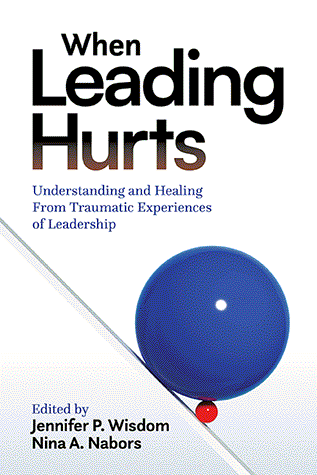
When Leading Hurts
When Leading Hurts shines a light on a hidden truth: leadership can inspire and transform, but it can also wound.
This groundbreaking volume explores the emotional and psychological toll that leadership roles can take, revealing how trauma sometimes emerges in organizational contexts and why it is so often ignored.
Drawing on interdisciplinary research and compelling case studies, experts in psychology, leadership development, and organizational behavior identify the forces that leave leaders feeling isolated, undermined, and sometimes deeply harmed. Topics include toxic cultures, identity-based harm, bullying, scapegoating, and gaslighting-issues leaders frequently endure but rarely discuss. Readers will find evidence-based strategies for prevention and healing, including clinical guidance for therapists, coaching models, and organizational interventions for systemic change.
Designed for leaders at every level and the professionals who support them, When Leading Hurts provides insight, validation, and a roadmap toward resilience, recovery, and reform.
- Chapter 1. Introduction to Trauma in Leadership: Sources, Mechanisms, and Impacts
Jennifer P. Wisdom and Nina A. Nabors
Part I. Sources and Impacts
- Chapter 2. Relational Sources of Workplace Trauma for Leaders
Nina A. Nabors, Kelley Costner, and Qiana Wells-Haridat - Chapter 3. Organizational Forces Contributing to Traumatic Experiences of Leadership
Cynthia Drake Morrow and Jennifer P. Wisdom - Chapter 4. The Impact of Childhood Adversity on Traumatic Experiences of Leadership
Brenda Huber - Chapter 5. Marginalized Identities and Institutional Trauma in Leadership
Nina A. Nabors - Chapter 6. Gender and Traumatic Experiences of Leadership
Jennifer P. Wisdom and Candice G. Nelson - Chapter 7. Intersectionality and Traumatic Experiences of Black Women Leaders in Higher Education
Savitri Dixon-Saxon - Chapter 8. The Impacts of Negative Leadership from a Motivational Perspective
Christina M. Frederick and Mary Coussons-Read - Chapter 9. Sources and Effects of Traumatic Experiences of Leadership Among Women
Kristina Hallett - Chapter 10. The Burden of Command: Navigating Psychological Stress and Institutional Betrayal in Law Enforcement Leadership
Tamara S. Lyn - Chapter 11. How Traumatic Experiences of Leadership Impact Religious and Spiritual Women in Academia
Rochelle Gilbert
Part II. Interventions
- Chapter 12. Coaching Approaches to Healing Traumatic Experiences of Leadership
Shari Dade and Chamarlyn Fairley - Chapter 13. Therapeutic Approaches to Healing Traumatic Experiences of Leadership
Alina Perez - Chapter 14. Trauma-Informed Organizations: Culture, Practices, and Leadership
Catherine T. Kwantes and Perpetual Ankamah - Chapter 15. Future Directions in Understanding, Preventing, and Healing Traumatic Experiences of Leadership
Nina A. Nabors and Jennifer P. Wisdom
Jennifer P. Wisdom, PhD, MPH, ABPP, is a licensed clinical psychologist, board-certified organizational and business consulting psychologist, author, consultant, and speaker. She has worked in complex healthcare, government, and educational environments for 25 years, including serving in the U.S. military, working with nonprofit service delivery programs, and as faculty in higher education. She consults with nonprofit and government agencies, research institutions, and universities to address leadership development and organizational change. She is author of 14 volumes in the Millennials' Guides series, Leaving Revolution: How We Are Learning to Let Go and Move On, and more than 100 scientific articles.
Nina A. Nabors, PhD, ABPP, LP, is a licensed clinical psychologist with more than 30 years of faculty and leadership experience in academia. She currently serves as Vice Provost for Healthcare Access and Quality at Walden University. She co-owns a group psychotherapy practice in Southeastern Michigan working primarily with clients from BIPOC, LGBTQAI+, and other underserved communities. She is board certified in rehabilitation psychology from the American Board of Professional Psychology and past president of the Association for Women in Psychology. She has published five book chapters, 15 peer-reviewed scientific articles, and over 65 conference presentations.
There are countless books about employees who leave toxic workplaces, but almost none about the trauma that leaders themselves carry. This book fills that gap with rare clarity, grounding its argument in the actual diagnostic meaning of trauma. I want every MBA, I/O psychologist, HR leader, coach, and consultant responsible for leadership development programming to read this to better understand such trauma and better help leaders navigate these experiences.
—Mira Brancu, PhD, PCC, consulting psychologist, founder, Towerscope; Duke University School of Medicine faculty, Durham, NC, United States; and Fellow of the American Psychological Association
This engaging book is an excellent resource for leaders and those responsible for leadership education and development. The contributors offer case studies, consider DEI and intersectionality, and deal comprehensively with the mainly ignored phenomena of traumatic leadership experiences—explaining what they are, why they happen, and what to do. You will develop new insights, understand leadership and organizations differently, and be better prepared to support and “do” leadership.
—Sharon Mavin, PhD, Professor of Leadership & Organization Studies, Newcastle University Business School, Newcastle upon Tyne, United Kingdom; author of “No One Deserves Professional Annihilation: Learning From Women’s Experiences of Leadership Work-Caused Trauma” in the journal Management Learning