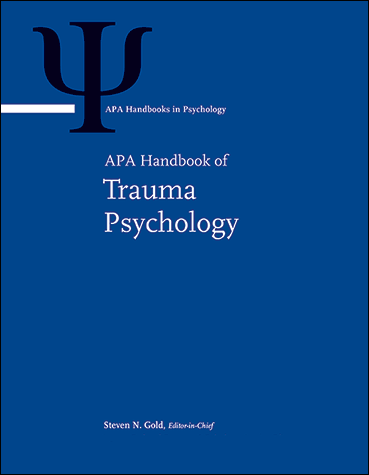
APA Handbook of Trauma Psychology
Available formats
Part of the landmark APA Handbooks in Psychology® Series from APA
The two volume APA Handbook of Trauma Psychology is the most comprehensive guide, text, and reference work on the subject to date.
The APA Handbook of Trauma Psychology provides a survey of all the major areas and subtopics of empirical knowledge and practical applications in the field of trauma psychology, written by top experts in the field.
Volume 1 is divided into sections on the nature of trauma, its psychological impact, major conceptual frameworks for understanding traumatization, and trauma as viewed from the diverse perspective of various disciplines.
Volume 2 covers various applications of trauma psychology, including various modalities of trauma assessment, major treatment approaches across the lifespan, and multi-client and organizational practice.
The APA Handbook of Trauma Psychology will be an essential resource to specialists in trauma who need comprehensive information, to practitioners who seek to familiarize themselves with the range of approaches for trauma assessment and treatment, or for students as a graduate level or advanced undergraduate level textbook.
Volume 1: Foundations in Knowledge
Editorial Board
About the Editor-in-Chief
Contributors
Series Preface
Introduction
- The Study of Trauma: A Historical Overview
Charles R. Figley, Amy E. Ellis, Bryan T. Reuther, and Steven N. Gold
I. Trauma: The Territory
- Defining Trauma
Constance J. Dalenberg, Elizabeth Straus, and Eve B. Carlson - Empirical Study of Trauma: Methodological and Statistical Considerations
Jeffrey Sonis, Michael K. Suvak, and Paula P. Schnurr - Trauma and Posttraumatic Stress Disorder Prevalence and Sociodemographic Characteristics
Dean G. Kilpatrick, Christal L. Badour, and Heidi S. Resnick - Assisting Individuals and Communities After Natural Disasters and Community Traumas
Patricia Watson and Jessica Hamblen - Child Physical Abuse
David J. Kolko and Olga V. Berkout - Adult Survivors of Childhood Sexual Abuse: Review of Theoretical and Empirical Literature
Victoria M. Follette and Catalina Vechiu - Military Trauma
Naomi Sadeh, Joanna Lusk, and Brian P. Marx - Training in Trauma: New Haven Consensus Conference Conclusions on Core Competencies
Joan M. Cook and Elana Newman
II. The Impact of Trauma
- Acute Stress Disorder and Posttraumatic Stress Disorder
Richard A. Bryant - Depression and Complicated Grief
Andreas Maercker, Robert A. Neimeyer, Vanessa Simiola - Substance Use Disorder and Trauma
Lisa M. Najavits, Scott M. Hyman, Lesia M. Ruglass, Denise A. Hien, and Jennifer P. Read - Dissociation as a Trauma-Related Phenomenon
Bethany L. Brand and Paul Frewen - Other Disorders Often Associated With Psychological Trauma
Patrick Luyten, Lies Van Assche, Fortesa Kadriu, Julie Krans, Laurence Claes, and Peter Fonagy - Complex Trauma and Complex Posttraumatic Stress Disorder
Julian D. Ford - Trauma and Memory
M. Rose Barlow, Kathy Pezdek, and Iris Blandón-Gitlin - Traumatic Brain Injury and Psychological Trauma
Michael L. Alosco, Christina J. Supelana, and Jennifer J. Vasterling - Physical Health and Health Services Utilization
Paula P. Schnurr
III. Conceptual Frameworks for Understanding Psychological Traumatization
- Mentalizing
Peter Fonagy, Chloe Campbell, and Patrick Luyten - Modern Attachment Theory
Allan N. Schore - Behavioral, Cognitive, Biological, and Neurocognitive Conceptualizations of Posttraumatic Stress Disorder
Jonathan D. Green, Shimrit K. Black, Brian P. Marx, and Terence M. Keane - A Constructive Narrative Perspective on Trauma and Resilience: The Role of Cognitive and Affective Processes
Donald Meichenbaum - Genetic and Biological Underpinnings and Consequences of Trauma
Ananda B. Amstadter, Christina Sheerin, Mackenzie Lind, and Nicole R. Nugent
IV. Cross-Disciplinary Perspectives on Traumatization
- Testimony About Trauma: Problems in Admissibility and Credibility
David L. Shapiro - Contributions of Feminist and Critical Psychologies to Trauma Psychology
Laura S. Brown - Philosophical and Existential Perspectives on Trauma
Bryan T. Reuther - Legal and Ethical Considerations in Working With Trauma Survivors: Risk Management Principles for Clinicians
A. Steven Frankel - Spiritual Challenges Resulting From Trauma: Implications for Inclusive Psychotherapy
Christine A. Courtois - Secondary Traumatization and Compassion Fatigue
Charles R. Figley and Marné Ludick - Future Directions
Steven N. Gold, Constance J. Dalenberg, and Joan M. Cook
Index
Volume 2: Trauma Practice
Editorial Board
Contributors
- Trauma Practice: Historical Overview
Lenore E. A. Walker
I. Trauma Assessment
- Incorporating Trauma Into an Assessment Interview
Judith Armstrong - Psychometric Assessment of Trauma
Constance J. Dalenberg and John Briere - Behavioral and Psychophysiological Assessment of Trauma
Nnamdi Pole - Trauma Resiliency and Posttraumatic Growth
Jack Tsai, Ilan Harpaz-Rotem, Robert H. Pietrzak, and Steven M. Southwick
II. Treatment Approaches
- Relational Theory: The Cornerstone of Integrative Trauma Practice
Karen W. Saakvitne - Cognitive Therapy
Jennifer Schuster Wachen, Katherine A. Dondanville, Alexandra Macdonald, and Patricia A. Resick - Exposure Therapy
Laurie J. Zandberg, Eliora Porter, and Edna B. Foa - Eye Movement Desensitization and Reprocessing Therapy
Francine Shapiro and Roger Solomon - The Central Autonomic Network in Trauma Etiology and Treatment
Richard Gevirtz - Emotion Regulation and Skills-Based Interventions
Julian D. Ford - Mindfulness and Acceptance and Commitment Therapy in the Treatment of Trauma
Alexandra L. Laifer, Kristie A. Wirth, and Ariel J. Lang - Dialectical Behavior Therapy for Treating the Effects of Trauma
Milton Z. Brown and Kristin Dahlin - The Psychoanalytic Concept and Treatment of Psychological Trauma: An Evolving Perspective
Harold Kudler - Contextual Treatment of Complex Trauma
Steven N. Gold and Amy E. Ellis - Complicated Grief: Assessment and Intervention
Robert A. Neimeyer - Psychopharmacological Treatment of Traumatization in Adults
Nancy C. Bernardy and Matthew J. Friedman - Trauma-Focused Cognitive–Behavioral Therapy for Children and Adolescents
Rochelle F. Hanson and Lisa Jobe-Shields - Trauma-Relevant Treatment of Dissociation for Children and Adolescents
Joyanna Silberg
III. Multiclient and Organizational Practice
- Trauma-Focused Therapy for Older Adults
Steven R. Thorp, Stephanie Y. Wells, and Joan M. Cook - Couple and Family Therapy for Traumatic Stress Conditions
Candice M. Monson, Anne C. Wagner, Steffany J. Fredman, Alexandra Macdonald, and Nicole D. Pukay-Martin - Trauma-Focused Group Therapy
Denise M. Sloan, J. Gayle Beck, and Alice T. Sawyer - Prevention of Posttraumatic Stress Disorder
Elisa E. Bolton, Alexander H. Jordan, Rebecca E. Lubin, and Brett T. Litz - The Sanctuary Model: Through the Lens of Moral Safety
Sandra L. Bloom - Trauma-Informed Care
Catherine C. Classen and Carrie S. Clark - Forensic Psychology in the Context of Trauma
Constance J. Dalenberg, Elizabeth Straus, and Marie Ardill - Looking Ahead: A Vision for the Future
Steven N. Gold, Joan M. Cook, and Constance J. Dalenberg
Index
Steven N. Gold, PhD, is a professor at the Nova Southeastern University (NSU) Center for Psychological Studies and director of NSU's Trauma Resolution and Integration Program, which he established in 1990.
He served as president of APA Division 56 (Trauma Psychology) in 2009, acted as inaugural editor of Division 56's scientific journal, Psychological Trauma: Theory, Research, Practice, and Policy, from 2008 through 2014, and was the 2014 recipient of Division 56's Award for Outstanding Service to the Field of Trauma Psychology.
In 2004, Dr. Gold served as president of the International Society for the Study of Trauma and Dissociation.
His research has focused on psychological trauma, posttraumatic stress disorder, dissociation, child abuse, and hypnosis. He has written many articles for professional journals and chapters in edited volumes on abuse, trauma, dissociation, and sexual addiction, and made numerous presentations on these topics at national and international professional conferences.
He has been an invited speaker throughout the United States, as well as Canada, Colombia, Argentina, Spain, and Austria. He authored the book Not Trauma Alone: Therapy for Child Abuse Survivors in Family and Social Context, and coedited the books Trauma Practice in the Wake of September 11, 2001 and Trauma and Serious Mental Illness.
Dr. Gold was founding coeditor of the Journal of Trauma Practice, and guest edited a special issue of the APA journal Psychotherapy on the treatment of trauma related disorders.
He is a certified traumatologist with the Traumatology Institute, and is certified as a consultant in clinical hypnosis by the American Society of Clinical Hypnosis.
He is also a member of the International Society for Traumatic Stress Studies, the Society for the Advancement of Sexual Health (formerly the National Council on Sexual Addiction and Compulsivity), and the organization MaleSurvivor.
He is on the board of directors of the Sidran Institute for Traumatic Stress Education and Advocacy and the Advisory Board of the Leadership Council on Child Abuse and Interpersonal Violence and on the publications board of APA Division 29 (Society for the Advancement of Psychotherapy).
Dr. Gold maintains an independent psychology practice in Plantation, Florida, and in recent years, he has regularly been retained as an expert witness in legal cases in which trauma and dissociation were relevant issues.
The editors and contributors to the APA Handbook of Trauma Psychology thoroughly examine virtually every aspect of trauma...This detailed resource will be invaluable to practitioners and researchers; it will also be of value to graduate students in psychology and counseling.
—Choice
The two APA Handbooks of Trauma Psychology are well written, for a wide audience, from those with sophistication in research or clinical care to those who are beginning to learn about it or wish to reference a therapy that they are considering for treatment. They serve as a modern encyclopedia that will likely stand the test of a decade without a need for revision because they are focused on evidence based trends and techniques.
—PsycCRITIQUES