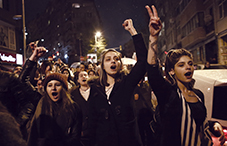

Until last year, developmental and community psychologist Serdar M. Değirmencioğlu, a former vice president of the Turkish Psychological Association, was chair of the psychology department at Doğuş University in Istanbul. But in February 2016, after an internal investigation prompted by pressure from government forces, the university administration revoked his chairmanship. Two months later, he lost his teaching position as well. Faced with unemployment, Değirmencioğlu has taken on temporary teaching positions abroad, and is now a visiting scholar at the University of Macerata in Italy.
Değirmencioğlu is just one of thousands of academics in Turkey—including many psychologists—who have been targeted in the government's crackdown on academic and other freedoms. Değirmencioğlu is receiving support from an advocacy and research group called the Scholars at Risk Network, but says the moniker "hardly conveys the gravity of my situation."
"As a full professor at the age of 50—at a time when I should be mentoring students, producing the kind of psychology Turkey needs—I am kicked out. Psychologists are produced in universities," adds Değirmencioğlu, who is a member-at-large of APA's Div. 48 (Society for the Study of Peace, Conflict and Violence). "When universities are destroyed, psychology will be destroyed, too."
On April 16, the results of a countrywide referendum dealt a further blow to those affected by the crackdown. Turkish voters narrowly voted to grant sweeping new powers to President Recep Tayyip Erdoğan, giving him the ability to make unilateral decisions about high-level vice presidential, cabinet and judicial appointments without parliamentary approval, among other new rights. The results have been widely contested in and outside the country, including by a major international monitoring organization that concluded that the vote was conducted on a uneven playing field, since opposition forces were forcibly silenced from presenting their platform.
Seeds of a crackdown
Değirmencioğlu's trouble began on Jan. 11, 2016, when a group of academics, including psychologists, held a press conference to declare their opposition to a 2015 decision by Erdoğan to stop peace talks and begin an intensive military campaign against ethnic Kurds in Turkey, who have long fought for greater civil rights and self determination.
While the reasons for the renewed military efforts are unclear, many speculate that they were an effort to rally support for Erdoğan before the country's parliamentary election in November 2015. The enmity between the Turkish government and militant Kurdish groups has gone on for decades and recently led to government-sponsored bombing campaigns, curfews, arrests, torture and displacements in Turkey's Kurdish regions, according to international human rights groups such as Human Rights Watch.
For its part, the Turkish government accuses Kurdish guerillas—many under the banner of the Kurdistan Workers' Party, or PKK—of terrorist activities, a judgment supported by some countries and entities but not by others.
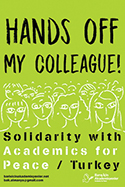 At the press conference, academics representing a group called Academics for Peace read from a strongly worded peace declaration signed by 1,128 Turkish academics, including Değirmencioğlu. More than 2,000 academics from the United States and around the world signed on as well, according to estimates.
"We demand [that] the state ... abandon its deliberate massacre and deportation of Kurdish and other peoples in the region," the declaration reads. "We demand [that] the government ... prepare the conditions for negotiations and create a road map that would lead to a lasting peace which includes the demands of the Kurdish political movement."
Immediately following the conference, Erdoğan publicly excoriated the statement's signers for being "traitors," "immorals" and "poor excuses for intellectuals," according to Turkish press reports. Larger hostile media campaigns soon followed, featuring inflammatory headlines and lists of the names and affiliations of those who signed the document.
In July 2016, matters heated up further when a breakout faction of the Turkish army attempted a poorly organized coup against the Erdoğan government. Government forces defeated the rebels in the span of several hours, and Erdoğan declared a state of emergency, staging mass arrests of anyone he deemed might have supported the coup, despite a lack of hard evidence. On April 19, Turkey's Council of Ministers extended the state of emergency for three more months and was awaiting parliamentary approval for the measure.
As of May, some 140,000 people had been fired or suspended from state and private sector jobs, 96,000 were being detained and 48,000 had been arrested, according to data compiled by international sources. In May alone, nearly 4,000 workers were dismissed, and the government had blocked the country's access to Wikipedia, the online volunteer encyclopedia, confirming fears that Erdoğan's new powers would lead to even greater restrictions, according to reports.
Those affected also include more than 7,300 academics, including 1,500 academic deans, hundreds of academics who signed the peace petition, and about 60 academic psychologists and 40 psychologists working in other capacities. Fifteen of the country's approximately 180 universities have been closed as a result of the crackdown.
The situation is likely to remain grim for affected academicians given the direction of Turkish politics, says Dan Munier, who conducts academic freedom monitoring research for the New York–based Scholars at Risk Network. And a disproportionate number of the targets work in the humanities and social sciences, he adds.
"Many of those who have lost their jobs or have been detained or arrested are individuals who were targeted for being politically active or contentious"—they didn't even necessarily support the factions the government was concerned about, such as Kurdish political parties or movements. "They might simply be critical of the current government—expressing pro-democracy and pro-human rights views," for example.
In a larger sense, the government crackdown represents the direst human rights situation Turkey has seen in many years, according to Hugh Williamson, Europe and Central Asia program director for the advocacy organization Human Rights Watch.
"With hundreds of thousands of people dismissed or detained without due process, an independent media silenced and Kurdish opposition members of parliament in jail, Turkey has been plunged into its worst crisis in a generation," Williamson said in a February statement.
Careers at risk
The mass purges have seen many academics scrambling to find temporary positions in other countries. Others, meanwhile, are unable to leave Turkey because their passports have been canceled or seized, Munier says, leaving them to face unemployment, underemployment and continued political threats in Turkey.
Like Değirmencioğlu, clinical psychologist Olga Selin Hünler, PhD, herself a former vice president of the Turkish Psychological Association, also faced an unwarranted university investigation after signing the peace declaration. She had been an assistant professor at a private university in Izmir, Turkey, but decided to apply for a scholarship abroad to escape the tensions. When the university refused to grant her a leave of absence, she was forced to resign, and is now doing a postdoctoral fellowship at the University of Bremen in Germany.
"Given the ongoing developments," she says, "it is impossible for any academics with a critical position or perspective to continue their scientific work."
Meanwhile, Turkish cognitive psychologist Esra Mungan, PhD, has been in the news for her role as one of four academics who held a second Academics for Peace press conference on March 10, 2016, to reiterate the terms of the petition. She and her three colleagues were jailed for 40 days following the event, and the government is keeping their cases open.
While all academics in Turkey with a bent toward challenging their government's actions are facing a variety of threats and challenges, young scholars are in a particularly vulnerable position, Değirmencioğlu says.
"They had a career ahead of them," he says, "and now a government tells them their career is already over. This is outrageous and unacceptable."
More help needed
Those who have left the country have been able to receive support from a number of U.S. and international organizations including Scholars at Risk, the Institute of International Education's Scholar Rescue Fund, and the Philip Schwartz Initiative in Germany (see "Resources" for more). They are also coordinating forces to help any colleagues who need immediate or longer-term psychosocial support, says psychologist Ayşe Dayi, PhD, who signed the peace petition and was fired from her university position shortly thereafter. She now holds a two-year position at the Université de Lausanne in Switzerland, and is working to secure positions and raise funds for affected colleagues.
In addition, many professional and scientific organizations—including the European Federation of Psychologists' Associations, Psychologists for Social Responsibility and the European Association of Social Psychology—have issued statements expressing concerns about sanctions imposed on academics and academic institutions that restrict academic freedom and freedom of speech. Meanwhile, the International Society of Political Psychologyopens in new window has launched a campaign to help affected academic psychologists from Turkey through letter-writing, fundraising, and efforts to host them in the United States and elsewhere.
While APA has not made a formal statement, the organization sent a letter of support to the Turkish Psychological Association in January 2016, expressing its concerns about these incursions on academic expression. In addition, APA's Office of International Affairs makes an annual contribution to Scholars at Risk, and in collaboration with APA's Government Relations Office and Science Directorate, is now discussing ways to connect Turkish scholars with options for further support, says Amanda Clinton, PhD, senior director of APA's International Affairs Office.
Despite such efforts, there is not nearly enough money or support to go around, says Munier.
"The situation is beyond the capacity of any one organization to handle," he says. "Many of the universities in our network—some 460 institutions in 35 countries—have stepped up to express their concern and offered to host these academics, but more help is needed." To this end, U.S. psychologists and universities can do their part by sharing information about support organizations with their colleagues in Turkey and, if possible, laying the groundwork to host a scholar from that country, he says.
The economic and psychological damage wrought by the situation is difficult to calculate, and it's hard to say how it will end, Değirmencioğlu adds.
"Careers as well as institutions are being destroyed," he says. "It takes decades to build a university tradition. Once destroyed, it will take years to restore these traditions."