
"Kind of wacky" — yet greatly rewarding — is how John Fraser, PhD, AIA, describes his career journey. Fraser is president and CEO of the New York City-based interdisciplinary nonprofit social science think tank NewKnowledge Organization Ltd., where as a conservation psychologist, architect and educator, he focuses on how people's experience with media and community influences their learning, attitudes and motivations for engagement with solving the problems that face society.
He spoke to the Monitor about his career, from his beginnings as an architect to becoming conservation psychologist, and his role at NewKnowledge, which includes projects with Amnesty International, the National Network for Ocean and Climate Change Interpretation, and the PBS NewsHour.
You began your career as an architect. How did you first cross paths with psychology?
I'd been working as a commercial architect when I was asked to lead a reconstruction project at the Toronto Zoo. One big challenge they faced was with their Mongolian wild horses, an endangered species that had destroyed their barn.
I spent a lot of time on my Uncle Vern's farm in Hamilton, Ontario, when I was growing up, so I knew that horses don't normally chow down on a building. So, I asked the zoo to tell me how they worked with these animals and to show me any behavioral psychology research that could help me understand the needs of this species.
They were a little surprised that the architect would ask for psychology papers. I said, "Well, clearly we're doing something wrong because they don't just decide to do these things for fun."
The zoo's curators said, "We don't get these kinds of questions from architects." And I thought, "This is really interesting. This is where architecture can be useful." That was the start of working with psychologists on how zoo facilities influence wildlife breeding success.
And so began your midcareer shift.
Yes. I was an architect with zoos and aquariums, working as much with interpretation as I was on building design. I was in the right place at the right time. I became friends with Dr. Carol Saunders, a psychologist at the Brookfield Zoo who brought together a group of psychologists and zoo folks to question what was known about behavior change. Her efforts led to the founding of the field of conservation psychology.
When I was director of interpretation for the Wildlife Conservation Society, my boss Richard Lattis suggested that if I really wanted to put my money where my mouth was, I needed a PhD. So, he encouraged me to go back to school. Carol Saunders and I were co-teaching zoo design, research and evaluation at Antioch University at the time, and that college also had a PhD program in environmental studies for midcareer professionals. My undergraduate degree was in environmental studies, so that program made sense.
You were one of the founders of NewKnowledge. How did this come about?
It kind of happened at me, with me. In November 2011, a group of colleagues and I were talking about what's needed to advance the work of well-intentioned organizations. As we discussed the issues of the biosphere, health and how cultural institutions are really vectors for advancing a better social world, we came up with the idea that became NewKnowledge and we ran with it.
We were founded by January 2012 and by the summer we'd grown to a team of 12. Five years on, we have people working in areas I never could have expected.
Tell us about some of that work.
Today, we're working with the "PBS NewsHour" on understanding science learning for a new generation of audiences and on how young adults engage with media outside of the broadcast experience. Dr. Rupanwita Gupta, a conservation psychologist on our team, was a co-principal investigator evaluating the development and use of the federally funded Third National Climate Assessment. Dr. Rebecca Norlander led our work with Amnesty International to conduct a review of human rights education [HRE] within two of their global campaigns, Stop Torture and My Body My Rights. Our goal with Amnesty International was to help identify ways to integrate HRE with youth activism in future global campaigns.
We've also developed Rhode Island's assessment of K–12 environmental literacy across the entire state and a strategy for getting that assessment entrenched in policy.
Our job is behind the scenes. We collaborate with change-makers to build strong, healthy democracies in a thriving biosphere. We measure, monitor, assess the data, and look at the structural relationships we see between people and the actions they take.
How do all the strands of your career come together in this role?
As a conservation psychologist, my focus is on the meta-discipline itself and thinking about large systemic ways that we come to engage with social challenges to make the world a better place. While I don't work as an architect designing buildings anymore, my architecture background really does inform how I think about the work. Fundamentally, architects explain how to organize things and then stick them together so they make sense and tell a coherent story of living. I feel I'm still doing that here at NewKnowledge, I'm just working on the architecture of human thought and mental processes.
I love my job! I may be called the head of this organization, but it's an organization that works as a team, and that's probably one of the most rewarding experiences for all of us.
What's a typical day like for the NewKnowledge team?
It's pretty typical. We get up, put on our socks, make a cup of tea. Then in about hourlong segments, we deal with the most protracted problems facing society today and figure out what the vectors are to fix them.
No pressure there, then! How does such a transdisciplinary team work together?
We are a very flat organization. We don't have much in the way of hierarchy because each person's expertise makes us stronger. I see too many think tanks that run like Petri dishes, "Here's a brain, put 'em behind a glass door."
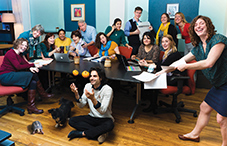
We've intentionally created a space where we constantly work side by side. We riff on each other's ideas. In a conversation, an anthropologist will say something, a social worker will offer another perspective, and a psychologist will add. In the space between we'll all say, "Hey, that hasn't existed before. Let's work on that."
How do you get involved in a project?
We collaborate with change agents to develop our contracts. Most of our work comes from collaboration with organizations seeking to achieve positive social change. We work with partners to develop a core research question and a budget that can help get them to a good answer. About half our work is self-initiated or cooperative grant development, while the other half is commissioned directly by our partners. Of the latter half, only a small portion is the result of competitive bidding.
You've worked on a great variety of research projects over the years. What's been one of the most memorable?
One project that has been so rewarding started for me before we founded NewKnowledge. The National Network for Ocean and Climate Change Interpretation is building the capacity of aquariums, zoos, science centers and nature centers to increase public understanding of climate change and its impacts. With my colleagues in Dr. Janet K. Swim's lab at Penn State, we've been able to describe a key social vector for changing the way Americans are talking about climate change.
After eight years, today we have a strong and powerful community of practice operating at 183 different major cultural institutions, all using the same strategy to talk about and activate a local population in order to reduce the American contribution to climate change and build a prepared, resilient society. That makes me happy.
As a researcher, I'm most excited about the questions we haven't answered yet, that we're still struggling with. What we've done makes me proud. What we're going to do keeps me doing the work.