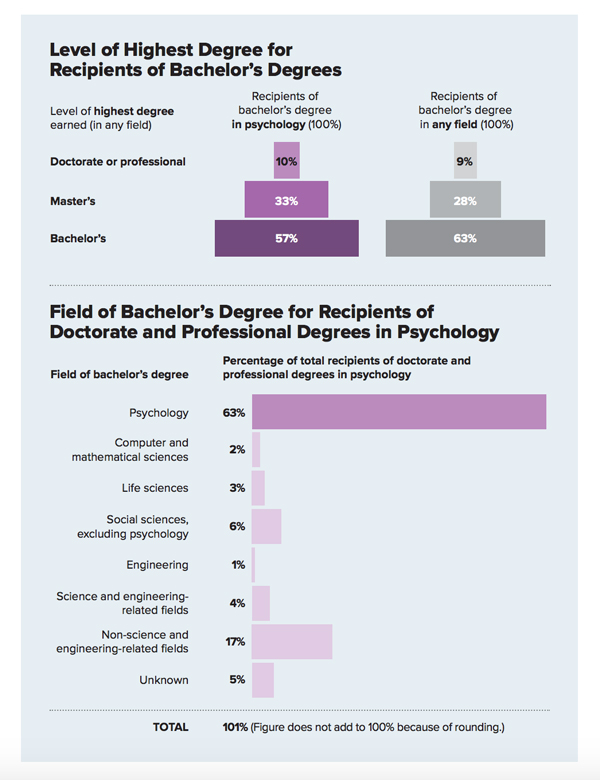
- In 2015, 3.4 million people in the United States held a bachelor's degree in psychology.1 For 57 percent of them, that was their highest degree. The remaining 43 percent also held graduate degrees (in any field): 33 percent earned a master's degree as their highest degree, and 10 percent earned a doctorate or professional degree.2 Compared with recipients of other bachelor's degrees, those with a bachelor's in psychology were more likely to obtain a graduate degree.3
- Approximately 4 percent of psychology bachelor's degree holders earned a doctorate or professional degree in psychology. They accounted for 63 percent of the 207,000 psychology doctorate or professional degree holders in the United States. The remaining 37 percent of psychology doctorate or professional degree recipients had earned a bachelor's degree in a field other than psychology.4
By Luona Lin, MPP, Peggy Christidis, PhD, and Karen Stamm, PhD
For more information, contact APA's Center for Workforce Studies at cws@apa.org.
1National Science Foundation, National Center for Science and Engineering Statistics. (2015). National Survey of College Graduates Public Use Microdata File and Codebook. Retrieved from https://ncses.nsf.gov/explore-data/microdata/national-survey-college-graduatesopens in new window. Field of bachelor's degree was based on respondent's first major field of first bachelor's degree. The use of NSF data does not imply NSF endorsement of the research, research methods or conclusions contained in this report.
2Examples of professional degrees include PsyD, JD, MD, DDS and DVM.
3Comparison was statistically significant at p < .05.
4Science and engineering (S&E) -related fields include health, science and mathematics teacher education, technology and technical fields, etc. Non-S&E fields include management and administration fields, education, social service, sales and marketing, art and humanities, etc. About 5 percent of psychology doctorate and professional degree holders did not report a field of bachelor's degree.