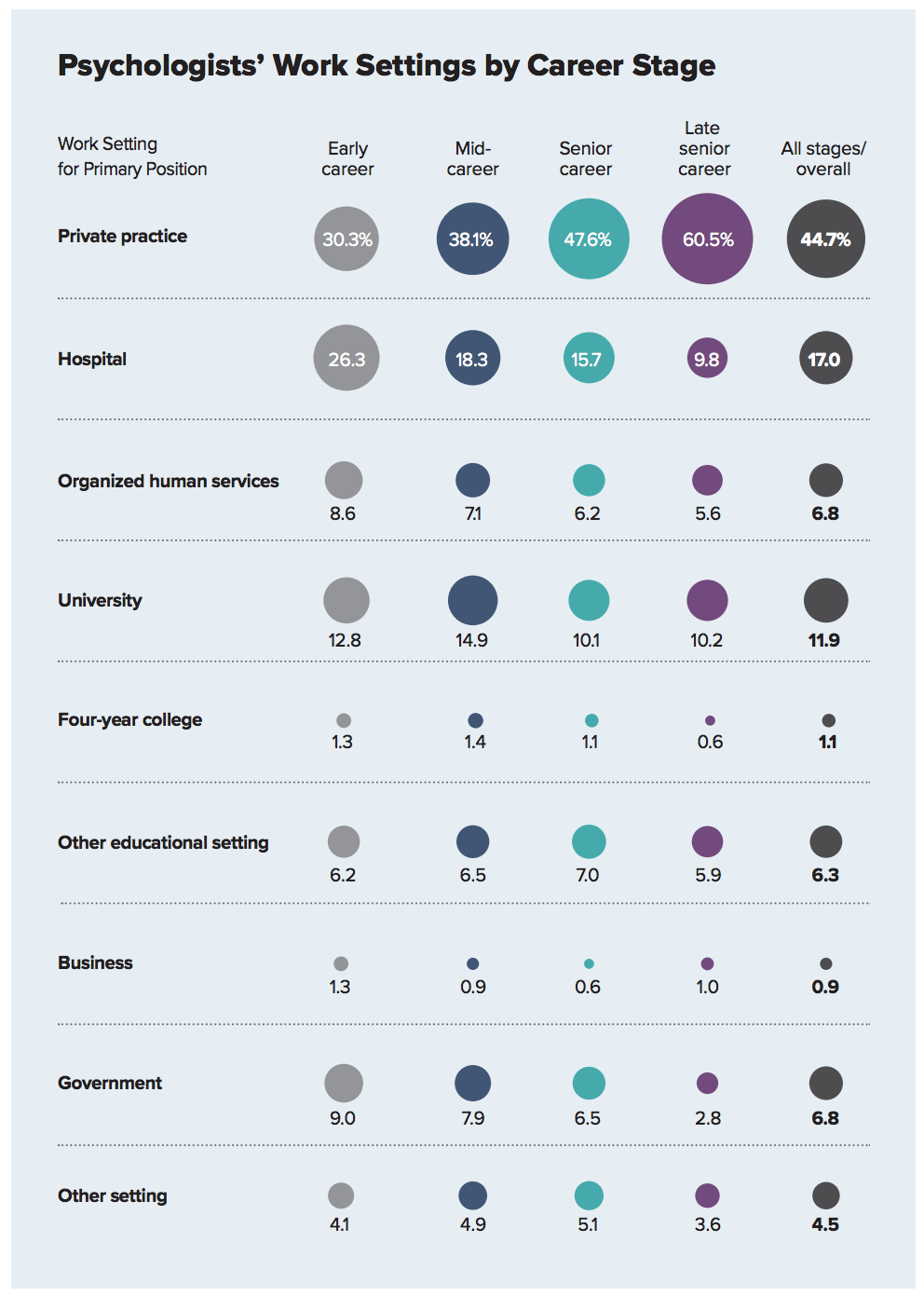
- In 2015, 44.7 percent of all licensed health service psychologists in the United States worked in private practice.1,2 The proportion in private practice was lowest for early career psychologists (30.3 percent) and highest for late senior career psychologists (60.5 percent).
- By contrast, early career psychologists were more likely than psychologists at any other career stage to work in hospitals (26.3 percent), government (9 percent) and organized human service3 (8.6 percent) settings.
- Early career (12.8 percent) and mid-career psychologists (14.9 percent) were most likely to work in universities. Very few licensed psychologists at any stage worked at four-year colleges or in business.
By Luona Lin, MPP, Peggy Christidis, PhD, and Karen Stamm, PhD
For more information, contact APA's Center for Workforce Studies at
cws@apa.org
.
1 APA. (2017). Career Stages of Health Service Psychologists: Special Analysis of the 2015 APA Survey of Psychology Health Service Providers. Retrieved from www.apa.org/workforce/publications/15-health-service-career/index . Work setting was defined as primary practice location. Percents are percents within career stage. Statements are based on statistically significant (p<.01) chi-square tests. Totals may not sum to 100 percent due to rounding.
2 Career stage was defined as years since doctorate: early career (1–10 years), mid-career (11–20 years), senior career (21–30 years) and late senior career (31 or more years).
3 Examples of organized human service settings include clinics and managed-care settings.