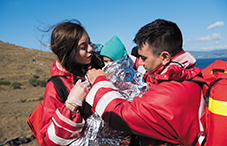

During the Ebola outbreak in Sierra Leone in 2015, the high mortality rate—especially among children—traumatized aid workers. Other stressors included pressure to work extremely long hours day after day and the possibility that they, too, could contract the deadly disease.
After the earthquake in Haiti in 2010, aid workers were confronted with the sight and smell of corpses, pleas for help from survivors and a sense of powerlessness as they realized their resources were inadequate for the scale of the disaster.
Even the most experienced aid workers can be traumatized by such circumstances. Yet they may be reluctant to potentially jeopardize their careers by seeking help. Often, help may not even be available, especially in situations where there are no psychologists in the area, and it is too difficult for safety or logistical reasons to send outside psychologists into the field.
Online psychological services can help fill that gap, says Amira Karray, PhD, a lecturer in psychopathology and clinical psychology at Aix-Marseilles University in France, who is among the first to study online psychological services with this unique population. By using the telephone or internet, she and her colleagues point out, psychologists can conduct assessments and offer psychological support to humanitarian personnel from the safety of their own offices. (See their review of online psychological services with aid workers in International Perspectives in Psychology: Research, Practice, Consultationopens in new window , Vol. 6, No. 2, 2017).
Keys to treatment
Some aid workers resist the idea of telepsychology. Karray and her co-authors encountered aid workers who rejected offers of telepsychology services outright. Some believed that if their employers really cared about their mental health, they would send a psychologist into the field to provide face-to-face support, calling this in-person assistance a sign of respect. "They could have sent you out with us instead of doing it this way," said one of the aid workers highlighted in Karray's paper. "It's clear we're not that important to them."
But, says Karray, telepsychology is the "least worst option" in humanitarian contexts where face-to-face interventions simply aren't possible. Plus, a growing body of literature suggests that telepsychology interventions can be as effective as face-to-face sessions. In a study of a telehealth intervention for post-traumatic stress disorder (PTSD), for instance, psychologist Ronald Acierno, PhD, of the Ralph H. Johnson Veterans Affairs Medical Center in Charleston found that telehealth treatment increased access to treatment without reducing its effectiveness ( Behaviour Research and Therapyopens in new window, Vol. 89, 2017). And there are ways to ensure that telepsychology services for aid workers are as effective as possible, say Karray and other psychologists:
Focus on building a long-distance bond. Aid workers may feel that the psychologists are too remote from their experiences to understand them. The disparity between psychologists' safety and aid workers' situations, the uncertainty of the phone or internet connections and the risk of privacy breaches can also hinder relationships, says Karray. As a result, psychologists should recognize that building therapeutic relationships may be particularly challenging.
The psychologist can actually use that distance to help build a bond, says Karray. Because the psychologist is outside the client's context, the individual must describe the situation more thoroughly than a client might if he or she were sitting in the psychologist's office. And having someone from the outside world listen and understand can be therapeutic, Karray adds. In addition, some aid workers may worry that the practitioner will share sensitive information they discuss with their employers. To address that fear, says Karray, the psychologist should make it clear that his or her primary obligation is to the patient.
Follow APA's guidelines for telepractice. APA's guidelines urge psychologists offering telepsychology services to make sure they are competent to provide services via telephone or internet, use the same ethical and professional standards they would for a face-to-face session and address the unique aspects of telepsychology in their informed-consent processes. In addition, the psychologist should work with the aid organization to come up with a list of local providers to refer clients to if clients are in crisis or in significant distress. To access the guidelines, go to https://www.apa.org/about/policy/telepsychology-revisions.
Think through technology options. APA's guidelines offer recommendations for ensuring confidentiality and data security. Also, psychologists should take a close look at user agreements. Skype and FaceTime, for example, are not appropriate for telepsychology and require users to grant ownership of all transmissions to the company (see "How to Make the Most of Telepsychology and Steer Clear of Pitfalls " in the May 2017 Monitor ). No matter what platform is selected, the psychologist and client should establish procedures for re-establishing connections during technological failures. The psychologist and client could agree to reconnect via email, phone or social media to schedule another time slot, suggest Karray and her colleagues.
Keep in mind jurisdictional issues. The APA guidelines also note that psychologists who practice across international boundaries must comply with the regulations or laws in their own country as well as those in the countries where clients live. Often there are none, but the psychologist needs to check, says Deborah Baker, JD, who directs legal and regulatory policy in APA's Practice Directorate. And psychologists should not assume they can practice across borders.
"It is important for the psychologist to consult with his or her professional liability company for guidance on risk management and issues to consider in situations where there are no clear guideposts," says Baker.
Consider extra safeguards for client privacy. Aid workers may worry that a third party could intercept their telehealth sessions. "That can be the case, especially with political activists or people living in political contexts where talking about their distress or whereabouts could be physically risky," says Sarah Kamens, PhD, a postdoctoral fellow in psychology at Wesleyan University. Kamens co-chairs the Global Psychosocial Network, a Psychologists for Social Responsibility initiative that supports aid workers and others.
To address such concerns, the network offers guidelinesopens in new window for enhancing confidentiality. For example, individuals can "de-identify" themselves during their communications transmissions. "We can preserve the meaning of what we're talking about without expressing relevant details that might identify the person," says Kamens. Clinicians can also use a browser called ToR, which relays online communications through a network of sites around the world to protect the user's physical location and identity.
Of course, says Kamens, any kind of digital communication, including that using ToR, can be vulnerable to attacks. "For us, ToR is a method of reducing risk, but we cannot make any guarantees," she says.
Continue support. Aid workers often need ongoing help even after they return home, says Idit Albert, PhD, a consultant psychologist and PTSD lead at the South London and Maudsley National Health Service Foundation Trust. Albert's team supported National Health Service staff who volunteered during the 2015 Ebola outbreak in Sierra Leone. When the volunteers came back to England and resumed their work, many continued to experience anxiety, depression and PTSD.
In addition, says Albert, "they had feelings of guilt and frustration at the lack of resources in Sierra Leone in contrast to the abundance of things here in the United Kingdom."
Keep in mind that interjurisdictional issues also apply when aid workers return to their home countries, adds Baker. If an aid worker returned from Africa to her home in Massachusetts, for example, the Virginia-based psychologist she had been talking to while abroad would no longer be able to provide services unless she was licensed to practice in both states. Instead of continuing to provide services, says Baker, the psychologist should help the client locate appropriate services in her own state.
APA Guidelines for the Practice of Telepsychology: For guidance on legal, ethical and other telehealth issues, go to https://www.apa.org/about/policy/telepsychology-revisions.