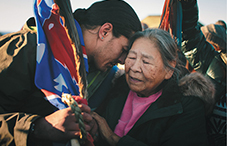

Psychologist Margaret Smith, PsyD, was prepared to endure harsh weather conditions and long hours when she volunteered to provide mental health support at the Standing Rock encampments in December 2016 and January 2017, but she was not expecting to enter what felt like a militarized zone. The National Guard patrolled a checkpoint a few miles from the entrance to the camp, helicopters hovered overhead and high-intensity spotlights glared over the camps at night.
That experience has only intensified Smith's desire to support indigenous people in the wake of the standoff over the Dakota Access Pipeline, which was designed to transport crude oil across four states—North Dakota, South Dakota, Iowa and Illinois. The Water Protectors, who included thousands of indigenous people and environmentalists, set up camps near the construction site primarily to pray. The activists were concerned that spills from the section of the pipeline that runs under the Missouri River near the Standing Rock Sioux Reservation would be a threat to sacred land and a hazard to drinking water.
During the eight-month-long gathering, hundreds were arrested and charged with inciting riots and trespassing. Federal officials closed the camps in February 2017 after President Donald Trump signed executive orders that advanced the pipeline project. The pipeline started transporting oil in June.
"People don't fully understand the violation of civil and human rights that the Water Protectors experienced," says Smith, who has Cherokee heritage and is an associate professor at the Illinois School of Professional Psychology at Argosy University, Chicago. "Many people at the camps were not only traumatized by tactics like the use of water cannons, tear gas and rubber bullets, but also by the nonstop surveillance."
The Water Protectors have now dispersed all over the country, and Smith and her colleagues with the Society of Indian Psychologists (SIP) are helping to connect activists with any mental health care they may need. SIP offers guidance about how to access local mental health services, identify mental health issues early and coordinate with legal professionals who can help Water Protectors prepare for court.
One of SIP's goals is to educate mental health care providers about the experiences of the Water Protectors, Smith says. "Some people who report symptoms of paranoia may sound delusional or psychotic, but they are not," Smith says. "There may be a risk of misdiagnosing or overmedicating these people."
SIP Past President Art Blume, PhD, of Washington State University Vancouver, says these protests have spurred American Indians, environmentalists and others to come together to protect indigenous lands in other parts of the country.
"Indigenous people have been beaten down for so many years that we have forgotten how strong we are, and coming together to nonviolently defend against the pipeline was a highly spiritual moment that was empowering for these people," says Blume, who is Cherokee and Choctaw. APA collaborated with SIP in supporting the activists by sending a letteropens in new window to then-President Barack Obama and a letter to the editor of The New York Times. APA also initiated a blog series that expressed serious concerns about the proposed route of the pipeline.
For psychologists such as Smith and Blume, supporting the encampments is non-negotiable. "Psychologists with indigenous backgrounds have a cultural demand to be socially responsible in how we practice psychology, and helping our people is our chance to do that," Blume says. —Heather Stringer
To read more about the Society of Indian Psychologists, go to www.aiansip.orgopens in new window.