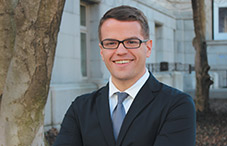

People in government like to think they’re basing decisions on evidence, says psychologist David Yokum, PhD. But generating the best and most current data—and putting it to work to improve citizens’ lives—can be a tall order. That, however, is the goal of The Lab @ DC, which Yokum has directed since it launched in 2016.
The Lab, a public initiative based in the office of Washington, D.C., Mayor Muriel Bowser, seeks to embed the scientific method into the heart of governing. It uses scientific methods to test and improve policies and provide high-quality evidence to inform decisions such as whether police should wear body cameras and how to eradicate the city’s rat population.
Yokum earned a PhD in psychology, with dual specialization in cognition and neural systems as well as psychology, policy and law in 2014, and he was a founding member of the White House’s Social and Behavioral Sciences Team. He joined the District of Columbia Office of the City Administrator as a senior policy adviser in 2015, where he was part of the team that took The Lab @ DC from idea to reality.
Yokum spoke to the Monitor about why he believes there are great opportunities for psychologists within government, and how The Lab @ DC is using science to improve city life.
What are some of your current projects?
We’re working with D.C. housing and homelessness agencies to design and evaluate a pilot program to see if flexible rent subsidies might reduce homelessness. We’re also synthesizing a wide swath of administrative data—from resident complaints to geodata on terrain—to develop an analysis system that predicts where rat infestations are most likely to occur. In addition, we recently held “Form-a-Palooza,” an event that brought together D.C. residents, behavioral scientists, design experts and government agency representatives to systematically improve the usability of five District forms, such as our applications for drivers’ licenses and business permits. Now, you can pull out an iPhone and intuitively know how to use these forms.
We also worked with the Metropolitan Police Department to conduct a large randomized control trial of the body-worn-camera program to learn how the cameras affect police interactions with residents and downstream court outcomes.
What were the results of the body-worn-camera trial?
When we compared the treatment and control groups, we found that body-worn cameras had no statistically significant effectsopens in new window on any of the measured outcomes. We learned that these cameras do not have detectable effects on documented uses of force or civilian complaints. That said, we can’t rule out that body-worn cameras may cause small decreases or increases in these two outcomes.
These results suggest we should recalibrate our expectations of the cameras’ ability to make a large-scale behavioral change in policing, particularly in contexts similar to Washington, D.C. We would also temper expectations about (and suggest further research into) the evidentiary value of these cameras.
How is your office structured?
Currently, we have 15 social scientists on the team, typically PhDs from diverse professional backgrounds and areas of expertise, including psychology, anthropology, sociology, statistics and public administration. We form a hub of people who wake up and go to bed thinking about how science is relevant to policy design and program implementation.
We also partner with scientists from other agencies, as well as those from universities and other research centers. This sets up a unique capacity to do three things. The first is to work with government stakeholders and staff to identify and articulate, “What is the problem we need to solve?” Oftentimes, people skip this step, but it’s absolutely critical and is usually 80 percent of the work.
Once we identify the opportunity, the second step is generating ideas that we think might work. For example, we will ask ourselves, “What do we know that might lead to a better policy or program design?” We draw on existing administrative data, academic research and industry literature to come up with what we think are the best ideas.
The critical third step is to evaluate those ideas as rigorously as possible once they are implemented in the field.
How did you get your job at The Lab?
Together with some great colleagues, we essentially invented the role. There were a few key players in District government, notably Mayor Muriel Bowser and City Administrator Rashad Young, who appreciated in a general way that psychological methods and insights could improve government, and I was lucky to get an opportunity to work with them to define and try out ways of just how that could work. Flash forward a couple years and you have The Lab @ DC. A lesson here is that you shouldn’t feel constrained to job postings as you find them. Pitch your own job if you have an idea for a role that can improve an organization or community.
What do you find most enjoyable about your role?
I like the combination of the meaty problems we’re dealing with—problems that really matter and that are difficult to solve—coupled with science. We’re doing actual experiments inside government.
I also like the challenges of the human element, such as negotiating what to work on and how to think about the results. There’s a lot of process and psychology behind that. How can we increase the odds that the results we’re generating get used? How will this affect how we spend money and how we staff things? There are exciting opportunities to invent ways to do that better.
What would you say to psychologists and graduate students who may not have considered a government career path?
There are so many opportunities for psychologists to have an immense amount of influence in government, but those positions aren’t necessarily posted, or they’re not asking explicitly for a psychologist.
Say there’s a posting for a manager or director in a department of public works, which oversees sanitation and parks. Historically, these job descriptions wouldn’t ask for graduate or undergraduate training in psychology. They might look for management experience or exposure in those particular areas. Yet the topics dealt with in that field are infinitely tied up with aspects of human behavior, such as recycling. How do people decide whether or not to recycle, or not decide at all? Someone with a psychology background might think about how to optimize labels to encourage people to recycle, or know how to use data to optimize routes that recycling trucks take.
There are so many examples like that, where if you were in that role, the way you’d think about executing the duties of that office would be so much richer because of your psychology background. If you’re looking at government postings as a psychologist, don’t just look for roles that explicitly ask for psychologists. Look at others and ask yourself, “How could a psychologist take this position to the next level?” Then pitch it, pursue it.
Learn more about The Lab @ DC’s projects at the Open Science Framework. Visit thelab.dc.govopens in new window and then follow the link to the OSF.