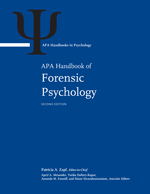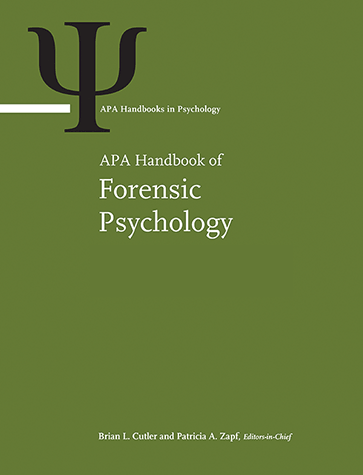
APA Handbook of Forensic Psychology
Available formats
The APA Handbook of Forensic Psychology consolidates and advances knowledge about the scientific foundations and practical application of psychology to law, the practice of law, and law-related policy. Drawing upon contemporary psychological research and practice, this Handbook provides a thorough, up-to-date, and far-reaching reference on forensic psychological issues that are important to researchers, practitioners and students in psychology, other social sciences and practice disciplines, and law.
The Handbook is divided into 2 Volumes, each comprised of 3 sections:
Volume 1 (Individual and Situational Influences in Criminal and Civil Contexts)
- Forensic Evaluation and Treatment in Criminal Cases
- Individual and Situational Predictors of Criminal Behavior
- Applications of Forensic Psychology in Civil Cases
Volume 2 (Criminal Investigation, Adjudication, and Sentencing Outcomes)
- Victim and Offender Groups
- Criminal Investigations and Jury Trials
- Sentencing and Incarceration
Volume 1: Individual and Situational Influences in Criminal and Civil Contexts
Editorial Board
About the Editors-in-Chief
Contributors
Series Preface
Introduction
I. Forensic Evaluation and Treatment in Criminal Cases
- Foundational Aspects of Forensic Mental Health Assessment
Kirk Heilbrun and Casey D. LaDuke - Forensic Assessment Instruments
Richard Rogers and Chelsea E. Fiduccia - Risk Assessment and Communication
Laura S. Guy, Kevin S. Douglas, and Stephen D. Hart - Legal Insanity and Mens Rea Defenses
Ira K. Packer - Criminal Competencies
Daniel C. Murrie and Heather Zelle - Mental Health Treatment of Criminal Offenders
Barry Rosenfeld, Jacqueline Howe, Ashley Pierson, and Melodie Foellmi - Capital Case Considerations
David DeMatteo, Michael Keesler, Megan Murphy, and Heidi Strohmaier
II. Individual and Situational Predictors of Criminal Behavior
- Criminal Behavior
Shelley L. Brown, Shannon Gottschall, and Craig Bennell - Psychopathy
Kevin S. Douglas, Natalia L. Nikolova, Shannon E. Kelley, and John F. Edens - Substance Use and Crime
David DeMatteo, Sarah Filone, and Jennie Davis - Sexual Offending
Michael C. Seto, Drew A. Kingston, and Skye Stephens - Intimate Partner Violence
Tonia L. Nicholls and John Hamel
III. Applications of Forensic Psychology in Civil Cases
- Child Custody and Access
Marc J. Ackerman and Jonathan W. Gould - Personal Injury and Other Tort Matters
Eric Y. Drogin, Leigh D. Hagan, Thomas J. Guilmette, and Lisa Drago Piechowski - Employment Discrimination
Margaret S. Stockdale, Katherine A. Sliter, and Leslie Ashburn-Nardo - Civil Competencies
Douglas Mossman and Helen M. Farrell
Index
Volume 2: Criminal Investigation, Adjudication, and Sentencing Outcomes
Editorial Board
I. Victim and Offender Groups
- Children as Witnesses
Debra Ann Poole, Sonja P. Brubacher, and Jason J. Dickinson - Juvenile Offenders
Jennifer L. Woolard, Sarah Vidal, and Erika Fountain - Elders and the Justice System
Eve M. Brank and Lindsey E. Wylie - Female Offenders
Tonia L. Nicholls, Keith R. Cruise, Duncan Greig, and Holly Hinz - Race in the Justice System
Jennifer S. Hunt
II. Criminal Investigations and Jury Trials
- Investigative Psychology
Paul J. Taylor, Brent Snook, Craig Bennell, and Louise Porter - Eyewitness Memory
Nancy K. Steblay - Deception Detection
Aldert Vrij - Confessions
Saul M. Kassin, Jennifer T. Perillo, Sara C. Appleby, and Jeff Kukucka - Jury Decision Making
Margaret Bull Kovera and Lora M. Levett - Media and the Law
Jennifer Groscup - Procedural Justice
Diane Sivasubramaniam and Larry Heuer
III. Sentencing and Incarceration
- Probation and Parole
Jill Viglione and Faye S. Taxman - Sentencing
R. Barry Ruback - Prison Overcrowding
Craig Haney - Community Corrections
Erin Crites, Courtney Porter, and Faye S. Taxman - The Death Penalty
Craig Haney, Joanna Weill, and Mona Lynch
Index
Brian L. Cutler, PhD, earned a doctorate degree in social psychology from the University of Wisconsin–Madison in 1987. He served on the faculties of Florida International University and the University of North Carolina at Charlotte. He currently serves as professor and associate dean of the Faculty of Social Sciences and Humanities at the University of Ontario Institute of Technology.
Dr. Cutler's primary area of research is forensic psychology. He is the editor of Reform of Eyewitness Identification Procedures, Conviction of the Innocent: Lessons From Psychological Research, Expert Testimony on the Psychology of Eyewitness Identification, and the Encyclopedia of Psychology and Law. He is also the author or coauthor of four books; 25 chapters in edited volumes; and 67 articles in peer-reviewed psychology, social psychology, psychology-law, and law journals.
Dr. Cutler has taught undergraduate and graduate courses in introductory psychology, social psychology, psychology-law, research methods, professional writing, and professional development. He has trained undergraduate, masters, and doctoral students in psychology-law research. He has also served as a mentor to junior faculty members, providing professional development guidance and advice.
Dr. Cutler served as editor-in-chief of Law and Human Behavior, the journal of the American Psychology-Law Society, from 2005 to 2011. He also served as president-elect, president, and immediate past president of the American Psychology-Law Society from 2011 to 2013. He has taught continuing legal education courses on psychology-law topics to attorneys in the United States and has served as a consultant and expert witness in cases involving eyewitness identification and false confessions in the United States and Canada.
Patricia A. Zapf, PhD, earned a doctorate degree in clinical forensic psychology from Simon Fraser University in Canada and is currently a professor in the Department of Psychology at John Jay College of Criminal Justice, The City University of New York. She was recently elected president of the American Psychology-Law Society, and she is the editor of the American Psychology-Law Society book series and the associate editor of Law and Human Behavior.
Dr. Zapf is the author of eight books and manuals and more than 85 articles and chapters, mainly on the assessment and conceptualization of criminal competencies. She was appointed Fellow of APA and Distinguished Member of the American Psychology-Law Society in 2006 for outstanding contributions to the field of law and psychology for her work in competency evaluation.
In addition to her academic endeavors, Dr. Zapf serves as a consultant to various criminal justice and policy organizations and has a private practice in forensic assessment. She has conducted more than 2,500 forensic evaluations in the United States and Canada and has served as an expert witness in a number of cases, including the competency hearing of Jose Padilla.
Dr. Zapf is the author of Best Practices in Forensic Mental Health Assessment: Evaluation of Competence to Stand Trial; editor of Forensic Assessments in Criminal and Civil Law: A Handbook for Lawyers; and associate editor of the Encyclopedia of Psychology and Law. She served on the National Judicial College's Mental Competency: Best Practices Model panel of experts and travels throughout the United States and internationally to train legal and mental health professionals on best practices in forensic evaluation.
A peerless source for all mental health practitioners, whether a generalist or a specialist with knowledge of an experience in forensic services.
—PsycCRITIQUES