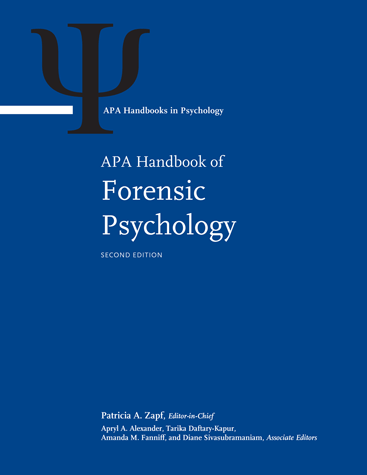
APA Handbook of Forensic Psychology
Part of the landmark APA Handbooks in Psychology® Series from APA
With significant new and updated content across two volumes and more than 40 chapters, this second edition of the APA Handbook of Forensic Psychology advances understanding of the scientific foundations and practical application of psychology to law and law-related policy.
Psychological knowledge is now regularly used in trial, appellate, and supreme court cases at state and federal levels, and is used to craft law on relevant topics. Psychologists routinely provide testimony about criminal defendants, litigants, and psychological issues in trial courts. Psychological knowledge finds its way into amicus briefs submitted to appellate and supreme courts. To address these and the many other contributions of the field, the first edition of this handbook was published in 2015. Since that time, social, cultural, and political events have shaped the evolution of forensic psychology towards a greater awareness of the importance of sociocultural identities and differences, and related structural and systemic issues. Further, the field has seen massive expansion of the use of technology, from videoconferencing for evaluations to machine learning in hiring decisions. Accordingly, this edition updates and expands the previous one, including discussions of sociocultural identities and systemic inequities, bias, and technology.
The first volume considers individual and situational influences in criminal and civil contexts, with chapters covering forensic evaluation and treatment in criminal cases, individual and situational predictors of criminal behavior, and applications of forensic psychology in civil cases. The second volume of the handbook presents the state of the field in criminal investigation, adjudication, and sentencing outcomes. Chapters examine victim and offender groups, criminal investigations and jury trials, and sentencing and incarceration. To ensure cohesiveness and thorough coverage of core topics, the chapters benefit from a standard set of headings, facilitating wayfinding and highlighting relevant themes. Chapter authors include well-established, internationally recognized scholars and practitioners, as well as rising stars in the field.
Drawing on contemporary psychological research and practice, the handbook provides an indispensable reference on forensic psychological issues important to researchers, practitioners, and students in psychology, other social sciences and practice disciplines, and law.
Volume 1. Individual and Situational Influences in Criminal and Civil Contexts
Editorial Board
About the Editor-in-Chief
About the Associate Editors
Contributors
A Note From the Publisher
Introduction
Part I. Forensic Evaluation and Treatment in Criminal Cases
- Chapter 1. Forensic Mental Health Assessment: Foundational Considerations
Kirk Heilbrun, Heidi Zapotocky, Chelsea Jackson, Kellie Wiltsie, and Hailey Fasone - Chapter 2. Advances in Forensic Assessment Instruments
Richard Rogers, Lindsey D. Ryan-Jones, and Kamar Y. Tazi - Chapter 3. Risk Assessment and Communication
Stephen D. Hart, Kevin S. Douglas, and Laura S. Guy - Chapter 4. Legal Insanity and Mens Rea Defenses
Natalie M. Anumba and Ira K. Packer - Chapter 5. Criminal Competencies
Daniel C. Murrie and Heather Zelle - Chapter 6. Competence Restoration
Daniel C. Murrie, W. Neil Gowensmith, Lauren E. Kois, and Ira K. Packer - Chapter 7. The Mental Health Treatment of Criminal Offenders
Perry A. Callahan, Linden Loutzenhiser, and Barry Rosenfeld - Chapter 8. Capital Case Considerations
David DeMatteo, Chelsea Jackson, and Kellie Wiltsie - Chapter 9. Applications of Technology in Forensic Mental Health Assessment
Ashley B. Batastini, Madison Lord, Michelle R. Guyton, and Michael J. Vitacco - Chapter 10. Cognitive Bias in Forensic Evaluation and Treatment
W. Neil Gowensmith, Daniel C. Murrie, Tess M.S. Neal, Marcus T. Boccaccini - Chapter 11. Forensic Applications of the DSM-5 Alternative Model for Personality Disorders
Abby L. Mulay, Emily D. Gottfried, and Matthew M. Yalch
Part II. Individual and Situational Predictors of Criminal Behavior
- Chapter 12. Criminal Behavior
Shelley L. Brown, Emma McFarlane, and Meghan Garvey - Chapter 13. Psychopathy
Kevin S. Douglas, Man Him Ho, Natalia L. Nikolova, Shannon Kelley, and John F. Edens - Chapter 14. Substance Use and Crime
David DeMatteo, Simone P. Grisamore, and Haleh Kanani - Chapter 15. Sexual Offending
Drew A. Kingston, Heather M. Moulden, and Michael C. Seto - Chapter 16. Intimate Partner Violence
Alexandra Lysova, Tonia L. Nicholls, John Hamel, and Faith Eiboff - Chapter 17. Gun Violence and Mass Shootings
Jillian Peterson and James Densley
Part III. Applications of Forensic Psychology in Civil Cases
- Chapter 18. Child Custody and Access
Marc J. Ackerman, Jonathan W. Gould, and Christopher Mulchay - Chapter 19. Personal Injury and Other Tort Matters
Lisa M. Drago, Anthony J. Giuliano, Thomas J. Guilmette, Eric Y. Drogin, and Leigh D. Hagan - Chapter 20, Employment Discrimination
Jane Goodman-Delahunty, Justin R. Ellis, Laura S. Brown, and Sofia B. Davey - Chapter 21. Civil Competencies
Randy K. Otto and Haley Barry - Chapter 22. Immigration Proceedings
Virginia Barber-Rioja, Adeyinka M. Akinsulure-Smith, and Sarah Vendzules
Index
Volume 2. Criminal Investigation, Adjudication, and Sentencing Outcomes
Editorial Board
Contributors
Part I. Victim and Offender Groups
- Chapter 1. Children as Witnesses
Jason J. Dickinson and Sonja P. Brubacher - Chapter 2. Youth Involved In the Legal System
Jennifer L. Woolard, Amanda NeMoyer, Lena DeYoung, Nivedita Anjaria, Naomi E. Goldstein, and Marina Tolou-Shams - Chapter 3. Older Adults and the Legal System
Eve M. Brank and Lindsey E. Wylie - Chapter 4. Criminal Justice-Involved Women
Tonia L. Nicholls, James Avery, Vivienne de Vogel, and Lisa Monchalin - Chapter 5. Race and Ethnicity in the Justice System
Jennifer S. Hunt - Chapter 6. Sexual and Gender Identities and the Legal System
Apryl A. Alexander, Amanda M. Fanniff, Leah Zachariah, Reilly E. Gallin, and Erin Kim Hazen
Part II. Criminal Investigations and Jury Trials
- Chapter 7. Investigative Psychology
David Canter - Chapter 8. Eyewitness Memory
Nancy K. Steblay - Chapter 9. Deception Detection
Aldert Vrij - Chapter 10. Confessions
Saul M. Kassin, Jennifer T. Perillo, Sara C. Appleby, and Gabriela Rico - Chapter 11. Jury Decision Making
Lora Levett and Margaret Bull Kovera - Chapter 12. Media and the Law
Jennifer Groscup - Chapter 13. Procedural Justice
Alana Saulnier and Diane Sivasubramaniam - Chapter 14. Law Enforcement and Policing
Mark Zelig, David M. Corey, and Michelle Hoy-Watkins
Part III. Sentencing and Incarceration
- Chapter 15. Specialty Courts: Advancing Rehabilitative Ideals in the Legal System
Spencer G. Lawson and Evan M. Lowder - Chapter 16. Plea Bargaining
Tina M. Zottoli, Tarika Daftary-Kapur, Allison D. Redlich, Rebecca K. Helm, and Vanessa A. Edkins - Chapter 17. Community Corrections, Probation, and Parole
Loveline C. Phillips and Faye S. Taxman - Chapter 18. Sentencing
Mia A. Thomaidou and Colleen M. Berryessa - Chapter 19. The Nature and Effects of Prison Overcrowding
Craig Haney - Chapter 20. The Death Penalty
Craig Haney, Joanna Weill, and Mona Lynch
Index
Patricia A. Zapf, PhD, is a forensic psychologist and vice president for business innovation and strategic advancement at Palo Alto University. Dr. Zapf obtained her PhD from Simon Fraser University. She began her career in 1999 at the University of Alabama. In 2002, she moved to John Jay College of Criminal Justice, where she developed and directed their clinical forensic psychology doctoral program. In 2009, she founded CONCEPT Professional Training. Dr. Zapf has authored numerous publications and has served as an editor for both journals and book series. She has developed training programs for forensic mental health professionals worldwide.
Apryl A. Alexander, PsyD, is the Metrolina Distinguished Scholar in Health and Public Policy and associate professor in the Department of Health Management and Policy at the University of North Carolina at Charlotte, and directs the UNC Charlotte Violence Prevention Center. She received her doctorate from the Florida Institute of Technology. Her work focuses on violence and victimization, forensic assessment, sexual offending and human sexuality, and trauma-informed and culturally informed practice. Dr. Alexander has received several early career research awards, accolades for her teaching and mentoring, and honors for her community engagement and legislative advocacy. Visit Dr. Alexander's website.opens in new window
Tarika Daftary-Kapur, PhD, is professor of justice studies, associated faculty with the doctoral program in clinical psychology, and codirector of the Legal Decision Making Labopens in new window at Montclair State University. Her research focuses on adolescent decision-making and legal competencies, the decision-making process of legal actors, and sentencing reform. She has testified before the legislatures of several states and collaborated with jurisdictions around the country on reforming youth justice systems. Dr. Daftary-Kapur is on the editorial board of Law and Human Behavior and has served on committees for the American Psychology-Law Society and grant review panels for the National Science Foundation.
Amanda M. Fanniff, PhD, is an associate professor of psychology at Palo Alto University. Dr. Fanniff received her PhD in clinical psychology from the University of Arizona. Her research focuses on forensic mental health assessment, legal system processing, and the impact of sociocultural identities. She is on the editorial board for the journal Sexual Abuse. She is a committee member for the American Psychology-Law Society and the Society for the Psychological Study of Social Issues, and serves as the American Psychology-Law Society appointed representative to the Forensic Psychology Specialty Board of the Council of Specialties in Professional Psychology.
Diane Sivasubramaniam, PhD, is professor and chair of the Department of Psychological Sciences at Swinburne University of Technology. She directs the Social Psychology of Innovation Research Group at Swinburne and coleads the Public Interest Technology Research Program in the university's Social Innovation Research Institute. Dr. Sivasubramaniam received her PhD from the University of New South Wales. Her research focuses on the social psychology of procedural and distributive justice. She has held leadership roles in the American Psychology-Law Society; has served the Australian and New Zealand Association of Psychiatry, Psychology and Law; and is an associate editor of Law and Human Behavior.