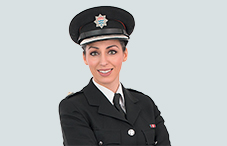

Collecting behavioral data on emergency responders—such as how they assess danger and how they make decisions—is challenging for researchers. And without such data, it’s difficult to develop evidence-based protocols for training, collaboration and even safety. But a breakthrough effort by Sabrina Cohen-Hatton, PhD, deputy assistant commissioner of the London Fire Brigade and an applied psychologist at Cardiff University in Wales, United Kingdom, is capturing such data and improving decision-making during emergencies.
Cohen-Hatton, a 17-year veteran of the fire service, served as a full-time commander while completing her bachelor’s degree in psychology and PhD in behavioral neuroscience. She now studies emergency responders via an honorary research fellowship at Cardiff University.
In a study, Cohen-Hatton strapped cameras to firefighters’ helmets as they tackled incidents simulated in virtual reality, on the firehouse training ground and during live burns in buildings slated for demolition.
The study tested a new goal-oriented training method that has resulted in greater situational awareness—understanding of the environment and what to expect next—and better planning among incident commanders, which leads in turn to increased safety and efficiency.
"We found that the number of commanders operating at the highest level of situational awareness increased by up to five times," says Cohen-Hatton, who won the Raymond S. Nickerson Best Paper Award in the Journal of Experimental Psychology: Appliedopens in new window.
Cohen-Hatton spoke to the Monitor about how goal-oriented training can increase safety and effectiveness in emergency responders.
How has your experience working as a firefighter shaped and inspired your research?
The whole reason that I wanted to start this research was because I’d had a personal incident myself as a firefighter. My husband, who is also a firefighter, was at the time my fiancé, and I was called to a fire where someone on his fire engine had been badly burned, and there was a one in four chance it was him. That was probably the longest 4 minutes and 37 seconds of my life. I was really lucky that day—it wasn’t my loved one, but it was someone else’s. I knew at that moment that I wanted to do more to try and keep firefighters safe.
Also, when you look at all industrial accidents, 80 percent are caused by human error. It’s the way that someone’s interpreted a situation—something’s gone wrong with the way they’ve judged the risk. It may be a cognitive bias that they have, the wrong association, the wrong conditioned response for some of the cues that they’re exposed to. For me, the only way to reduce human error and keep firefighters safer is to understand how people think and behave.
How does goal-oriented training differ from the conventional training firefighters receive?
The standard decision-making model used across the United Kingdom fire service is a very analytical model, but an earlier study of ours observed many commanders exhibiting a much more intuitive process, where they rely on experience and conditioning to make decisions.
The new model we came up with recognized both the analytical and the intuitive. Commanders will make a decision based on their previous experiences and coping strategies, and we knew we weren’t going to stop someone from using an intuitive process. The appropriate point to make an intervention is once they’ve made a decision but before they implement that decision.
So, that was the point that we focused on, and we introduced a rapid mental check called a "decision control." The commanders ask themselves: Why am I doing this, what is my goal, and what do I expect to happen? Our goal was to raise their situational awareness to the highest level by giving them a scaffold for their thought process to anticipate what would happen next and assess how the benefits outweighed the risks.
How did the use of three phases, including a live burn, maximize the translational power of the study?
Over the past decade in the United Kingdom, the number of actual fires we go to has been reduced by 50 percent because of the improvements in fire safety regulations. That also means 50 percent less practice. We studied several training interventions—virtual reality, the firehouse training ground and live burn—to understand whether incident commanders use similar decision-making processes in each context.
The final intervention—the live burn situation—was the most exciting part, because you were introducing a level of risk and realism akin to an actual incident. We found that people’s decision-making processes were similar across all contexts, and that our goal-oriented training was effective across the board. This suggests that some of those less realistic (but much less expensive) training methods, such as virtual reality, are valuable ways to supplement our current regimen.
How has your research influenced policies and training for emergency responders?
As a direct result of this research, the new decision-control process is now embedded within national policy: All incident commanders across the United Kingdom are using that process.
We’ve also had international fire services interested in the work and how it can help to improve firefighter safety.
What questions or potential safety improvements do you hope to explore next?
One area we’re particularly interested in is what happens when strategic decision-makers come together during an emergency. We want to explore both how they sequence their decision-making, and how we can make that collaboration more goal directed. It’s introducing a whole new layer of group dynamics into the decision-making process that we’ve been so focused on unpacking on an individual scale.
Dr. Cohen-Hatton further explores the psychology of incident command in her memoir, "Through the Fire," which will be published in the spring of 2019.