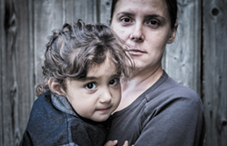

Children as young as ages 2 to 3 can display behaviors that are predictive of serious anti-social behaviors later in life, including violent crimes. But as researchers at the Pitt Parents and Children Lab at the University of Pittsburgh have found, providing a child's family with even one positive parenting intervention can lead to fewer of these destructive behaviors a decade later.
Because parental stress, parental depression and rejection of parenting are tightly associated with poor childhood outcomes, the key is to get a child's caretakers on the right track, according to Daniel Shaw, PhD, who heads the lab. For more than 25 years, Shaw and his collaborators have tracked multiple cohorts of families with young children to better understand how poverty, housing insecurity, the death of a parent and other extreme challenges can affect child outcomes—and to identify ways to help these children by boosting protective factors in their home environment.
 Shaw and his colleagues observe family dynamics in relatively informal settings, beginning in family's homes. Shaw's team also observes children in environments they spend more time in with age, including their neighborhoods, schools and after-school activities. They then break down how specific behaviors lead to serious conduct problems that could result in drug use, criminal behavior and other negative outcomes. The researchers then teach moms, dads and other family caregivers positive parenting behaviors and help them connect with their children. "Our overriding strategy is to help at-risk children by motivating parents to improve their parenting," Shaw says.
A driving philosophy of the lab is that it's never too early to intervene. "We believe it's easier to intervene as soon as possible, before certain really maladaptive family dynamics are crystallized and entrenched," says Anne Gill, PhD, the lab's clinical supervisor. "When you're able to work with young children, you really do have the potential to significantly change the child's trajectory."
Getting to the root of anti-social behavior
Shaw, who earned his PhD in child clinical and developmental psychology at the University of Virginia in 1988, has long been fascinated by the ways parental conflict affects children. "I couldn't help but notice that, not surprisingly, such conflict often results in disruptive behavior in the child," he says.
He was particularly intrigued by the work of Mary Ainsworth, PhD, and Dick Bell, PhD, two giants in developmental psychology who happened to be University of Virginia faculty. Ainsworth had performed groundbreaking experiments that advanced the development of attachment theory. Bell studied how parent-child interactions might lead to anti-social behavior later in life.
Inspired by these researchers, Shaw sought to identify early precursors of destructive behavior that could be the basis for an intervention administered in early childhood. "We were convinced that it was really hard to get kids to change course once they reached 10 or 11 years of age," Shaw says. "But back in the late '80s and early '90s, it was considered fairly novel to work with kids so young."
He embraced the idea that disruptive behavior stems from a child who might not be easy to manage combined with stressed, depressed and unskilled parents, particularly mothers who lack critical resources such as money or help from a partner. That led Shaw to collaborate with Thomas Dishion, PhD, then at the University of Oregon and currently at Arizona State University, to help adapt Dishion's Family Check-Up intervention for toddlers. Previously, the Family Check-Up had primarily been used with parents struggling with an adolescent's behavior. The Family Check-Up incorporates motivational interviewing to foster parents' ability to address their child's disruptive behavior; then it uses evidence-based parent training to improve their caregiving skills.
Shaw took a position at the University of Pittsburgh primarily because of its proximity to a population plagued by health, educational and financial disparities. He hoped that by studying this population, he could identify risk factors in early childhood that would predict serious forms of anti-social behavior in later childhood and adolescence. He would then target these risk factors in early childhood to prevent those behaviors.
In part, Shaw was spurred by research that showed that while middle-class children can develop oppositional behavior during the "terrible twos," few develop serious conduct disorders that culminate in violent behavior. However, his research has shown that young children raised in poverty who demonstrated high levels of oppositional and dysregulated behavior and/or who experienced harsh parenting were much more likely to be arrested before age 18 (Child Development, Vol. 88, No. 1, 2017opens in new window).
Helping parents
Shaw launched the Pitt Parents and Children Lab in 1988. Most of the lab's projects have been funded by the National Institutes of Health, including three current studies. Each study has its own project coordinator. In addition, the lab currently employs four lab members that it calls "family coaches." There are also five graduate students and several other staff members assisting with data collection, coding and analysis.
The first large-scale longitudinal study the lab launched was the Pitt Mother & Child Project. Begun by Shaw in 1991 in collaboration with University of Pittsburgh colleague Joan Vondra, PhD, with support from the National Institute of Mental Health and the National Institute on Drug Abuse (NIDA), the project identified factors associated with resiliency and vulnerability among low-income boys in the Pittsburgh area. Shaw and his team recruited 310 families with infant boys ages 6 months to 17 months from area Women, Infants, and Children Special Supplemental Nutrition Program (WIC) clinics. The team assessed family members—including the boys, their parents, siblings, peers and eventually romantic partners—at participants' homes or in the lab every six to 24 months until the boys reached age 23.
Data from the Pitt Mother & Child Project have spawned dozens of publications over the years. Shaw and his team identified several factors associated with resilience, including child intelligenceopens in new window, child nighttime sleepopens in new window, child observed likability and mother-reported emotionality and sociabilityopens in new window. They also found that those factors were less protective for children living in particularly high-risk neighborhoodsopens in new window. In addition, the team identified precursors of future conduct problems, including child fearlessnessopens in new window, child hyperactivityopens in new window, child noncompliance, maternal depressionopens in new window, maternal rejection of parentingopens in new window and sibling conflictopens in new window.
As his lab started to get a handle on early childhood indicators that predicted later anti-social behavior, Shaw began to think about how to help at-risk families change course and increase resiliency. In 1999, he met Dishion and learned about the Family Check-Up.
The lab has since used the tool in most of its intervention studies. At the core of the Family Check-Up is a feedback session in which a lab member compares a child's behavior to normative averages and motivates the parents to want to do something positive for their child. "We'll say, ‘If there were 100 kids in the room right now, your child would be one of the two most disruptive,'" says Kate Hails, a graduate student in the lab. "That's a very powerful incentive for the parent."
After the feedback session, the parents identify goals for behavior change and decide whether they want to continue seeing the lab member—usually three or four times a year—or work on their goals themselves. Interestingly, although follow-up treatment sessions after initial feedback do not seem to improve long-term child outcomes, annual feedback does. Shaw believes the feedback sessions motivate parents into positive action.
The lab's first big project using the Family Check-Up is an ongoing study started in 2002 called the Early Steps Multisite Study, designed to test whether the intervention can curb conduct problems, drug use and risky sexual behavior through early adolescence. Supported by NIDA, and in collaboration with Dishion and University of Virginia psychologist Melvin Wilson, PhD, Shaw and his team recruited an ethnically diverse sample of at-risk families when children were 2 years old from urban (Pittsburgh), suburban (Eugene, Oregon) and rural (Charlottesville, Virginia) areas. The team found that in all three areas, the Family Check-Up prevented conduct problems and improved maternal depression, parenting, language development and school achievement. The effects have lasted more than a decade (Child Psychiatry & Human Development, Vol. 45, No. 5, 2014opens in new window).
Now that the children in the Early Steps study are turning 16, Shaw and his team have been testing whether the positive effects have persisted into adolescence. Preliminary data analyses suggest that by improving parenting and maternal depression when children are between ages 2 and 3, the children exhibit a decrease in high-risk behaviors between ages 14 and 16, including substance use.
In 2014, Shaw and his team launched another ongoing project, the Smart Beginnings Study, to catch at-risk children and their families at birth. Supported by the National Institute of Child Health and Human Development, the study aims to improve school readiness, including social-emotional, preacademic and self-regulation factors by using the Family Check-Up and the Video Interaction Project, designed by New York University behavioral pediatrician Alan Mendelsohn, MD. The Video Interaction Project provides parents with a developmental specialist who records parents and their children playing together and coaches the parents on effective parenting practices. "The lab member highlights what parents are doing really well and then offers some suggestions for things that can be done better," Gill says.
Shaw and his team also demonstrated that the Family Check-Up can be used to improve health-related areas of functioning—such as sleep regulation, physical activity and emotion regulation—in children ages 10 to 13 (Clinical and Translational Science, Vol. 6, No. 3, 2013opens in new window).
In another effort aimed at helping adolescents, in 2014 Shaw launched the Safekeeping Youth (SKY) Study, also funded by NIDA. Through the study, the lab screens adolescents for risk of substance use and offers the Family Check-Up. Early results are promising, though they have yet to be published. Gill says if the intervention effects continue to look strong, the team may ask NIDA for funding to perform MRIs on the study participants to see if differences in brain function are associated with youth high-risk behavior.
"The SKY Study has been really eye-opening for me," Gill says. "If you asked me before the study when the ideal developmental time period is to intervene, I would have said early childhood, no questions asked. But being able to support parents of adolescents in making meaningful change and seeing parents really do things differently has been incredibly powerful and moving."
Setting up shop in the real world
After more than 25 years researching precursors of conduct problems in children and testing interventions, Shaw and his team have now launched the Center for Parents and Children, where they are collaborating with community agencies that serve young children and families to implement their interventions.
"I've accomplished my goals as a researcher," Shaw says. "The next phase is seeing if we can get results in the real world."
Initially, the center will work with Head Start programs throughout Pittsburgh. Head Start teachers will refer at-risk families to lab members such as graduate student Lindsay Taraban, who will then observe the child in the classroom and meet with the child's parents in their homes to perform the Family Check-Up.
The ultimate goal of the center is to make Pittsburgh a laboratory that other communities could learn from and emulate. "Our dream for the center is to make a difference in our community and beyond, not just study families and learn from them but to really empower parents to make a difference in their children's lives," Gill says.
"Lab Work" illuminates the work psychologists are doing in research labs nationwide.