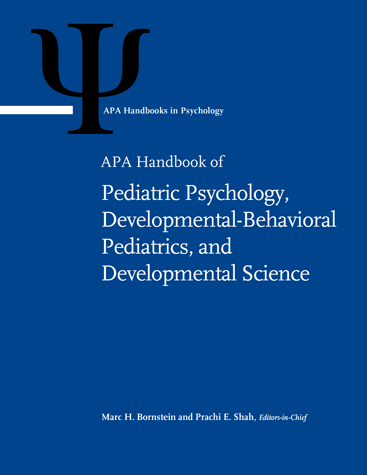
APA Handbook of Pediatric Psychology, Developmental-Behavioral Pediatrics, and Developmental Science
Part of the landmark APA Handbooks in Psychology® Series from APA
This vital two-volume handbook summarizes current and emerging research and clinical evidence to provide a working knowledge of the contributions of pediatric psychology, developmental-behavioral pediatrics, and developmental science, and promote the integration of these disciplines to improve child and adolescent health and well-being.
In a nutshell, pediatric psychology emphasizes fostering children’s adaptation in the face of illness and hospitalization; developmental-behavioral pediatrics aims to improve the health of children through an understanding of the biopsychosocial, educational, and cultural influences on them and their families; and developmental science focuses on theoretical and empirical advances in understanding mental, emotional, and social aspects of human development and their underlying and associated processes and contexts. There has been longstanding recognition of the need to more closely unite the three fields.
The APA Handbook of Pediatric Psychology, Developmental-Behavioral Pediatrics, and Developmental Science aims to deepen communication between these domains by providing an integrative approach to addressing specific issues in child well-being. Chapters in Volume 1 highlight the developmental origins of risk and resilience across early phases of the life course, covering developmental science framing and processes, biopsychosocial systems in development, and social and material contexts of child and adolescent health and well-being. The contributions in Volume 2 focus on clinical applications of developmental science in pediatric psychology and developmental-behavioral pediatrics, discussing family systems and ecological contexts, child developmental contexts and child health conditions, and developmental-behavioral and mental health conditions.
The handbook coeditors-in-chief recruited a diverse array of outstanding professionals from developmental science, medicine, and pediatric psychology. This stellar roster prompts trainees, researchers, practitioners, and other professionals to explore new ways to understand and manage child and adolescent health and well-being, and promote deeper interdisciplinary collaborations that can support growth and development.
Volume 1. Developmental Science and Developmental Origins of Risk and Resilience in Childhood and Adolescence
Contents
Editorial Board
About the Editors
Contributors
A Note from the Publisher
Introduction
Part I. Developmental Science Framing and Processes
- Chapter 1. Child and Adolescent Health and Well-Being in Pediatric Psychology, Developmental-Behavioral Pediatrics, and Developmental Science
Marc H. Bornstein and Prachi E. Shah - Chapter 2. Neurobiology, Brain Development, and Child and Adolescent Health and Well-Being
Amanda E. Guyer and Christine W. Nordahl - Chapter 3. A Bioecological-Contextual Framework for Developmental-Behavioral Pediatrics and Pediatric Psychology
Theodore D. Wachs and Feyza Corapci - Chapter 4. Cascades in Child and Adolescent Development and Health
David H. Rakison and Vanessa LoBue - Chapter 5. Adverse Childhood Experiences and Later Health and Development
Elizabeth T. Gershoff and George W. Holden
Part II. Biopsychosocial Systems in Development
- Chapter 6. Psychoneuroendocrinology, Stress, and Physiological Markers of Child and Adolescent Development and Mental and Physical Health
Jenalee R. Doom, Deborah Han, and Delia M. Vazquez - Chapter 7. Prenatal Stress and Child and Adolescent Development: Pathways, Processes, and Interventions
Eszter Szekely, Enav Z. Zusman, Alegra Kandiyoti, Ashley Wazana, and Tim F. Oberlander - Chapter 8. Language and Language Disorders in Childhood and Adolescence
Dani Levine, Caroline Gaudreau, Dana L. Suskind, Roberta Michnick Golinkoff, and Kathryn Hirsh-Pasek - Chapter 9. Executive Function and Health in Childhood and Adolescence
Destany Calma-Birling, Romulus Castelo, and Philip David Zelazo - Chapter 10. Attachment in Pediatrics: No Such Thing as a Child
Marian J. Bakermans-Kranenburg and Marinus H. van IJzendoorn - Chapter 11. Prosocial Development to Support the Well-Being of Children and Adolescents With Pediatric Health Conditions
Paul D. Hastings - Chapter 12. Social and Moral Development in Childhood and Adolescence: Mental State Understanding, Intergroup Interactions, and the Importance of Context in Health
Jacquelyn Glidden, Kathryn M. Yee, and Melanie Killen - Chapter 13. Sibling Relationships Across Childhood and Adolescence: Recommendations for Parents and Healthcare Practitioners
Brenda L. Volling, Nina Howe, and Laurie Kramer - Chapter 14. Maladaptive Peer Relationships and Bullying: Associations With Child and Adolescent Health
Kirsty S. Lee, Slava Dantchev, and Dieter Wolke - Chapter 15. Promoting Resilience in Children, Families, and Communities in the Service of Health Promotion
Nicholas V. Alen, Camelia E. Hostinar, and Suniya S. Luthar - Chapter 16. Unpacking Extended Adolescence: Ecological Contexts, Relationships, and Pathways to Adulthood From a Developmental Health Perspective
Nancy E. Hill and Alexis Redding
Part III. Social and Material Contexts of Child and Adolescent Health and Well-Being
- Chapter 17. Digital Media, Children, and Mental Health
Tiffany Munzer and Kristen Harrison - Chapter 18. Health Disparities in Childhood and Adolescence: Pathways to Equity Through Nurturing Care and Complex Systems
Maureen M. Black, Alysse J. Kowalski, and Elizabeth Randolph - Chapter 19. Diversity, Equity, Inclusion, and Social Justice in Health Research and Professional Practice With Children and Adolescents
Aerika Brittian Loyd, Diamond Y. Bravo, David D. Lo, and Juliet McMullin - Chapter 20. Nurturing the Healthy Development of Children and Adolescents of Color in a Racialized Society
Rashmita S. Mistry, Taylor Hazelbaker, Jessica P. Montoro, Jeffrey Yo, and Anna M. Kimura - Chapter 21. Foster Care, Adoption, and Children’s Health and Well-Being
Laurie C. Miller and Ellen E. Pinderhughes - Chapter 22. Children and Adolescents in Immigrant Families: Implications for Health
Linda R. Cote, Silvia Pereira-Smith, Maryann P. Valcourt, and Jacey Carey - Chapter 23. Family Homelessness as a Context of Risk to Children’s and Adolescents’ Health and Development
Janette E. Herbers and J. J. Cutuli - Chapter 24. Poverty and Socioeconomic Adversity in Relation to Child and Adolescent Health
Alexander J. Dufford, Pilyoung Kim, and Gary W. Evans - Chapter 25. Child Maltreatment and Trauma in Behavior Pediatric Perspective
Dante Cicchetti - Chapter 26. Parental Substance Use and Addiction: Developmental Science and Pediatric Effects for Children’s and Adolescents’ Health and Development
Hiram E. Fitzgerald, Vincent C. Smith, and Julie M. Croff - Chapter 27. Parental Incarceration and Pediatric Health
Danielle H. Dallaire, Jennifer M. Traver, and Sierra L. Forester - Chapter 28. Preparation and Response to Natural Disasters, Pandemics, Terrorism, and War Through Interdisciplinary Coalitions: Associations With Child and Adolescent Health and Development
Joy D. Osofsky and Howard J. Osofsky
Index
Volume 2. Pediatric Psychology and Developmental-Behavioral Pediatrics: Clinical Applications of Developmental Science
Contents
Editorial Board
Contributors
Part I. Family Systems and Ecological Contexts Relevant to Child Health, Development, and Behavior
- Chapter 1. Family Processes and Child Outcomes in Children With Chronic Health Conditions
Thomas G. Power, Wendy M. Gaultney, and Lynnda M. Dahlquist - Chapter 2. Pediatric Treatment Adherence
Alexandra M. Psihogios, Annisa Ahmed, Christina E. Holbein, and Aimee W. Smith - Chapter 3. Chronic and Recurrent Pain: Considerations for Child Health and Well-Being
Tonya M. Palermo and Irina Gorbounova - Chapter 4. Pediatric Medical Traumatic Stress
Melissa Carson, Joshua Kallman, and Douglas Vanderbilt - Chapter 5. Pediatric Palliative, End-of-Life, and Bereavement Care
Cynthia A. Gerhardt, Anna Olsavsky, Garey Noritz, and Amy E. Baughcum
Part II. Select Child Developmental Contexts, Child Health Conditions, and the Role of Pediatric Psychology
- Chapter 6. Gender Identity, Gender Dysphoria, and Gender Affirming Models in Childhood and Adolescence: Clinical and Developmental Science Perspectives
Diane Ehrensaft - Chapter 7. Genetic Disorders in Childhood: Chromosome 22q11.2 Deletion Syndrome, Down Syndrome, and Fragile X Syndrome
Kathleen Angkustsiri, Angela Thurman, and Randi Hagerman - Chapter 8. Congenital Medical Conditions in Childhood and Adolescence, Stigma, and Psychosocial Adjustment
Canice E. Crerand and Jennifer Hansen-Moore - Chapter 9. Pediatric CNS Disorders: Spina Bifida, Epilepsy, and Traumatic Brain Injury
Grayson N. Holmbeck, Dhanashree Bahulekar, Olivia Clark, Julie Doran, Aimee W. Smith, Amery Treble-Barna, and Adrien M. Winning - Chapter 10. Pediatric Sickle Cell Disease: Implications for Child Health and Development
Kemar V. Prussien, Lamia P. Barakat, and Lisa A. Schwartz - Chapter 11. Childhood Cancer: Promoting Health and Well-Being Through Pediatric Multidisciplinary Care
Lisa A. Schwartz, Katie Darabos, Megan Perez, Branlyn DeRosa, Kemar Prussien, Meredith E. MacGregor, and Lamia P. Barakat - Chapter 12. Pulmonary Disorders: Asthma and Cystic Fibrosis, Considerations for Child Health and Well-Being
Emily F. Muther, Courtney Lynn, Emily Skeen, and Monica Federico - Chapter 13. Pediatric and Congenital Heart Disease
Jennifer L. Butcher, Laurel Bear, Cheryl L. Brosig, Colette Gramszlo, Erica Sood, and Samantha Butler - Chapter 14. Type 1 and Type 2 Diabetes: Interdisciplinary Management in Pediatric Settings
Luiza Mali, Gabriela Guevara, and Alan M. Delamater - Chapter 15. Pediatric Obesity, and Implications for Child Health and Well-Being
Bethany J. Gaffka, Susan J. Woolford, Hurley O. Riley, and Alison Miller
Part III. Developmental-Behavioral and Mental Health Conditions and the Role of Behavioral Health Providers
- Chapter 16. Autism Spectrum Disorder and Disorders of Social Cognition Across Childhood and Adolescence
Christina Toolan, Elaine Clarke, Kathleen Campbell, Paul Carbone, and Catherine Lord - Chapter 17. Preterm Birth: Implications for the Family System and Child and Adolescent Health and Well-Being
Maria Spinelli, Julie Poehlmann, and Prachi E. Shah - Chapter 18. Neurosensory Disorders: Hearing, Visual, and Multisensory Impairments in Childhood
Desmond Kelly, Anne Kinsman, and Erin R. Hahn - Chapter 19. Sleep and Sleep Disorders in Children
Judith A. Owens - Chapter 20. Elimination Disorders in Children and Adolescents
Dawn Dore-Stites and Barbara T. Felt - Chapter 21. Attention and Attention-Deficit/Hyperactivity Disorder in Childhood
Tanya E. Froehlich and Stephen P. Becker - Chapter 22. Internalizing and Externalizing Problems in Children and Youth
Lana Mahgoub, David Meyer, and Mary Margaret Gleason - Chapter 23. Pediatric Eating Disorders: ARFID, Anorexia Nervosa, Bulimia Nervosa, and Binge Eating Disorders
Terrill Bravender, Natalie Prohaska, and Jessica Van Huysse - Chapter 24. Suicidal Thinking and Behavior in Youth: Prevention, Intervention, and Implications for Child and Adolescent Health
Cynthia Ewell Foster, Seth Finkelstein, Daniel Epstein, and Cheryl A. King
Part IV. Multidisciplinary Assessments, Interventions, and Treatments to Foster Child Health and Well-Being
- Chapter 25. Developmental Assessment of Infants and Toddlers: Concepts, Psychometric Issues, and Related Brain Development
Glen P. Aylward - Chapter 26. Learning, Cognition, and Intellectual and Learning Disorders—Evaluation and Management in Pediatric Settings
Danielle N. Shapiro and Jennifer C. Gidley Larson - Chapter 27. Psychological Consultation in Inpatient Pediatric Medical Settings
Cassie N. Ross and Kristin A. Kullgren - Chapter 28. Integrated Behavioral Health in Pediatric Health Care Settings
Blake M. Lancaster, Hannah L. Ham, Alexandra Neenan, Eleah Sunde, Sharnita D. Harris, Luke K. Turnier, Richard Birnbaum, and Alexandros Maragakis - Chapter 29. Relationship-Focused Interventions and Psychotherapy: Applications for Child and Adolescent Health and Behavior
Megan Julian, Fiona Miller, and Jerrica Pitzen
Index
Marc H. Bornstein, PhD, holds a BA from Columbia College and an MS and a PhD from Yale University. Dr. Bornstein has professional positions at the National Institute of Child Health and Human Development, the Institute for Fiscal Studies, London, and UNICEF. He previously held faculty positions and other academic appointments around the world. The recipient of numerous awards, Dr. Bornstein is president emeritus of the Society for Research in Child Development and serves on the Executive Committee of the International Society for the Study of Behavioral Development.
He is coauthor, editor, or coeditor of dozens of books and hundreds of scientific papers. Dr. Bornstein is editor emeritus of Child Development, founding editor of Parenting: Science and Practice, and sits on the editorial boards of several professional journals. He has administered federal and foundation grants and consults widely.
Prachi E. Shah, MD, MS, is a professor of pediatrics and psychiatry at the University of Michigan, Ann Arbor. Dr. Shah obtained her medical degree from Baylor College of Medicine in Houston, Texas, where she also completed her pediatric residency. At Michigan, her clinical efforts focus on early child development and the diagnostic assessment of children, and she is the medical director of the Neonatal Followup Program and the Fetal Alcohol Spectrum Disorders Diagnostic Clinic.
She is active in the Fetal Alcohol Spectrum Disorders Committee of the American Academy of Pediatrics and in other professional organizations, and is a coauthor on the forthcoming clinical update on the diagnosis and management of fetal alcohol spectrum disorders. She has served as the associate editor of Parenting Science and Practice and is an ad hoc reviewer for numerous journals.