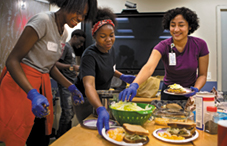

It's a Wednesday evening in the South Bronx, and scores of teenage boys and girls are playing soccer, learning English and filling up on a nutritious home-cooked meal. The event is being hosted by Terra Firma, an innovative medical-legal partnership affiliated with Montefiore Medical Center and supported by the Children's Health Fund.
Terra Firma has become a weekly gathering place and support center for these teens, many of whom have recently immigrated to New York from one of several Central American countries, including El Salvador, Guatemala and Honduras.
Their journey to the United States typically involves traveling alone or in small groups and can include walking for days or riding atop freight trains. Once they reach the U.S. border, they may have to swim across the Rio Grande or travel through the desert in Texas, Arizona or New Mexico, where they either turn themselves in or are apprehended by authorities. After spending some time in an immigration processing center—often ice-cold and offering only cursory medical services at best—the teens are transferred to an Office of Refugee Resettlement shelter, located in cities across the country, including New York City, before they join family or friends.
The voyage may be dangerous, but staying in their home countries is more perilous: Nearly all of the teens are fleeing poverty, community violence, gangs and often abuse or neglect in their own homes, says psychologist Cristina Muñiz de la Peña, PhD, one of the three co-founders of Terra Firma, and the program's mental health director.
"The vast majority of these youth come to the U.S., and then to our organization in New York, with a history of complex trauma, and also likely trauma they faced during their journey here," she says.
Critical support under one roof
These "unaccompanied minors" are often reunited with family members—a parent, an aunt or uncle—whom they haven't seen since they were very young, adds Muñiz de la Peña, a native of Spain. "Once they're here, you add in the stress of adjusting to a new country and a new living situation without an established family connection. That's why bringing these kids and families together is so critical."
 In addition to gathering with others who understand the challenges of acculturating to a new country, these adolescents can also receive free medical, mental health and legal help at Terra Firma. Bringing these three professions together under one roof to provide integrated care to immigrant children is important because it facilitates access to all services and helps develop a strong safety net for children with complex needs. These children also may face legal, transportation, financial and language barriers to receiving quality care, says Terra Firma's medical director and co-founder Alan Shapiro, MD. "These children are getting a medical home and mental health services for the first time in their lives," says Shapiro, a pediatrician.
Terra Firma also gives the children critical documentation from a health-care professional of the complex trauma they have experienced, which can be crucial to the legal process they undergo to seek permission to stay in the United States, says Brett Stark, an immigration attorney with Catholic Charities and Terra Firma's third founder.
"This is one of the few areas of law where emotions actually matter," Stark says. "We often have to prove that someone has experienced persecution, which typically involves trauma and a well-founded fear of returning," he says. "Having a mental health professional and physician to help us prove that is absolutely essential."
Collaborating for legal residence
The typical profile of arriving immigrants has shifted greatly in recent years, away from lone Mexican men seeking work and toward Central American families and unaccompanied children who are fleeing violence in their home countries. According to U.S. Customs and Border Protectionopens in new window, more than 37,000 unaccompanied minors crossed the border from October 2017 to June 2018. While not as high as in 2014, when President Barack Obama declared the waves of children crossing the Mexican border a humanitarian crisis, these numbers are still robust.
In the fall of 2013, a Guatemalan teen named Ricardo* came to see Muñiz de la Peña and Shapiro at a mobile health clinic they were working at outside a drop-in homeless center in Harlem. Ricardo had accidentally washed all his schizophrenia medications in the pocket of his jeans and needed a new prescription. Shapiro and Muñiz de la Peña recognized that the teen was having trouble expressing himself and the only contact he could provide was his case manager at Catholic Charities' immigration legal services office. That's where they met Stark, whose office explained that the boy was seeking asylum as an unaccompanied immigrant child.
At that moment, the three professionals realized the importance each of them played in helping children like Ricardo.
"The three of us just started brainstorming about what the best model of care might be for these children," says Shapiro. "We realized that launching a medical-legal partnership where attorneys come to the community health center and work side by side with pediatricians and mental health professionals would allow us to provide wraparound, comprehensive care to these unaccompanied children and their families."
Since then, the practice has seen nearly 500 unaccompanied minors and has expanded to serve as a community center of sorts, providing medical care, pro bono legal services and individual, family and group therapy for teens experiencing depression, anxiety, and adjustment and traumarelated disorders. It also provides a soccer league, field trips, exercise and photography classes, job search training, English-language instruction and nutrition services.
One of Terra Firma's core offerings is a trauma-informed youth therapy group. Every Wednesday evening, teens participate in a psychotherapy group to process the traumatic experiences they've been through with others who have similar stories.
"So often, even as adults we have trouble articulating when something has been traumatic, but for kids it's even more difficult to identify it and explain these experiences in detail," Muñiz de la Peña says. Information shared during group therapy helps these kids build community and reveals critical information for an unaccompanied minor's legal case.
Several years ago, after one of Stark's clients had been in group therapy for nearly nine months, the client disclosed that gang members had beheaded his best friend right next to him.
"He was so traumatized by this that he'd partly blocked it out of his memory, but it was a critical piece of information for his legal case," says Muñiz de la Peña. "Just witnessing community violence doesn't automatically qualify someone to receive asylum. You have to have been directly threatened."
At the boy's asylum hearing, Muñiz de la Peña testified that it had taken so long for the patient to tell this story because he had suffered from post-traumatic stress disorder. The judge granted him asylum.
 The boy is just one of many whom Terra Firma has helped through the asylum process. Since the practice's founding in 2013, Shapiro and Muñiz de la Peña have written 102 affidavits or letters of support, and all of the cases have won legal relief or are pending hearings.
Two years ago, Terra Firma expanded its reach by launching a therapy group for the adult sponsors of these minors, who can include a child's family or family friends.
"We've realized over the years how much the caretakers themselves struggle with these youth, and the financial and emotional challenges these families often face," Muñiz de la Peña says. "We work with them to develop trust and a secure attachment with these teens."
The program is also beginning to serve adult undocumented immigrants with children, Muñiz de la Peña says. This population is mainly young mothers with small children who have crossed the border illegally, usually for the same reasons as the unaccompanied minors Terra Firma serves.
Integrated from the start
When they launched Terra Firma, all three founders agreed it was essential to have a strong structure of interdisciplinary weekly meetings to discuss clients' mental and physical health needs, as well as where their legal cases stand. "We put this in place mostly because this is an ongoing learning process for all of us, but also because the status of immigration is constantly changing, especially with the current administration," Muñiz de la Peña says.
"Plus, there's always a lot of informal conversations that take place throughout the day to coordinate care," she says. The team has grown to include a second pediatrician, another attorney, an administrative director and a social worker.
New York is unique in that it's one of only six states, plus Washington, D.C., that provide health insurance for undocumented children, so health-care professionals don't have to worry about getting reimbursed, Muñiz de la Peña says. New York City also offers funding for pro bono legal services to this population. Without those two factors, Terra Firma would not have had the resources that have contributed to its success.
"This model is predicated on having integrated behavioral health services and truly wouldn't exist without the co-location of medical, mental health and legal services," Shapiro says. "We really aspire to empower immigrant children to develop resilience, attain stability and reach their full potential."
*Name changed to protect patient identity.
The Monitor's "Adventures in Integrated Care" series explores the work psychologists are doing as members of interdisciplinary teams. If you have a story to share, contact editor Sara Martin at smartin@apa.org.