

The need for psychologists' expertise at the U.S. Department of Veterans Affairs (VA) has never been higher. Over the past decade, more than 2 million Americans have been deployed to Iraq and Afghanistan, and increasing numbers are returning home with depression, anxiety, post-traumatic stress disorder (PTSD) and substance use disorders. The VA reported in Juneopens in new window that an average of 20 veterans die by suicide each day, with female veterans two times more likely to die in that way than nonveteran American adult women. Homelessness also continues to affect veterans at a higher rate than nonveterans, according to a 2015 review led by VA psychologist Jack Tsai, PhD (Epidemiologic Reviews, Vol. 37, No. 1, 2015opens in new window).
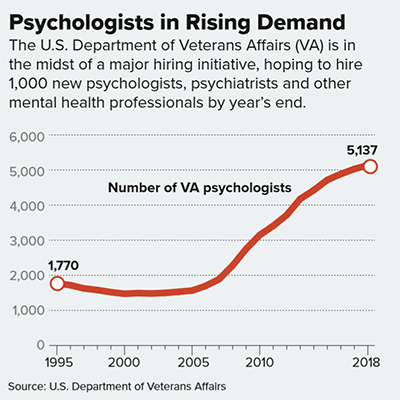
In an effort to reverse those statistics and expand mental health services for veterans, the VA has committed to hiring 1,000 additional mental health providers by the end of 2018opens in new window. The agency is seeking to hire a range of mental health providers, including psychologists, psychiatrists, psychiatric nurses and social workers, as well as licensed professional mental health counselors and marriage and family therapists.
"This initiative aligns with the VA's top critical priority—suicide prevention—but we're also really focused on providing services across the continuum of care," says clinical health psychologist Lisa Kearney, PhD, lead of the mental health hiring initiative in the VA's Office of Mental Health and Suicide Prevention. "We want to hire professionals whose vision and passion is serving those who have served us."
Opportunities for psychologists abound across the agency's 140 health-care systems. They include research, clinical, training and leadership positions, with many options for roles that combine some or all of these skills, Kearney notes. The hiring initiative welcomes mental health professionals from all career stages, including trainees and early career psychologists, as well as those further along in their careers.
Leading the way
Why work at the VA? A top perk is that the agency provides diverse opportunities for career growth and continued learning, say psychologists who work there.
"Part of why I love being in the VA is the range of opportunity," says psychologist John McQuaid, PhD, associate chief of staff for mental health at the San Francisco VA Health Care System. "The VA systems where I've worked have provided the opportunity for psychologists to serve in the multiple roles we do well, including providing excellent patient care, doing the science to understand patient care and do it better, doing the training to prepare people to be the best providers they can be and using our skills to help improve systems."
Also attractive to psychologists is the VA's role as a leader in integrated care. Clinical psychologists at the VA provide evidence-based general and preventive mental health services; treatment for PTSD, substance abuse, depression and anxiety disorders; and spinal cord injury treatment. They also work in inpatient, outpatient and residential care settings, says Terence Keane, PhD, director of the Behavioral Science Division of the National Center for PTSD and associate chief of staff for research and development at the VA Boston Healthcare System. "No one has the breadth and the depth and the scope of mental health and psychological treatments that the VA offers," he says.
The VA, for example, is one of the nation's only health-care systems that offers integrated mental health care in all of its primary-care settings. When patients raise a mental health issue with their primary-care physician, the physician can simply walk the patient down the hall and introduce him or her to an on-site psychologist for treatment in the same clinic. That approach has led to a near-constant demand for primary-care psychologists at the VA, Keane says.
The VA also has interdisciplinary care teams for nearly any condition a veteran might face—most of which include and need psychologists.
"We have an interdisciplinary team dedicated to helping patients manage tinnitus, for example, which can be a consequence of war-zone exposure and can be very distressing for people," Keane says. "Psychologists work with audiologists, speech pathologists, and ear, nose and throat physicians to help patients manage the condition in different ways."
Others say the VA is a good place for early career psychologists to launch their careers if they aren't yet sure which direction to take. "The VA offers so many opportunities to try different things," says Wayne Siegel, PhD, training director at the Minneapolis VA Health Care System. "From a clinical perspective, it's also really nice to work in an environment that is not driven by a billing system. We never have to consider whether we're going to get paid when we're providing a needed treatment to a patient."
The VA is also a leader in providing telemental health services, Kearney says. In May, the VA broke new ground by allowing its health-care providers to practice via telehealth across state lines, pre-empting previous state licensing and telehealth restrictions. The move allows VA providers, including psychologists, to deliver care, and veterans to receive care, from any location. Other aspects of VA care that psychologists say they enjoy are the agency's emphasis on empowering patients to take charge of their own treatment and recovery, and on helping veterans and their families connect with the information and services they need to resume civilian life.
Competitive research
 The VA also offers unique opportunities for psychologists interested in pursuing research. There are strong advantages to being a researcher at the VA, Keane says, the biggest of which is access to the VA's large funding pool.
What's more, VA researchers have access to a huge national population of study participants, thanks to a data warehouse that includes information on millions of veterans who use VA services each year, says Tsai. That includes portals that allow researchers to access the data, he adds.
The agency also operates Centers of Excellence, ripe for scientists interested in studying PTSD, geropsychology, Alzheimer's disease, traumatic brain injuries and neurological disorders such as amyotrophic lateral sclerosis, or ALS. Keane notes that the VA also runs Mental Illness Research, Education and Clinical Centersopens in new window, or MIRECCs, many of which are headed by psychologists and include clinical and neuropsychology researchers. (See Life-changing research at the VA.)
"These roles can include a 50 percent or larger commitment to research," Keane says.
Some psychologists who work at the VA also hold joint affiliations with nearby universities. Tsai, for example, has dual appointments as an associate professor of psychiatry at the Yale School of Medicine and as director of the university's Division of Mental Health Services and Treatment Outcomes Research. He's a staff psychologist at the VA's Errera Community Care Center in West Haven, Connecticut, where he is also director of research. Throughout his career Tsai has studied VA programs for homeless veterans—including the best ways to implement and support these programs—as well as ways to improve social integration among veterans once their military service ends, he says.
"I spend about 50 percent of my time doing direct clinical work on a critical time intervention team, working with veterans who are homeless and/or experiencing severe mental illness, and the other 50 percent of my time conducting research that aligns with that clinical work," he says.
McQuaid, who also holds a dual appointment as vice chair of adult psychology at the University of California, San Francisco, in addition to his role at the San Francisco VA Health Care System, says the combined staff and academic positions provide the best of both worlds. "I have the stability of a staff VA position, but the creativity and innovation of an academic role," he says.
Training and leadership
 The VA has always had a strong teaching and training mission, and as a result, the agency has become a major training ground for psychologists, both within the discipline and intraprofessionally, Siegel says.
The agency provides predoctoral internships, postdoctoral fellowships and doctoral practicum training for psychology trainees nationwide. In fact, over the past 13 years, VA psychology internship and postdoctoral training has almost tripled in scale. This year, the VA is funding 711 psychology internship positions across 133 internship programs in all 50 states, the District of Columbia and Puerto Rico. Similarly, the agency supports more than 450 postdoctoral fellowship positions at 145 VA medical centers.
As the psychology training director at the Orlando VA Medical Center, Mary Beth Shea, PhD, uses her 25 years of institutional VA knowledge to train and supervise doctoral psychology students, interns and postdocs on how to provide excellent mental health care to the veterans they serve.
"The VA has really recognized the ability of psychologists to help train our medical colleagues on how to better serve the veterans that they see," she says.
With their expertise in improving operational excellence, psychologists are also well-equipped to take on administrative and leadership roles within the VA, McQuaid says.
"Part of why I like being in the VA is the ability to have a big impact across a system," he says. Much of McQuaid's daily job as associate chief of staff for mental health is ensuring that his staff has the resources they need and measuring outcomes to determine whether veterans' needs are being met effectively. McQuaid's team recently developed the Behavioral Education and Support Team (BEST) program, which takes a team-based approach toward reducing behavioral disruption among veterans in inpatient care, using what they call development plans. Since the program was launched, the VA has seen a 40 percent drop in injuries among nurses and an increase in the nurses' feelings of safety and effectiveness, McQuaid says.
"This is a program that is not a classic psychologist role in a lot of ways," he says. "But the psychologist is central to creating the development plans and in educating staff on how to implement them."
While the VA offers a plethora of career options for psychologists, those who work there do admit that, as with any job, the roles can come with challenges. One is the ongoing demand for psychologists' services, Kearney says.
"Anyone who has ever worked in a PTSD clinic will tell you about how it's hard to hear those stories over time, and the requests for mental health services seem to be ever-expanding," she says. "These days especially, the needs are increasing while our staffing hasn't grown at the same rate. It can seem almost impossible to keep up with all that need."
McQuaid also notes that it can sometimes be challenging for psychologists who have not had exposure to military or veteran culture to familiarize themselves with some of the unique expectations and challenges veterans are addressing, such as the transition from military to civilian life.
Some psychologists also point to the potential for challenges related to working in the large, complex bureaucracy of the federal government and the political nature of how the U.S. Congress and the public view the VA.
"The VA has become a target for political debate, with some arguing the system should be privatized," Keane says. "The criticisms of the system have led to demoralization of people who are working exceptionally hard to provide excellent patient care."
Yet Siegel notes that these challenges are outweighed by the positives of working for a system that "cares for its population for their life spans." Kearney agrees, adding that the ability to develop and implement such life-changing programs keeps the work rewarding.
"I have never felt stuck at any point in my 15-year career at the VA because it's so easy to switch pathways, learn new things and advance my career as a psychologist," she says.
To search for VA job openings, see the special classified ad section in this issue, or visit www.psyccareers.com or www.vacareers.va.gov/careers/mental-health.opens in new window