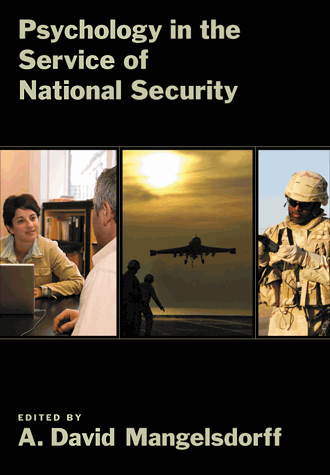
Psychology in the Service of National Security
ISBN: 978-1-59147-355-8This volume highlights the diverse contributions of military psychologists toward U.S. security and toward the discipline of psychology itself. The United States Armed Forces have frequently led American culture in personnel and policy changes that the general population had difficulty accepting, such as racial integration and the integration of women. In addition, psychologists in the military have used clinical approaches to post traumatic stress disorder (PTSD), substance abuse, and psychopharmacology that have tested research understanding before widespread use for the general public.
Currently, psychologists are working with policy makers to help the public build resiliency and cope with disasters, terrorism, and possible threats to the homeland. By putting their skills to work in such areas as personnel management, ergonomics, clinical care, training, leadership and executive development, and social and behavioral research, these individuals have transformed psychology into an integrative discipline that now encompasses aspects of health care and other fields such as information technology and disaster management.
Psychology in the Service of National Security includes perspectives of psychologists and social scientists representing the uniformed services, research institutions, business, and academia. Readers interested in the history of psychology will learn how our armed services came to be on the cutting edge in many areas of basic and applied science. Readers inside and outside the military will learn lessons from military psychology that they can apply to community-based homeland security efforts.
Contributors
Foreword
—Patrick H. DeLeon
Introduction
I. From Military Psychology to National Security Psychology
- The Changing Face of National Security
—A. David Mangelsdorff - Foundations of National Security Psychology
—Warren R. Street
II. Individual Differences
- Human Factors Research in the Naval Service
—Paul D. Nelson - National Security Interests at the Naval Health Research Center
—Karl F. Van Orden and D. Stephen Nice - U.S. Army Research in Human Performance
—Gerald P. Krueger - The History of Special Operations Psychological Selection
—L. Morgan Banks
III. Personnel Management
- The Human Resources Research Organization: Research and Development Related to National Security Concerns
—Peter F. Ramsberger - Psychology in Air Force Training and Education
—Henry L. Taylor - The Navy Personnel Research and Development Center
—Martin Wiskoff and Edmund Thomas
IV. Clinical and Counseling Psychology
- Navy Clinical Psychology: A Distinguished Past and a Vibrant Future
—Morgan T. Sammons - Clinical Psychology in the U.S. Army: 1946–2004
—Robert S. Nichols - Air Force Clinical Psychology: History and Future Trends
—Karl O. Moe
V. Applied Social Psychology
- The U.S. Army Research Institute for the Behavioral and Social Sciences
—Paul A. Gade, Jonathan D. Kaplan, and Nicole M. Dudley - The Racial Integration of the U.S. Armed Forces
—Alan Gropman - Psychological Research with Military Women
—Janice D. Yoder and Loren Naidoo - Military Family Research
—Mady Wechsler Segal
VI. Conclusions
- Psychology's Strategic Position for Today's National Security Concerns
—A. David Mangelsdorff
Additional Resources
References
Author Index
Subject Index
About the Editor