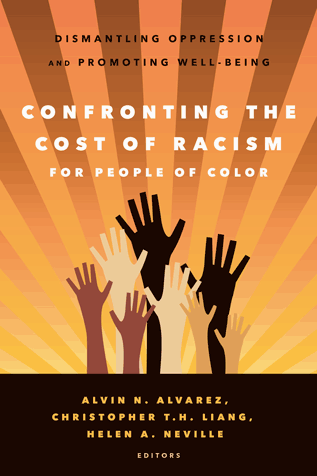
Confronting the Cost of Racism for People of Color
This fully updated edition highlights new research on the impact of racism on people of color, emphasizing models of hope, healing, strength, resiliency, and resistance.
Communities of Color are far from a monolith, encompassing a diversity of racial and ethnic backgrounds, migration experiences, languages, class, and political ideologies. With this diversity in mind, models of hope and resiliency are needed now more than ever. This new edition draws inspiration from both ancestors and current communities that continue to come together to reinvent legacies of resistance and activism that have been lifelines for generations.
The first part of the book discusses the underlying conceptual and methodological framework that serves as the basis for the empirical results and applied interventions that follow. In the second part, chapter authors provide a deeper survey of the psychological, behavioral, physical, and educational impacts of racism. The final part of the book turns toward research and praxis focused on healing, helping to identify ways to disrupt racism and promote well-being on a societal and personal level. This reflects a growing recognition of People of Color not simply as victims of oppression, but as agentic individuals and communities capable of resistance, transformation, and liberation.
With its skillful synthesis of voices and approaches, this work will appeal to a broad range of scholars and practitioners in clinical psychology and allied fields. The book seeks to step toward the future by beginning to build a foundation for the scholarship that sustains and empowers Communities of Color.
Contributors
Series Foreword
Christopher T. H. Liang
Introduction: Confronting Racism—Towards Radical Hope and Well-Being
Alvin N. Alvarez, Christopher T. H. Liang, and Helen A. Neville
Part I. Theoretical and Methodological Foundations
- Chapter 1. Theoretical Perspectives on Race and Racism: Origins, Maintenance, and Effects
Alex L. Pieterse, Michael M. Gale, and Shantel Powell - Chapter 2. Applying Intersectionality Theory to Research on Racism
Jioni L. Lewis and Patrick R. Grzanka - Chapter 3. Improving the Measurement of Perceived Racial Discrimination: Challenges and Opportunities
David R. Williams and Sirad A. Hassan - Chapter 4. Moderators and Mediators: Coping, Rumination, and Mindfulness in Racism Research
Christopher T. H. Liang, Olivia Wojtowicz, Irene A. Sanchez and Alvin N. Alvarez
Part II. Context and Costs
- Chapter 5. Social Cognitive Pathways Linking Racism to Mental Health
Elizabeth Brondolo, Amandeep Kaur, Luke Keating, Ivy Chen, Brandon M. Dial, Robert Lane, Kristy-Lee Jean Pierre, and Wan Ng - Chapter 6. The Toll of Racism: Behavioral Health, Stress, and Well-Being
Richard Chang and Gloria Wong-Padoongpatt - Chapter 7. The Cost of Racism on Physical Health: How Structural and Interpersonal Racism Gets Under the Skin
Joseph Keawe'aimoku Kaholokula and Rebecca Delafield - Chapter 8. Addressing Racism in Psychological Practice in Education: Dismantling the Gatekeeping Apparatus
Christopher T. H. Liang, Olivia H. Wojtowicz, Bethany M. Gen, Irene A. Sanchez, and Katy Kithcart
Part III: Resistance and Healing
- Chapter 9. Bringing Alive the Beloved Community: Practices for Racial Freedom and Liberation for Psychologists of Color
Anneliese Singh - Chapter 10. Psychology of Radical Healing: Uplifting Our Personal and Collective Well-Being
Helen A. Neville, Radia DeLuna, Hector Y. Adames, Nayeli Y. Chavez Dueñas, Jioni A. Lewis, Grace A. Chen, Della V. Mosley, and Bryana H. French - Chapter 11. African-Centered Healing Circles as Catalysts for Activism and Liberation
Kristee L. Haggins and Evan Auguste - Chapter 12. Healing From the Inside Out: What Integrating Black and Latina Feminist Epistemologies Within Critical Consciousness Theory Teaches Us About Black, Latina, and Afro-Latina Girls' Resistance
Taina Quiles-Kwock and Josefina Bañales - Chapter 13. You Can't Self-Care Your Way Out of Racism: White Supremacy, Health, and the Price of Black Excellence
Arianne E. Miller
Index
About the Editors
Alvin N. Alvarez, PhD, is a professor of counseling and formerly the dean of the College of Health and Social Sciences at San Francisco State University. His scholarship focuses on Asian Americans, racial identity, and the psychological impact of racism. Dr. Alvarez has been supported by the National Institute of Mental Health and garnered the Janet E. Helms Award for Mentoring and Scholarship. He is a former president of both the Society for the Psychological Study of Culture, Ethnicity, and Race (APA Division 45) and the Asian American Psychological Association who awarded him their Distinguished Contributions Award.
Christopher T. H. Liang, PhD, is a professor of counseling psychology. Broadly, his research focuses on the intersections of racism and masculinity ideologies, as well as racial equity in schools. He is the current editor of the American Psychological Association's book series Cultural, Racial, and Ethnic Psychology. He is a fellow of the American Psychological Association (Divisions 17, 45, 51), former president of the Society for the Psychology of Men and Masculinities, and through his work in the community, was recognized as a Citizen Psychologist by the APA.
Helen A. Neville, PhD, is the chair of the Department of Educational Psychology, a professor of educational psychology and African American studies, and a Center for Advanced Study professor at the University of Illinois Urbana-Champaign. She is past president of the Society of Counseling Psychology (APA Division 17) and the Society for the Psychological Study of Culture, Ethnicity, and Race (APA Division 45) and a fellow of the American Psychological Association. She is active in the Association of Black Psychologists, having served on their board of directors and receiving their Distinguished Psychologist Award.