
In August 2017, Typhoon Hato rocked Macau, a special administrative region of China, just across from Hong Kong on the Pearl River Delta and home to some 600,000 people. The storm was the biggest natural disaster to hit Macau in half a century. On the University of Macau campus, the electricity flickered, public transportation came to a standstill and many students were unable to contact their families, recalls psychology doctoral student Wei Shi. The campus was without power and water for several days.
Fortunately, Shi had support from an expert in traumatic stress: her advisor, Brian Hall, PhD, a clinical psychologist and epidemiologist who heads the multidisciplinary Global and Community Mental Health Research Group. Not only did he ease students’ fears during the storm, but afterward he delivered drinking water around campus and calmed his students over shared takeout meals.
Meanwhile, his researcher mind was whirring.
In the days following the storm, Hall and his students collaborated with colleagues at the university’s counseling and student affairs offices to screen some 2,000 students for mental health problems and direct those who needed interventions to services on campus. The researchers have since followed up with the students every six months in a longitudinal study designed to understand how the storm affected their mental health and the factors that influenced them to seek help.
“We’re looking at trajectories of symptoms to understand resiliency in the [student] community,” Hall says. “And we’re looking at key barriers that might prevent students from seeking mental health treatment, so we can design intervention approaches that might enhance their likelihood of receiving the services they need.”
Such work is all part of Hall’s larger mission to improve public health in Asia and around the world through research, advocacy and education. As a subfield of global public health, the field of global mental health aims to eliminate disparities in mental health around the world, in ways that are sensitive to local cultures and customs.
The field is still in its infancy, and to Hall, it’s exciting to watch it take shape. “Global mental health is not just public health, and it’s not just psychiatry or psychology or anthropology. It’s a combination of all different types of fields working together to create something new,” he says.
A public health calling
Hall received his PhD in 2011 from Kent State University in Ohio, where he trained as a clinical psychologist and focused on patients with post-traumatic stress disorder. At the same time, he was involved in epidemiological studies of trauma and terrorism in Israel. That sparked an interest in global health.
In 2011, he was awarded a postdoctoral research fellowship in psychiatric epidemiology at the Johns Hopkins Bloomberg School of Public Health. The following year, he traveled to Macau to teach a psychotherapy course as a visiting professor. “I realized how under-resourced Macau and China were to address mental health issues, and I thought my work could make an impact,” he says.
He returned to the United States and began studying Chinese. In 2013, the National Institutes of Health gave him a Fogarty Global Health Fellowship, which ferried him back to Asia, where he began to study the social and health challenges of African and Chinese migrants in Guangzhou, China. A year later, he jumped at the chance to join the faculty at the University of Macau, as the university was reorienting its mission from a teaching institution to a comprehensive research institution.
Now, Hall’s lab is one of the few in Asia focused on global mental health. He continues to study mental health challenges among migrants in China, but he is also doing research on local Chinese populations—all with the goal of improving public health. He uses whatever methods it takes. “One of the strengths of the work is that we engage in a lot of mixed-methods research,” he says, including qualitative interviews to understand local perspectives, quantitative research to measure the burden of disease and culturally adapted interventions to improve mental, physical and sexual health.
As part of this work, Hall and his colleagues conducted the first epidemiological study of depression in Macau, surveying 1,068 Macau Chinese adults by phone. They found that 8 percent of Macau residents were experiencing depression, compared with about 5 percent in the United States and just 4 percent next door in Hong Kong (Social Psychiatry and Psychiatric Epidemiologyopens in new window, Vol. 52, No. 10, 2017). And in Macau, depression rates were higher among older adults compared with younger people—an opposite pattern to that seen elsewhere in China, Hall notes.
Though Macau and Hong Kong share many similarities, there are notable differences, too. While Hong Kong has long been an urban center, Macau has seen dramatic development in the last two decades, growing into a glittering city of casinos and hotels, and it is now the largest gambling destination in Asia. Quantifying the problem of depression in the community is an important first piece of improving mental health in Macau, Hall says.
Yet interventions will only be effective if they take local customs and culture into account. To better understand those cultural factors, Hall is working on a study he dubbed the “Wisdom of Our Elders” project, in which he interviewed local Macau Chinese about health beliefs that have been passed down for generations. His team is drawing from that work to develop a model that describes what local people are likely to do when they feel unwell—for example, whether they first visit a traditional Chinese medicine doctor or a Western doctor, or if they choose one type of provider over another for a particular condition.
“Our contribution isn’t to discover Chinese health practices but to document them and to understand how that might influence their behaviors and their overall health,” Hall explains.
Mental health and migration
Besides Chinese health, Hall’s other research priority is the health of migrants, who are often socioeconomically disadvantaged and face serious social challenges. Hall had done some research with domestic workers from the Philippines during his first visit to Macau, so when he returned to establish his research group there, he was eager to better understand the health challenges among Filipino and Indonesian migrants who live and work in China.
The first step was making connections. “I was going to marketplaces and hanging out with domestic workers late at night when they got off work—just sharing stories and learning about their communities,” he says. He also reached out to groups such as the Philippine consulate, the Indonesian Migrant Workers Union and local charities and priests who could connect him with overseas domestic workers.
His partner in that effort was his then-postdoctoral researcher Melissa Garabiles, PhD, a Filipino psychologist who is now an assistant professor at Ateneo de Manila University. Together, they interviewed Filipino domestic workers to understand the social determinants of their health.
Those workers face daunting difficulties. Poverty and unemployment are pervasive in the Philippines. Worldwide, more than 2 million Filipinos live and work abroad to provide for their families. A quarter of them are female domestic workers, who are often separated from their children and other family members. “Some of these women may be away working for 20 years, and they are seldom able to see their families back home,” Hall says.
Garabiles’s dissertation involved understanding how those families maintain resilience across the years and miles. Families use a variety of relational processes to adapt to the challenges, such as using technology to stay in close contact and working to rebuild family ties during their infrequent visits. Resilient families embrace new family roles, with fathers becoming the primary caretakers of the children while mothers become the breadwinners. As they adapt to these new roles, families accept and recognize the support they receive from other relatives. They also prioritize their families and commit to working together toward the collective goal of being together again (PLOS ONEopens in new window, Vol. 12, No. 8, 2017).
Despite those efforts, living apart from loved ones takes a significant toll. In a study now under review for publication, Hall and colleagues found concerning results: Roughly 30 percent of the migrant workers they interviewed met criteria for at least one mental disorder. Anxiety and depression were linked to stressors common to many overseas domestic workers: financial problems, difficulties at work, issues with their living conditions abroad and concern with being away from family, especially children, says Garabiles.
“This shows the importance of coming up with ways to address these problems,” she says, including boosting awareness of mental health problems and finding ways to prevent them.
 International collaboration
Addressing such practical problems is a driving mission for Hall as well. But connecting Macau citizens and migrants with mental health treatments is a steep challenge. There are just four doctoral-level clinical psychologists in Macau, Hall has found. Of those, only one provides treatment in Chinese, though it’s Macau’s primary language.
To reach those who are struggling, Hall is collaborating with the World Health Organization (WHO) to develop and evaluate mental health interventions for populations facing adversity, including domestic workers. The collaboration began in 2015, and it ramped up when Hall was awarded the inaugural 2017 APA-IUPsyS Global Mental Health Fellowship, part of a program sponsored by APA and the International Union of Psychological Science that allows clinical psychologists to contribute to the work of the WHO on issues related to global mental health.
Early research on potential interventions suggests that technology can play an important role in reaching migrant domestic workers. Hall and colleagues found that most Filipino domestic workers in Macau own smartphones, and more than 62 percent report they would be likely to use electronic mental health services (Global Mental Health, in press).
Now, Hall’s team is pilot testing a web-based intervention for Filipino migrant workers that is primarily aimed at reducing depressive symptoms through behavioral activation. With guidance from Filipino psychologists and domestic workers in Macau, the team tailored an illustrated WHO intervention, Step-by-Step, to include realistic activities that migrant workers often engage in (such as picnics and sightseeing trips) and avoid potentially offensive scenarios (such as any mention of drug use). “This isn’t prescriptive from an ivory tower. It’s about going to the community and working step-by-step to develop and tailor the programming for their needs,” Hall says.
Meanwhile, Hall and his students are engaged in a variety of other projects, including the ongoing study of mental health following the 2017 typhoon. His graduate student Shi’s dissertation research, for instance, focuses on identifying the barriers that prevent students from seeking mental health treatment. Grace Yi, a student at Johns Hopkins Bloomberg School of Public Health who is spending a year in Hall’s lab as a global health fellow, is exploring spatial associations between Macau residents’ mental health outcomes and their proximity to the epicenter of Typhoon Hato.
Cultural nuances
Hall’s commitment to creating positive change in the community was one reason that Yi was eager to work in his lab. “Often, academic research tends to stay within academic spheres, and this is a barrier that Dr. Hall fights tooth and nail,” she says. “He is committed to engaging the migrant worker communities, and he really makes sure that their perspectives and opinions inform all of the work.”
Connecting with those communities is all the more challenging as a non-native Chinese speaker. Hall says he’s still learning the nuances. “Native language fluency takes many years, and some of the terms used in Western contexts don’t apply,” he says.
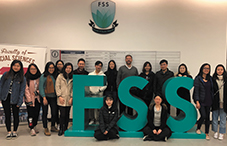
Fortunately, he can rely on his Chinese research team to help translate questionnaires and conduct interviews. Hall advises four PhD students and works closely with about 10 University of Macau undergrads at any given time, involving them in hands-on field research. “I’ve been incredibly fortunate to find a lot of talented undergraduate students,” he says. “I’m trying to make them part of the research and expose them to as many kinds of research skills as possible.”
As an immigrant to China, Hall is no stranger to cultural differences. Fortunately, being mindful of cultural nuance is a skill he has honed over the course of his international career. The APA-IUPsyS fellowship also enabled Hall to contribute to WHO’s forthcoming 11th revision of the International Classification of Diseases (ICD-11). Working with a team of cultural psychiatrists, Hall helped create guidelines on the cultural variation in symptoms of each of the ICD’s mental disorders.
Global mental health efforts have great potential, says Hall, but psychology programs have been slow to jump aboard. “So far, the field has been dominated by psychiatry and public health departments,” he says, and only a handful of psychology programs in North America offer training in global mental health. He’s hopeful that will change as psychologists realize how much there is to contribute to improving mental health around the world.
“The kinds of projects we’re doing are labor intensive and cost a lot of energy—they’re not easy,” Hall says. “But we don’t shrink away from doing what is important just because it’s difficult.”
“Lab Work” illuminates the work psychologists are doing in research labs.