Threat to Democracy
Available formats
Also available from
- PROSE Award Finalist
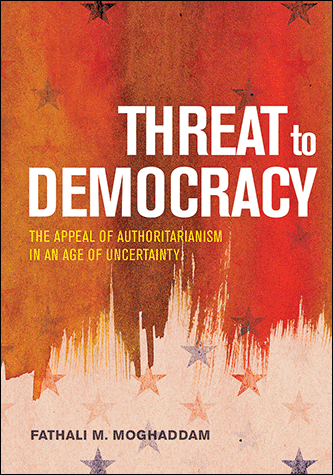
This book explores the recent international decline in democracy and the psychological appeal of authoritarianism in the context of rapid globalization.
The rise of populist movements and leaders across the globe has produced serious and unexpected challenges to human rights and freedoms. By understanding the psychological foundations of the surge in populism and authoritarian leadership, we can better develop ways to nurture and safeguard democracy.
Why and how do authoritarian leaders gain popular support? In this book, social psychologist Fathali M. Moghaddam discusses the stages of political development on the continuum from absolute dictatorship to the ideal of actualized democracy. He explains how “fractured globalization”—by which technological and economic forces push societies toward greater global unification, while social identity needs pull individuals back into tribal identification—can produce a turn toward dictatorship, even in previously democratic societies. The book concludes with potential solutions to the rise of authoritarian leaders and ways to strengthen democracy.
Preface
Introduction
I. Political Patterns and Reversals to Dictatorship
- Repeating Patterns of Political Behavior
- Reversals From Democracy to Dictatorship
II. Freedom and Dictatorship
- Understanding the Immortal Dictator
- Attached Versus Detached Conceptions of Freedom
- Sacred Groups, Alienation, and Belonging
- Political Plasticity and Dictatorship
III. Globalization and Dictatorship
- Globalization and the Springboard to Dictatorship
- The Dictator–Follower Nexus
IV. Future Trends and Solutions
- Continuing Dangers: Social Media, Illiberal Education, Politics as Show Business, Unbounded Bureaucracies
- Solutions: How to Defeat Dictatorship
Afterword
References
Index
About the Author
Fathali M. Moghaddam, PhD, is a professor in the Department of Psychology and director of the Interdisciplinary Program in Cognitive Science at Georgetown University. He is the editor of Peace and Conflict: Journal of Peace Psychology (a quarterly journal published by APA).
Dr. Moghaddam was born in Iran, educated from an early age in England, and worked for the United Nations and for McGill University before joining Georgetown in 1990. He returned to Iran in the "Spring of Revolution" in 1979 and was researching there during the hostage-taking crisis and the early years of the Iran–Iraq war.
He has conducted experimental and field research in numerous cultural contexts and published extensively on radicalization, intergroup conflict, human rights and duties, and the psychology of dictatorship and democracy.
His most recent books include The Psychology of Dictatorship (2013), The Psychology of Democracy (2016), The SAGE Encyclopedia of Political Behavior (2017), and Mutual Radicalization: How Groups and Nations Drive Each Other to Extremes (2018).
Dr. Moghaddam has received numerous recognitions for his scholarly contributions, including the Outstanding International Psychologist Award for 2012 from APA Division 52 (International Psychology).
More about his research can be found on his websiteopens in new window.
- Mentioned on NPR Marketplace Tech
This inspired book combines personal stories, historical context, psychological insight, and disturbing evidence to argue for the modern appeal of dictators. Moghaddam makes a compelling case against complacency for those who count on democracy.
—Susan T. Fiske, PhD
Eugene Higgins Professor, Psychology and Public Affairs, Princeton University, Princeton, NJ
The troubling rise of authoritarian rulers and dictators worldwide challenges all of us to understand how autocrats gain mass support and take action to resist them. In this readable, lucid book, Moghaddam gives a compelling analysis of the social and psychological factors behind the lure of authoritarian leaders and the steps we can take to preserve democracy.
—Michael Wessells, PhD
Professor, Program on Forced Migration and Health, Columbia University, New York, NY
In this eye-opening book about the fragility of democracies around the world, Moghaddam addresses the central question: Why and in what contexts do authoritarian regimes emerge? Weaving personal experience with a solid social science foundation, he explains the present threats to democracy and offers potential solutions to this growing crisis.
—Roxane de la Sablonnière, PhD
Professor of Psychology, University of Montreal, Canada
This inspired book combines personal stories, historical context, psychological insight, and disturbing evidence to argue for the modern appeal of dictators. Moghaddam makes a compelling case against complacency for those who count on democracy.
Susan T. Fiske, PhD, Eugene Higgins Professor, Psychology and Public Affairs, Princeton University, Princeton, NJ