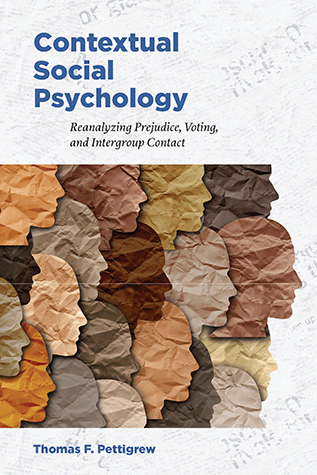
Contextual Social Psychology
Available formats
Also available from
Using vivid examples of both historical and current events, acclaimed scholar Thomas Pettigrew’s compelling book advocates for a robust contextual social psychology, maintaining that far more attention should be paid to the social context of various phenomena relevant in the world today.
The volume traces the author’s 65-year career, and offers a contextual, three-level approach for studying and theorizing about a variety of social psychological phenomena, combining cultural, situational, and personality levels of analysis.
Each chapter illustrates concepts important to the field and provides insight into its advantages, applying these analyses to critical topics such as prejudice, far-right voting patterns, relative deprivation, and intergroup contact. The book describes milestones in establishing a theoretically and methodologically sound contextual approach, including major statistical advances that have made this research easier to conduct, more rigorous, and more commonplace.
As the book demonstrates, in an educational capacity, contextual social psychology opens the possibility for joint undergraduate and graduate courses with other social science classes, such as sociology and political science. Pettigrew paints a broad picture of how social science truly operates at multiple levels.
Dedication
Acknowledgements
Introduction
- A Personal Quest
- What Is Contextual Social Psychology?
- Five Advantages of Contextual Analyses For Social Psychology
- Statistical Advances Enable and Encourage Contextual Analyses in Social Psychology
- Applying Contextual Analyses to Intergroup Prejudice
- Applying Contextual Analysis to Relative Deprivation
- Applying Contextual Analysis to Intergroup Contact
- Applying Contextual Analysis to Far-Right Voting Patterns
- Looking Ahead
References
Index
About the Author
Thomas F. Pettigrew, PhD, is research professor of social psychology at the University of California, Santa Cruz. He received his BA from the University of Virginia, and his MA and PhD in social psychology from Harvard.
Dr. Pettigrew has spent more than 6 decades studying intergroup relations, prejudice, meta-analyses of intergroup contact and relative deprivation while publishing more than 400 journal articles and books.
He has received dozens of honors and awards, including a Guggenheim Fellowship, a Senior Fulbright Fellowship, the University of California’s Distinguished Emeriti Panunzio Award, Harvard Graduate School’s Centennial Medal, the Lewin Prize, two Allport Intergroup Research awards, the Scientific Impact Award, the Cox-Johnson-Frazier Award for race relations research, the Cooley-Mead Award for social psychology, and the Spivack Award for Race Research.