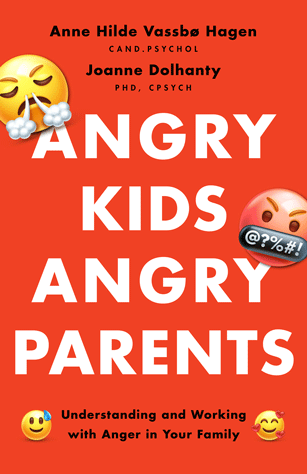
Angry Kids, Angry Parents
Psychologists Anne Hilde Vassbø Hagen and Joanne Dolhanty explain everything you need to know about your child’s anger and how to manage it.
Anger can be normal and healthy when it enables us to stand up for ourselves and defend against injustice. However, it can also lead to aggression—even violence—while also hiding other, more vulnerable emotions. For instance, an angry child may be hiding embarrassment, shame, disappointment, sadness, loneliness, or fear. As a parent, it is your job to help your child understand their anger, express it in an appropriate way, and address the underlying need.
In Angry Kids, Angry Parents you will learn how to respond to your child’s anger in a sensitive and productive way that validates their feelings, addresses their needs, and teaches them to manage their own anger. It can be nerve-wracking to watch your child explode in rage. This book will teach you how to stay calm and protect your boundaries.
Supported by years of psychological research and therapeutic practice, the strategies in this practical, compassionate book will help any parent who struggles with their child’s anger.
Acknowledgments
Introduction: Anger Can Be Useful
I. The Power of Anger
- Chapter 1. Constructive Versus Destructive Anger
- Chapter 2. Challenge 1: Anger as a Cloaking Device
- Chapter 3. Challenge 2: New Day, Same Old Anger
- Chapter 4. Challenge 3: Adopting the Stance of Anger
- Chapter 5. Challenge 4: When Anger Gets Aggressive
II. Responding to Your Child’s Anger
- Chapter 6. The Art of Validating Anger
- Chapter 7. From Validation to Problem Solving
- Chapter 8. Troubleshooting While Validating
- Chapter 9. But I’m Not a Robot: Parents Have Feelings, Too
- Chapter 10. The Magic of Apology
III. Setting and Enforcing Limits
- Chapter 11. All About Boundaries
- Chapter 12. Setting Limits
- Chapter 13. Giving Consequences
- Chapter 14. Troubleshooting While Setting Limits
Afterword
References
Index
About the Authors
Anne Hilde Vassbø Hagen, cand.psychol, is a psychologist, author, mother of three, and filmmaker who produced the popular educational film series “Alfred & Shadow.” She is head of the Institute of Psychological Counseling, Inc., in Norway, and the director of The Norwegian Institute of Emotion-Focused Therapy.
She has written several books in Norwegian about emotions, and is co-author of the book, Emotion-Focused Skills Training for Parents: A Guide for Clinicians.
She is an experienced trainer, speaker, and therapist in emotion focused therapy and emotion focused skills training for parents, and is also trained in emotion focused couples therapy.
Joanne Dolhanty, PhD, CPsych, is a clinical psychologist and the mother of two young-adult sons.
She has extensive training in emotion focused therapy, is a certified supervisor with the International Society for Emotion Focused Therapy, and provides trainings to individuals, parents, professionals, and organizations through her Emotion Training Institute, the Emotion Focused Therapy Clinic at York University, and through institutions in countries around the globe.
With Dr. Leslie Greenberg, Dr. Dolhanty developed the application of emotion focused therapy to eating disorders. She is the developer of an emotion focused skills training (EFST) program that brings the benefits of emotion focused therapy to the broader population in a simplified format.
She is first author of Emotion-Focused Skills Training for Parents: A Guide for Clinicians.
The authors have a lovely way of validating and normalizing the struggles of so many families throughout the book. I can feel their genuine sense of compassion and faith in all caregivers—there’s a sense of hope and relief that comes just by reading the book (let alone putting the suggestions into practice). I could hear the authors in my head, and reading this book created a very personal and down-to-earth experience.
—Jennifer Cometto, PhD, Clinical Psychologist, Assistant Clinical Professor, Department of Psychiatry and Behavioural Neurosciences, McMaster University, Hamilton, ON, Canada
This book gives you all you need to know about how to deal with your child’s anger and your own. More than anything, it explains why anger is something we shouldn’t fight so much as listen to. By means of many examples and descriptions of different methods, it will help relieve you of any guilt and shame you may have about your competence as a parent. We all struggle. Having offered groups and training programs to thousands of parents, the authors really get down to helping the reader deal with anger and provide helpful tools. Do yourself a favor and read this book. You will feel how close to reality what they write about is. You will leave with a greater understanding of what anger is and what to do with it.
—Leslie S. Greenberg, PhD, Distinguished Research Professor Emeritus, Department of Psychology, York University, Toronto, ON, Canada
It is wonderful to see the authors embracing anger and providing guidance for how parents can understand and respond to it. So often we fear anger—yet it can be such a healthy part of our growth. This book provides very practical ways for parents to meet their child’s anger so they grow up understanding and experiencing anger in ways that will help them meet their needs, rather than suppressing and bottling it up. This will contribute to a much healthier culture around anger.
—Sophie Havighurst, PhD, Professor; Leader and Coauthor, The Tuning in to Kids Parenting Programs, The University of Melbourne, Melbourne, Australia
Finally, a book that resonates deeply with the angry struggles of our children and of ourselves! Angry Kids, Angry Parents reads like a conversation about working with hard feelings in a soft way, compassionately embracing the dirty secret that parents are often angry too. As a researcher and clinician, I was delighted by how this book put solid research into very practical terms. As a parent, I wish I had read this book years ago.
—Antonio Pascual-Leone, PhD, Psychologist; Professor, University Of Windsor, Windsor, On, Canada; Honorary Research Professor, University Of Lausanne, Lausanne, Switzerland; Coauthor, Emotion-Focused Therapy For Complex Trauma: An Integrative Approach (2nd Ed.)
Parenting is one of the most important tasks we face. However, we are given little information about how to do it, and the opportunity for vicarious learning within our individualist cultures is limited. Developing emotional intelligence is a key element of parenting. This book is a step-by-step guide to managing one of the most difficult emotions to master—anger. It is written by experts in training emotional intelligence and should be part of every parent’s tool kit.
—Janet Treasure, OBE, PhD, FRCP, FRCPsych, Professor of Psychiatry, Institute of Psychiatry, King’s College London, London, England